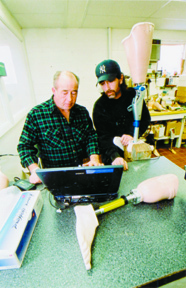
Company: Rhode Island Limb Company
Location: 1159 Elmwood Ave., Cranston
Owner: William R. Teoli
ISO 9001:2026: A Practical Opportunity to Build for What’s Next
For Rhode Island manufacturers, ISO 9001 has been much more than a certificate on the…
Learn More
Type of business: Manufacturer of prosthetic limbs and orthotics
Employees: 7
Year founded: 1950
Annual Revenues: WND
It’s 3:30 on a Thursday afternoon and William Teoli should be packing up for the day.
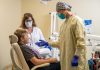
After seeing patients for most of the morning and into the afternoon, the owner of Rhode Island Limb Company has spent the last few hours sitting behind the workbench in the backroom of his Cranston facility. Then the phone rings.
The conversation is a short one.
“Bring him in now. I will wait.”
“He’s been sick,” Teoli says of the patient on the way. “That’s why we haven’t seen him. What am I going to do tell him, he can’t come in? I can’t do that. My patients are like my family, they depend on me.”
For more than 50 years the Teoli family has been providing prosthetic limbs and orthotics to more than 4,000 patients from Rhode Island and around New England.
It’s a job that its second-generation owner takes very seriously.
So seriously that if a patient can’t get to him, he will send someone over to pick the patient up and then drop him or her off after the visit. If a patient has a question over the weekend, he has the answering service forward the calls to his home. And if a patient needs to just talk with someone who has experienced the same thing, a patient advocate is available to do just that.
Why do all this? According to Teoli, it’s simple.
“When people come in here and they have lost a limb, often times they think life is over,” he said. “We tell them that life is not over. Then we work to put them back in the mainstream.”
It’s not an easy job. Most of his patients, who range in age from children to the elderly, have either lost a limb through trauma, or as a result of diseases such as diabetes or cancer.
Teoli said the process of fitting someone with a new limb begins by talking to a patient about what they need in a prosthetic.
“So many people ask me, ‘Will I be able to run with my new leg,’” he said. “And my answer is always, ‘Did you run before? Because if you didn’t run before the odds of you running now aren’t all that great.’”
He may not be a miracle worker but the chances are great that a patient who had a leg removed below the knee (BK) or above the knee (AK) will be able to walk up and down stairs without falling after spending some time with Teoli. That’s because Teoli fits each limb to a specific patient and doesn’t stop until he thinks he has gotten it right.
The examples are endless: Bill, a teacher and motorcycle enthusiast, was recently fitted with the latest high-tech leg on the market; Peter has been fitted with a silicone suction socket with a Springlite Advantage foot.
“There is no Cadillac and there is no Volkswagen when it comes to artificial limbs,” Teoli said. “You have to work with the individuals, see what’s right for them and then teach them to walk again.”
The process isn’t cheap. As a result one of Teoli’s biggest challenges in the last few years has been working with third-party insurers to get reimbursed for the services he provides. There have been times, he said, when a patient will walk out with a leg that hasn’t been paid for.
“What am I going to do, take it back?” he asked. “I can’t do that. It’s really frustrating for me.”
He doesn’t let that stop him from learning about his industry. A lot has changed over the 30 years since he started working at the company. And while dried plaster and wooden tools are still used, today there is much more computer programming and design. The latest leg model called a C-leg is fitted with a computer chip that is programmed to react to the a person’s walking style. The company also recently launched its own Web site, www.rilimb.com. Teoli said the Web site is designed to provide current patients and potential patient with all the information that they could possible need about prosthesis, amputation and orthotics.
“I have an obligation to my patients to learn the new things,” Teoli said. “I need to earn 75 education credits every five years to keep up my certification. But I really believe that if you want to be in this business you have to learn everything you can.”
What he doesn’t learn on his own, he picks up from his children. Son Jonathon is a prosthetics/orthotics student at the University of Texas Southwestern Medical Center in Dallas and daughter Courtney is studying physical therapy at the University of Rhode Island. Both are involved with the family business. So too is his wife Elaine.
“I love my job,” Teoli says. “The best thing in the world is making a leg
for someone and then six months later watching them walk out the door.”
For the complete current issue, visit our subscription Web site, or call (401) 273-2201, ext. 227 or 234.