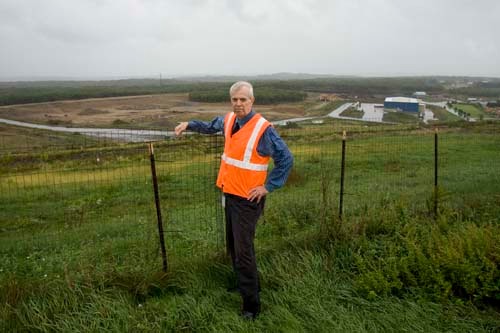
Director of Operations and Engineering Brian Card likens the action at the state’s Central Landfill to a complicated orchestra.
The first-chair musicians are trucks dumping garbage and in the second chairs are bulldozers compacting the castaway shoes, political lawn signs, bags and run-of-the mill household waste. Directing it all are the maestros – men in bright yellow vests motioning to the truck drivers. By the end of an average day this orchestra will have compacted about 3,000 tons of garbage – or the weight of more than 700 African elephants – into the Johnston landfill.
But like any performance, the show here will stop some day. The land will fill up and likely send the performance out of state, raising prices for patrons that include municipalities, commercial trash haulers and, ultimately, Rhode Island residents and business owners.
For three years the Central Landfill’s operator, the R.I. Resource Recovery Corporation, has been planning a 103-acre expansion to the existing 250-acre landfill. Known as Phase VI, the expansion to the west – entirely on existing corporation property – receives a crucial public hearing before the R.I. Department of Environmental Management on Oct. 13. After taking public comment, the department is expected to rule within 30 days whether to let the expansion move forward.
If approved, the enlargement would extend the life of the landfill to about 25 years. Without the expansion, the landfill would run out of space in about three-and-a-half years.
Corporation Executive Director Michael OConnell said closing the landfill would force trash out of state, likely to faraway places like Pennsylvania or Virginia. That would drive up costs for municipalities from $32 to dispose a ton of trash to as much as $100 a ton or more.
The corporation estimates closing the landfill today would increase municipal disposal costs by a collective $25 million annually.
Private haulers would also see their rates – now at $54 a ton and a 10-year low – skyrocket. And Card said local businesses like truck-repair shops that have sprung up around the landfill would suffer. And many, if not all, of the corporation’s 97 employees would be out of work.
And stacking garbage to new heights would run afoul of environmental regulations and make it impractical for equipment to reach the top.
So the expansion in Johnston remains the only viable option, OConnell said. The expansion itself would come in phases as workers add to the existing mound of trash that reaches 575 feet above sea level. Before the trash arrives, however, workers will lay plastic and build a series of pipes to capture gases and liquids. The gas heads to an electric plant that uses the methane as fuel and the liquid flows to a wastewater treatment plant.
If DEM issues the permit this year, work preparing the site would likely start next spring, although the first trash won’t arrive until 2013 or so, Card said. As the heap of garbage grows, the corporation will need to demolish a handful of buildings, including a $20 million structure just eight years old.
Envisioned as a tipping station, the 60,000-square-foot, warehouse-like structure was supposed to hold garbage dumped by trucks until corporation vehicles moved the rubbish to the dump site a few hundred yards away. OConnell says the building was approved by a former executive team and has proven to have been a waste of money.
Today, the corporation sends trucks laden with garage directly to the dump site in what OConnell says is a far more efficient operation than having them stop at the building first. When the corporation demolishes the building, it will not rebuild it.
The corporation will need to relocate its garage and Eco Depot, a building that stores hazardous household waste until it is moved off-site. Depending on the demand, it may also reconstruct a building that crushes waste from construction sites.
And because the corporation receives no money from the state, it will need to find a way to pay for it all itself. OConnell said that means squeezing efficiencies out of the operation. The corporation has shed 32 employees over the last three years. The corporation also ended contracts with outside vendors who cleaned bathrooms and undertook small construction projects, turning instead to in-house crews.
“There’s no money coming” from the state, OConnell said. “We would be an absolute failure if we did not run this in a cost-effective way.”
The corporation has successfully persuaded the state to stop raiding its income and transferring it to other parts of the state budget. In years past the General Assembly and governor plucked as much as $5 million a year from the agency.
And the corporation received a break when it hammered out an agreement with Ridgewood Renewable Power LLC, which operates a methane-powered electric plant in the path of the expansion.
Ridgewood agreed to move the plant and take over maintenance of the methane collection system in return for significantly reduced methane royalties and free land from the corporation for the new plant.
OConnell says the landfill may also search for new money by raising fees for commercial haulers if the market allows it, although the expansion is not dependent on higher fees. The corporation is also pursuing an aggressive plan to boost the collection of recyclable material, which it sells on the commodities market. Within 18 months, the corporation plans to accept paper, plastic and glass combined in one bin.
OConnell said elimination of sorting should boost recycling by 15 percent to 20 percent and thereby increase corporation revenue. Ultimately, the corporation wants to grow recycling by 60 percent in three to five years and expand its recycling sorting operation from one shift to two.
Turning to the state for more revenue, however, is not an option.
“It would be an admission of failure if we had to go to the state and ask for money,” OConnell said. •