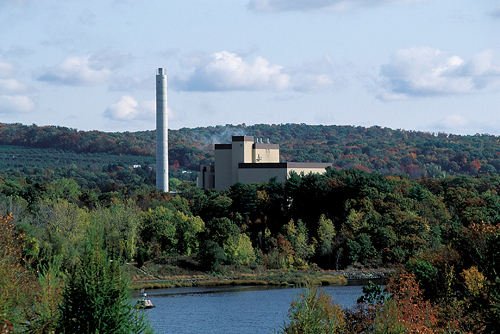
A proposal to overturn the state ban on incineration is before the General Assembly at a time when energy companies claim waste-to-energy plants produce emissions far cleaner than decades ago and generate more electricity than other waste-based methods.
But that doesn’t mean there’s no opposition to the idea.
Opposed are many of the state’s major environmental groups, including Clean Water Action, Audubon Society of Rhode Island and the Environment Council of Rhode Island and renewable energy advocates such as People’s Power & Light, mostly because organizers say release of toxins into the atmosphere would be harmful. They advocate recycling instead.
Local environmentalists are especially incensed by the fact that the pending legislation categorizes waste incineration as renewable energy. “That’s outrageous,” said Sheila Dormody, Rhode Island director of Clean Water Action.
Companion bills in the House and Senate would remove the incineration ban and allow a waste-to-energy facility only at the central landfill in Johnston. The Senate version has four sponsors, Sens. Domenic J. Ruggerio, D-Providence; Daniel DaPonte, D-East Providence; Maryellen Goodwin, D-Providence; and John J. Tassoni Jr., D-Smithfield; sponsor of the House bill is listed as Rep. Peter F. Kilmartin, D-Pawtucket.
Paul Gilman, chief sustainability officer for Covanta Energy Corp. in Fairfield, N.J., provided Providence Business News with an Aug. 10, 2007, memo from the U.S. Environmental Protection Agency, office of air quality planning and standards, concerning improved incineration emissions over the last 15 years.
The memo reported on tests done on emissions from 227 large and small municipal waste combustion (MWC) units, comparing results obtained in 1990 with those from 2005 for eight separate pollutants. In six cases, levels dropped more than 94 percent; in one case, sulfur oxide, the reduction was 88 percent; and for the eighth pollutant, nitrogen oxide, the drop was 24 percent.
“Of particular interest are dioxin/furan and mercury emissions,” the EPA said. “Since 1990 … dioxin/furan emissions from large and small MWCs have been reduced by more than 99 percent, and mercury emissions have been reduced by more than 96 percent.”
According to Gilman, such reductions are possible because of the advanced technology in modern waste-to-energy plants including, for instance, boilers with computerized controls to regulate the combustion process, resulting in a cleaner burn, and continuous monitors to measure and adjust emissions in real time.
Gilman also provided the summary of a study announced in February 2009 in the journal Environmental Science and Technology that found waste-to-energy plants generate 10 times more electricity than landfill-gas-to-energy facilities, where trash decomposes and the resultant methane gas is used to create energy.
Anthony J. Orlando, president and chief executive officer of Covanta, told the House Finance Committee during a hearing last week that a typical waste-to-energy facility would process 2,000 to 3,000 tons of trash per day and create $1 billion of economic activity.
Included in the latter estimate are: a $500 million to $750 million construction cost over three years, generating 300 to 500 construction jobs and 700 to 1,000 indirect jobs; and, when a plant opens, it would have a $30 million to $40 million annual operating budget, with between 60 to 80 full-time jobs for payroll costs of $6 million to $8 million annually including benefits.
Officials from Covanta, which says it is the largest waste-to-energy company in the world, told the legislative panel they are interested in doing business in Rhode Island. They operate 38 plants in 17 states, including Connecticut, Massachusetts, Maine, Oregon, New York, New Jersey, Virginia, Florida, Michigan and Maryland.
But no amount of new jobs ever could make up for the damage that incineration would do to the environment of Rhode Island and its residents, according to environmentalists.
Dormody said the primary concern of environmentalists is the nature of the incinerator emissions – containing such substances as lead, mercury, dioxins and other toxins – that would be spewed into the air, potentially contaminating waterways and causing illness.
“We’re a very compact, relatively urban population,” Dormody said, “and that is a special consideration. We are so densely populated more people would be exposed” to more toxins than in other states.
Dormody said the state should continue its commitment to recycling, noting that just last year the General Assembly enacted legislation that requires communities to meet specific recycling goals by the year 2012. “You would create a lot more jobs by promoting recycling,” Dormody said. “What we really need is to build a new recycling facility. That would add construction jobs and long-term, cleaner, greener jobs, and would make it easier for residents to participate in recycling.”
At the R.I. Resource Recovery Corporation, which operates the state landfill and has responsibility for managing the state’s solid-waste programs, officials said approval of the incineration bill would allow them to include waste-to-energy proposals in the long-term planning required before the landfill is full.
But the corporation did not ask that the incineration ban be lifted and has no official stand on the pending proposals, said Sarah Kite, director of recycling services. “We don’t know what the face of solid-waste management will look like in Rhode Island in 20 years, and we must do significant planning because the landfill won’t be open forever,” she said.
Kite said she knows of no plans to construct an incinerator in Rhode Island, and she stressed that the resource recovery corporation remains “absolutely committed” to recycling, composting and other forms of natural waste management.
Asked if a new state recycling center is an option, Kite said it is.
“We are doing everything possible to extend the life of the landfill,” she said. •