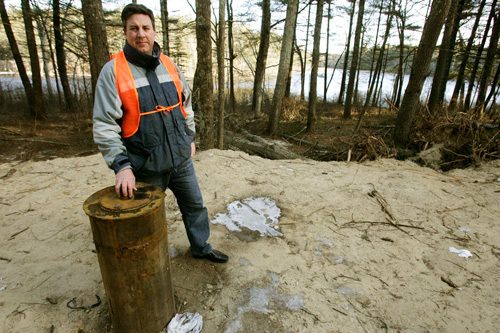
In December, the R.I. Water Resources Board announced it had successfully drawn water from test wells in the Big River Management Area. Quickly thereafter, officials said they saw the wells as a piece of a game plan to jump-start Rhode Island’s ailing economy.
Wells in the management area spanning four towns – West Greenwich, Coventry, Exeter and East Greenwich – hold the potential to pump 4 million gallons of water a day, Water Resources Board General Manager Kenneth Burke said.
To put that in perspective, that’s about 1 million more gallons than the entire town of North Kingstown, excluding Quonset Business Park, uses on an average day. The entire state consumes about 116 million gallons on an average day, according to the Water Resources Board.
Residences use about 57 percent of that water, but that can balloon during dry weather when residents water their lawns. It is difficult to peg the maximum capacity of the system because weather, development and other factors can change the amount of water available.
If the sale of Big River water occurs, the state would realize a decades-long dream to draw water from the area it took by eminent domain between 1965 and 1967 with never-realized plans to build a reservoir.
Officials from Gov. Donald L. Carcieri’s office on down say that the state needs the water if it is going to attract and keep businesses in Rhode Island. The goals, said Carcieri spokeswoman Amy Kempe, are clear-cut.
“It’s very simple – provide residents quality drinking water and also recognize that this is an economic-development tool,” Kempe said.
The state witnessed firsthand the interconnection between water and economic development in 2006. Pharmaceutical manufacturer Amgen Inc. wanted 800,000 gallons of water a day for its West Greenwich plant, but was told by Kent County Water Authority officials that the supplier could not guarantee that amount. Amgen balked. In response, the General Assembly eventually passed a law ensuring that Amgen received all the water it needed, but the spat spotlighted the importance of an adequate water supply to economic development.
William Penn, chairman of the Water Resources Board, said the board predicts southern Rhode Island communities will face rising demand – largely the result of a building boom – without the corresponding rise in supply within the next decade. Meanwhile, the rural parts of western Rhode Island primarily rely on private wells.
“People have not had to think about it. You go to your tap, you turn it on and it comes out – magic,” said Susan Licardi, director of water supply for North Kingstown.
Licardi is mulling whether to start a campaign that connects the economy to water usage. Borrowing a phrase from others in the industry, “lawns vs. the economy” would highlight how watering the lawn could be costing the town a business that wants to locate in the community or hurt an already established company dependent on water, she said.
Licardi isn’t sure if it would make sense for North Kingstown to access water flowing from the Big River project. On a typical day in 2009 the town pumped about 3.1 million gallons of water a day from the Hunt-Annaquatucket Pettaquamscutt (HAP) aquifer to supply both North Kingstown and part of Narragansett. The town’s pumps can comfortably draw as much as 8 million gallons a day.
Sometimes the town draws more than that, like in August 2005, when it hit 8.3 million gallons. That can draw down the aquifer and leave the Hunt River at a dangerously low level.
“We’ve looked at it close enough to know that we need more water than we have available to us right now in order to develop that growth center,” she said.
Right near that targeted growth center sits Quonset Business Park – an area highlighted by the state for economic development and industrial use.
David Preston, a spokesman for the Quonset Development Corporation, said the park, served by its own water supply, already has plenty of water, including wells left by the U.S. Navy after it departed its Quonset base.
“There’s more than enough pumping capacity than Quonset is going to need down there,” Preston said.
Shigeru Osada, senior vice president for engineering and maintenance at Toray Plastics (America) hopes there is plenty left. Toray, a tenant in the park, relies on 100 million gallons a year to manufacture its plastics.
“Bottom line for our company or any business user in the park is a secure water supply,” Osada said.
A consultant hired by the R.I. Economic Development Corporation said much the same thing in a report delivered last year. Despite Preston’s optimism about the park’s water supply, John Rhodes from Moran, Stahl & Boyer labeled Kent County and the “Quonset area” (which includes the park) the two “most water-resource challenged” parts of the state. In an interview, Rhodes said the already overstressed HAP could leave less water from the park to draw on years down the road.
Michael Walker, a senior project manager at EDC, said the state is attuned to the need to offer a steady stream of water.
Walker said he was unaware of any company besides Amgen that has groused about water supply and threatened not to come here because of it. Nor, he said, are there companies waiting in the wings for the water from the Big River project.
“It’s not as simple as we have 500 companies and now we have water and they will come,” Walker said.
Walker said the state needs to offer the holistic approach, including an educated work force and access to capital.
And there are, as with any project, detractors who say the state is overselling the potential of the wells at Big River. The investment required to build the infrastructure to shunt the water to the right places could outweigh any economic-development value, said William Falcone, who retired as the water resources board’s chief of staff in 2003.
It’s unclear where the water from Big River would go, how much it would cost or who would pay for the necessary infrastructure. Burke expects a consultant to issue a report in late January or early February detailing possible scenarios.
Falcone, who started working for the board in 1968, said the creation of a reservoir would still be the most cost-effective plan, provide more water for economic development and serve as a complementary and backup supply for the Scituate Reservoir.
In 1989, the U.S. Environmental Protection Agency shot down a plan to develop a reservoir, but Falcone said the plan could be revised and turned into a federal project backed by federal stimulus dollars. The project, which could take at least a decade to construct, would also put people to work in a state suffering from high unemployment, Falcone said.
“If you want economic development, build a reservoir because we’re going to need [more] water eventually,” he said. •