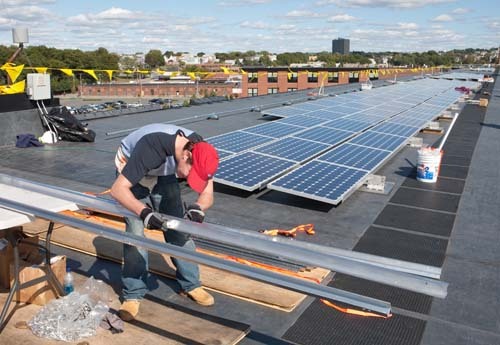
One proposed solar power project calls for 12.3 acres of photovoltaic panels to be installed atop a capped landfill in Westerly.
Another project would have 1,650 solar panels set up on the roof of Toray Plastic (America) Inc.’s North Kingstown building.
And the owners of a sprawling structure near T.F. Green Airport in Warwick are putting together plans to cover the top with a 15-acre solar electric generating field.
Spurred on by the availability of millions of dollars in federal stimulus money for renewable energy, a surge of solar power projects that wouldn’t be viable without the help of government subsidies are either in the works or at least under consideration in Rhode Island.
But those involved in the local solar energy industry expect the burst of activity to quickly fade once the windfall from the $787 billion American Recovery and Reinvestment Act evaporates.
“What it means to the industry is a short-term shot in the arm, which is very much appreciated,” said Bob Chew, wind business president for Alteris Renewables Inc., a Providence-based solar and wind company. “But after that, it will go back to normal in Rhode Island, and normal is not great.”
Solar-power advocates say the state isn’t doing enough to give the green energy industry a boost beyond the federal stimulus money. Yes, Rhode Island’s net metering policy and state tax credit program have been advantageous for alternative energy projects. And the R.I. Renewable Energy Fund has provided a helping hand through grants and loans.
But some insist the state is behind others in instituting other government-backed financing methods for solar power, such as renewable energy certificates that can be sold and traded.
Keith W. Stokes, executive director of the R.I. Economic Development Corporation, said last week that he agrees it would be nice if the state could provide more assistance, but officials are grappling with deep-seated fiscal problems that must be solved first.
“Until we have a balanced budget, [subsidies for solar energy] are an opportunity cost,” Stokes said.
Supporters of solar power say smaller subsidies in Rhode Island could be a problem, considering there’s been lots of talk about training the local work force for the green economy. Just last week, the city of Providence received $3.1 million from the U.S. Department of Labor to prepare 190 residents in the city’s poorest neighborhoods with green job skills.
Paul Raducha, chief financial officer at Alteris, said many of his staff are in New Jersey, which has enacted a solar renewable energy certificate program that has stimulated that market.
Projects in Rhode Island are such a small part of the company’s revenue that when executives visit Alteris worksites in other states, local officials wonder why the company just doesn’t relocate.
Adding to the feeling of neglect within the solar industry: state legislators are considering midyear changes to the 2010 state budget that would transfer $1 million from the Renewable Energy Fund to the general fund as part of a plan to close a $220 million deficit.
That $4.3 million Renewable Energy Fund has provided $1.31 million in grants for 10 solar-power projects with a total value of $4.13 million since June 2008, according to the EDC.
“[Shrinking the fund] is going to impact future projects and jobs,” lamented Larry Gemma, president of Gem Plumbing & Heating Co., which has been installing solar panels for five years. “We’re already behind the rest of the world.”
Chew said the state gets a good amount of sun, has high electric rates and has favorable net-metering policies that allow a utility customer who has renewable energy to deduct the electricity generated from the total amount of kilowatt-hours on an electric bill.
In addition to the Renewable Energy Fund, the state offers tax credits for those who install renewable energy systems. Ken Payne, administrator of the R.I. Office of Energy Resources, said the use of the tax credit has climbed every year since 2006. Right now, however, the bulk of subsidies is coming from federal stimulus money.
Earlier this month, Gov. Donald L. Carcieri announced 45 renewable energy projects had received $3.3 million. Another round of grants totaling about $5 million is expected to be announced soon.
Jeff Broadhead, executive director of the nonprofit council said the idea would have never gotten off the ground without the $750,000 grant. As it is, the project still has numerous financial challenges.
The proposal calls for the electricity generated by the panels to power some of the town’s needs, with surplus power sold back to National Grid under the net metering guidelines.
“This is about long-term price stability for the town,” Broadbent said.
Also receiving a $500,000 grant was Toray Plastics, which has proposed a 375-kilowatt system with 1,650 panels at the Quonset Business Park in North Kingstown.
In Providence, 192 solar panels on the roof at United Natural Foods Inc. – thought to be the largest project in the state to date – came on line in December with an estimated output of 175,000 kilowatt hours annually, enough to power 19 homes for a year.
At a cost of $1.5 million, the installation would have been impossible without a $700,000 grant from the state’s Renewable Energy Fund, according to Thomas D. Dziki, United Natural Foods vice president.
Dziki said the company has installed other solar-power systems at locations in Connecticut and California and is hoping to use the Providence installation as a demonstration project for local companies.
Chew said there are some outside factors that are making solar power more viable right now.
A worldwide shortage of ultra-pure silicon used in photovoltaic panels has ended now that more refineries have come on line. Also, Chew suspects there will be a glut of equipment on the market now that Germany is winding down its strong solar incentives that had ratcheted up demand.
Those factors are lowering solar’s cost per watt. That, combined with the state’s favorable net metering policies, is giving Chew hope for the future.
“I’m feeling better about Rhode Island than I did before, but it still has a way to go,” he said. •