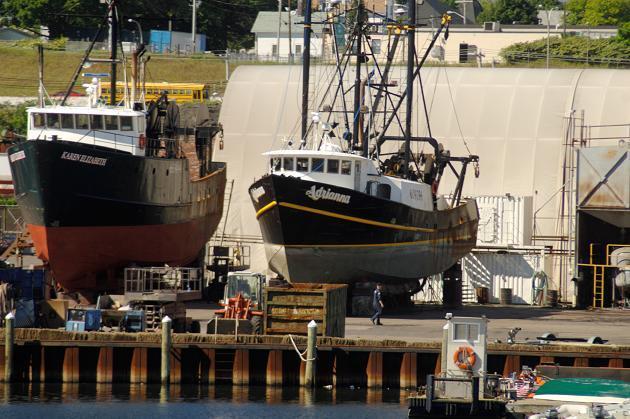
Eight water-dependent companies last week announced they have formed an alliance to oppose a plan to “gentrify” the Allens Avenue industrial corridor through rezoning.
“Providence Tomorrow,” a master plan developed by the city that is being refined with input gathered at neighborhood charrettes, has suggested rezoning the section of Allens Avenue north of Thurbers Avenue from industrial use to mixed use.
Members of the new group, called the Providence Working Waterfront Alliance, say such a change could jeopardize their businesses.
But Thomas Deller, director of planning for the city, said the suggestion is just meant to help identify what residents want; it’s not a definite plan. The alliance and the city likely have compatible goals, he said.
“I think what we say in Providence Tomorrow, particularly in the waterfront section, is that we recognize the importance of the waterfront, we recognize the importance of jobs on the waterfront,” said Deller. “But we also recognize the fact that there’s a need to have greater flexibility and ability to change.”
The report says the businesses are essential to the regional economy, but that “land area reserved for industrial uses, however, is currently more extensive than the demand for heavy industrial, water-dependent uses and activities.”
It continues that some land could be used for open space, recreational maritime facilities or “residences and public access combined with revenue-generating, water-oriented activities” to make the area more accessible. Future zoning categories could include “port,” to be used solely for industrial uses, and “waterfront mixed-use.”
The alliance business owners, however, said there is no room for mixed-use or residential space along that stretch of the waterfront. Ash Kinzel, manager of terminal operations at Sprague Energy, said his business is loud and operates at all hours.
“I’ve had bulldozers going for three days straight on top of that [salt] pile,” he said. “There would be issues, to say the least, if there was a condo next door to me.”
Alliance members also believe the city wants to push all industrial operations south of Thurbers Avenue. Joel Cohen, vice president of Promet Marine Services, said his business wouldn’t have anywhere to relocate to – partly because it has a 2,000-pile, 600-foot dock.
“What happens is, the next thing you know, the heavy industry that has been here for 100 years plus, is now offensive,” said David Cohen, Promet president. “There’s a weld flash when some nice lady is looking out the window.”
Alliance members say their businesses are crucial to the region’s economy, supplying energy, road salt and ship repair for municipal and private companies within a 100-mile radius.
“We’re basically industries that bring fresh money into the state,” said David Cohen. “We’re bringing in outside dollars. We’re bringing in federal dollars and dollars from fisherman, ferry owners and tugboat owners from the middle Atlantic states to Maine.”
Julie Gill, assistant director of the Oil Heat Institute Inc., said the waterfront’s energy storage capacity has already been scaled back enough to possibly cause, in the future, oil or petroleum droughts.
“Back in the early 1980s, there were 350 million gallons of storage here, and the dismantling of tank yards has happened at an alarming rate. We are down to about 110 million gallons of storage,” she said. “We are very worried about any more tank yards being dismantled.”
Rhode Island is not the only New England city struggling with conflicting demands on its waterfront. During the early 1980s, Portland, Maine, switched zoning on its industrial waterfront to include residential and mixed use. But that didn’t last, said Senior Planner Bill Needleman. The rezoning led to backlash from residents, so a five-year moratorium was imposed, followed by stricter zoning regulations.
“The strict moratorium on non-marine uses actually had some non-intended consequences resulting in a lack of investment in the piers,” he said.
In Portland, an alliance eventually helped create an environment compatible with mixed use, said Needleman. But residential development still isn’t allowed.
In Providence, the charter members of the alliance, which is actively recruiting along the industrial corridor, are Promet Marine Services, Sprague Energy, Providence Steamboat, J. Goodison Co. Inc., Narragansett Improvement, Northeast Marine Pilots, the Oil Heat Institute and Phillips Services Corp.
Together, the port businesses – including ones that have not joined the alliance – bring to Rhode Island 2,000 ships with more than 9 million tons of cargo each year, according to the alliance. Through the port, too, comes oil to heat 450,000 Rhode Island homes. Importing that oil from another port would be exponetially more expensive, said David Cohen.
Jack Goodison, executive vice president of J. Goodison Co. Inc., subcontracts marine work from businesses along Allens Avenue. He tried, but failed, to base his business on Allens Avenue.
“I tried for two years to secure a small piece of real estate in this industrial area and to stay within the HUB zone,” he said. “And after two years I was told outright that the City of Providence had no interest in small industrial businesses.”
The alliance seeks to educate the public about the vitality of the waterfront companies to the city’s economy, said David Cohen.
“It’s a sad situation where a businessman has to realize the city of Providence is his biggest adversary,” he said.
Deller said the planning department welcomes the alliance’s input.
“We’re looking forward to working with this group, and any group, as we move forward in trying to revitalize and grow the city,” he said. •