For nearly four years, The Centurion Foundation CEO Ben Mingle has argued the nonprofit would be the best steward of Roger Williams Medical Center and Our Lady of Fatima Hospital.
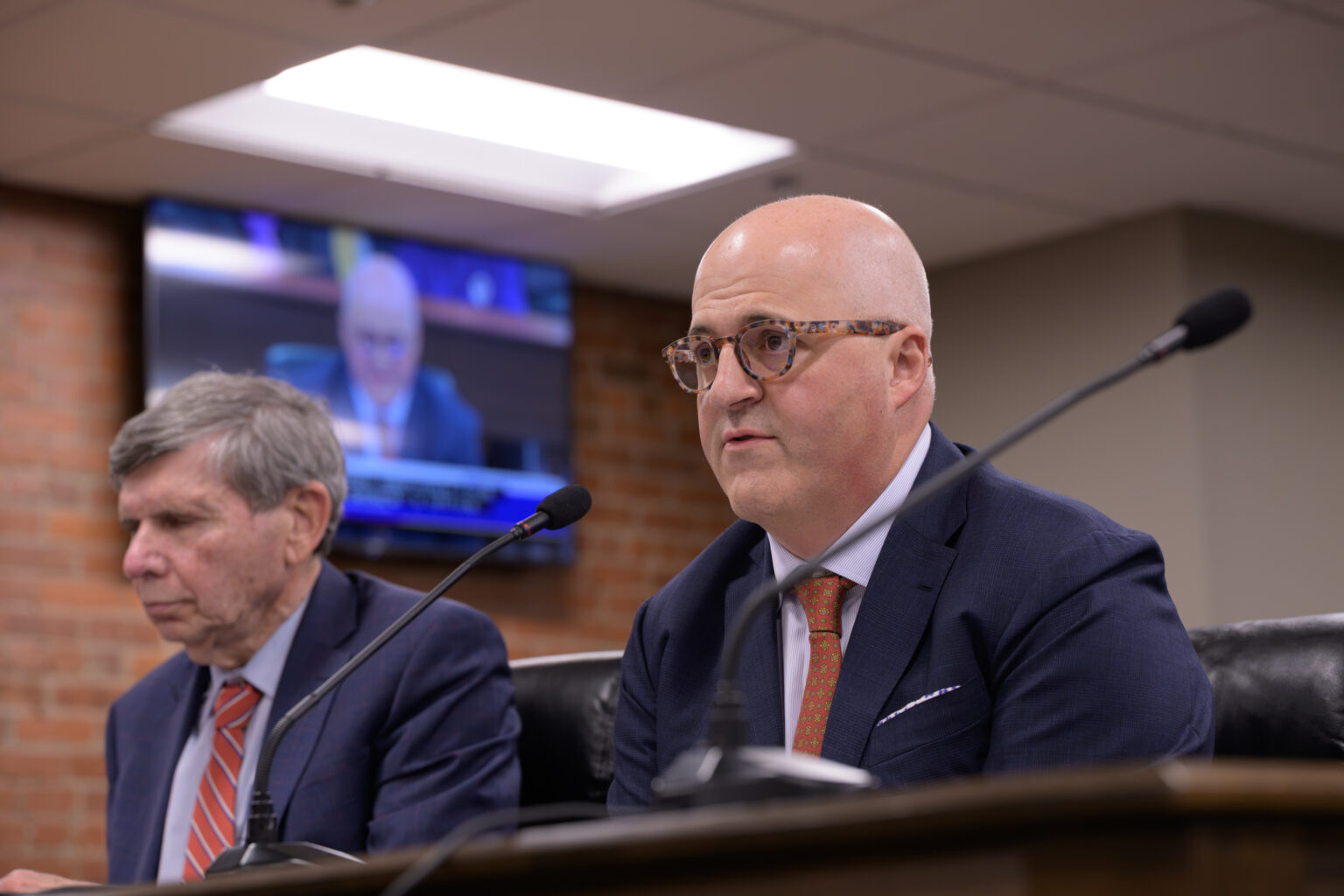
But Tuesday marked Mingle’s first time appealing directly to Rhode Island lawmakers, whose authority over state borrowing could make or break the long-awaited sale of the struggling hospitals. And the House Committee on Finance vetting the request for an $18 million state backstop to Centurion’s purchase did not let Mingle off easy.
Your Business Has Gone Global. Has Your Insurance?
A decade ago, “doing business internationally” was mostly a large-company concern. Today, a manufacturer in…
Learn More
Members of the 15-member legislative panel grilled Mingle with questions, scrutinizing the proposed legislation and taking testimony for three hours before a standing room-only crowd. Mingle was unrattled.
“We’ve answered hundreds of thousands of questions,” he said, shrugging as he stepped into the hallway of the State House basement to take a break during the hearing. “I’m used to it.”
His nonchalance belied the gravity of the situation. Supporters, experts and even critics agree it’s vital to keep the struggling hospitals open, in turn preserving the statewide health care system.
“It’s not an exaggeration to say our other hospitals would be challenged and in fact destabilized if they needed to absorb the volume, and they could only do so at even greater cost,” Dr. Jerry Larkin, state health director, told lawmakers Tuesday. “We need to act now to get ownership of these two facilities to an entity that is ready to ensure continuity of care to the patients and the community.”
Larkin later described a potential closure of the facilities, which account for more than 500 hospital beds and 55,000 annual emergency room visits between them, as “catastrophic.”
The hospitals employ more than 2,500 workers, serving more than 300,000 patients a year between inpatient, outpatient and emergency services. Yet, the facilities have struggled under their now-bankrupt owner Prospect Medical Holdings, losing roughly $45 million a year while major infrastructure repairs and technology upgrades get pushed off and employee recruitment dwindles.
Centurion, which received conditional state regulatory approval in June 2024 to buy the facilities, was viewed as the best — and only — path to revival, restoring the hospitals to nonprofit status and local control. A slew of safeguards set up by the Rhode Island Attorney General’s office and Rhode Island Department of Health, which reviewed the sale under the state Hospital Conversions Act, imposed additional guarantees for improvement and survival.
But investors in the bond market have been wary of the hospitals’ weak balance sheet and the future of health care facilities more broadly because of federal budget cuts under the One Big Beautiful Bill Act.
After two failed public bond offerings through the Rhode Island Health and Educational Building Corp. last year, easing of conditions by state regulators and multiple deadline extensions by the federal bankruptcy court overseeing Prospect’s restructuring, Mingle’s familiar promise of progress came with substance. On Jan. 20, he wrote to state leaders relaying the verbal commitment of four unnamed bond investors, willing to pony up the $87 million in tax-exempt bonds needed to close the deal. The catch: The investors want a backstop from the state in case Centurion can’t make its annual debt payments.
“Bond investors read the newspapers,” Mingle told lawmakers Tuesday. “They want to know the state of Rhode Island cares about these hospitals like this management team cares.”
The proposed $18 million state reserve account, introduced as legislation in both chambers on Jan. 29, would be drawn from an existing state supplemental rainy day fund with a $55 million balance, Joe Codega, state budget officer, said Tuesday. The bill, sponsored in the House by Finance Chairman Marvin Abney, a Newport Democrat, also lets the state swap the cash for a line of credit during the repayment process.
The state reserve would be a second guarantee on the bond payments, in case a separate, $9 million backstop set up by Centurion using bond proceeds gets drained. The two funds together would provide enough money to cover three years of the annual debt service on the bonds, Mingle said. He declined to share a term sheet outlining the debt service and repayment schedule, but told lawmakers the interest rate is around 8%.
If Centurion never needs to tap into the state guarantee, the money gets returned to state coffers, either in 10 years when the bonds can be refinanced, or 30 years when the bonds mature. And, if it depletes the state reserve, there can’t be another request for more money, according to the legislation.
Risk versus reward
Lawmakers remained worried that the stopgap was a short-term solution that might still end with the hospitals at risk of closing, or being put in state-appointed receivership.
“What are we going to do to prevent us from being back in this position?” Rep. Alex Marszalkowski, a Cumberland Democrat, queried. “Are there any written guarantees, or are we just putting this money up and hoping it will be enough to get this over the finish line?”
Several state representatives also noted Centurion’s lack of experience running hospitals — a concern initially shared by the 1,200 union workers at the facilities, though the United Nurses and Allied Professionals (UNAP) has since warmed to Centurion as the best possible option.
“I’m willing to take the risk because we need these hospitals, but I also don’t want us to be taken for a ride,” said Rep. Raymond Hull, a Providence Democrat.
Hull chastised Larkin and Health and Human Services Secretary Richard Charest for being unable to answer lawmakers’ questions around the deal. Larkin and Charest, who spoke before Mingle, deferred to Centurion multiple times when asked about the financing details and the buyer’s turnaround plan.
“I don’t like that answer,” Hull told Gov. Dan McKee’s cabinet members. “You really should be drilling them down in the interest of the people we’re here to represent.”
Charest in response noted the “grueling process” — spanning more than a year — under which the state health department and the AG’s office reviewed and scrutinized Centurion before authorizing its purchase of the hospitals.
The state review culminated in 85 conditions meant to ensure the hospitals’ operational and financial stability, from an upfront cash injection into their balance sheet to regular reporting to both state agencies, a chief restructuring officer, and local representation on both the board of directors and a separate community advisory board.
“There’s going to be very heavy oversight by these two agencies to ensure this doesn’t happen again,” Mingle said.
The final countdown
Mingle expects to close the sale by Feb. 27, the final day to do so under the latest order from the U.S. Bankruptcy Judge Stacey Jernigan. The tax-exempt bonds combined with the balance in a state-controlled escrow account, will provide more than $100 million in cash for the hospitals, Mingle said.
An immediate conversion to nonprofit status, allowing the facilities to bypass state and federal taxes and to qualify for the 340B federal drug discount plan, along with other elements of the turnaround plan, is expected to save $75 million a year, according to a 10-slide presentation with graphics and charts presented by Centurion Tuesday night. Subtracting the roughly $45 million operating loss at present, that leaves $30 million for debt service payments and operating expenses, alongside capital projects.
Rep. Teresa Tanzi, a South Kingstown Democrat, questioned whether the promises of community involvement were genuine. Tanzi said she heard the same kinds of “beautiful words” in Mingle’s statements that were given by executives at South County Hospital when it created a community advisory board in response to mounting concerns over leadership among residents and employees. Even with the launch of the 17-member panel in December, the nonprofit leaders running the hospital have been “utterly unresponsive to the community,” Tanzi said.
Mingle sought to differentiate Centurion from South County Health. The former is subject to state mandated requirements for community involvement, and is less an operator than a financing vehicle that lets the local, expert hospital leaders renew their powers of decision-making.
“The essence of our transaction is that the local management team has the right skill set, the right management plan in place to run these hospitals on an effective basis,” Mingle said.
Jeffrey Liebman, CEO of CharterCARE Health Partners, Prospect’s local subsidiary, also touted the decades of experience and personal investments of CharterCARE’s local leadership team, who would stay on under the change in ownership.
“Believe me, we understand the impact on the community and how important it is for us to provide good, safe, reliable care,” Liebman said, noting that both his now-adult children went to the hospitals’ emergency rooms for treatments in their younger years.
Lynn Blais, president of UNAP and a nurse at Fatima, recalled her formative years as a candy striper at Roger Williams more than half a century ago, which later led to pursuing a nursing degree at St. Joseph School of Nursing on Fatima’s campus.
Proud, but under pressure
After the Brown University mass shooting in December, which killed two students and injured nine more, Roger Williams and Fatima treated walk-in emergency room patients who would have otherwise gone to Rhode Island Hospital where the shooting victims were being treated, said Lynn Leahey, vice president of patient care services and chief nursing officer for CharterCARE.
“We are very proud to be the safety-net hospital,” Leahey said.
Despite the loyalty of longtime providers and employees, recruitment has ground to a standstill since November, while some of the area colleges and universities that rely on the hospitals’ clinical program opted not to participate this semester because of the uncertainty over the sale, Leahey said.
Which puts even more stress and pressure on the remaining staff, alongside aging equipment and supply shortages.
“We still provide care to be proud of, but those who provide it are tired,’ said Dr. Louis Mariorenzi, chair of orthopedic surgery at Roger Williams.
The leading-edge musculoskeletal surgery is one of many critical services that are lacking in other health care settings statewide. Others include inpatient psychiatric and geriatric care, bone marrow transplants and advanced cancer therapy treatments.
“If these doors close, there’s nowhere for them to land,” Lynn Redding, a psychiatric nurse at Roger Williams, said of the hospital’s 12-bed geriatric psychiatry unit. “It breaks my heart to see that it’s coming down to, quite frankly, $18 million, when our elderly people deserve better than that.”
Redding continued, “Although we’re concerned with the fiscal state of Rhode Island, we should all be concerned with the human cost of what’s going to happen if we don’t pass this bill.”
The state is also working on a backup plan in case Centurion fails to close the deal. One floor up from the House Finance Committee, a separate legislative panel gave preliminary approval to a second bill which speeds up the state regulatory review process for an alternative buyer.
The legislation streamlines the application process and speeds up the decision-making, requiring state regulators to issue a verdict within 90 days. It applies only to hospital sales in cases such as bankruptcy, receivership and special mastership, and expires a year after passage.
Unlike their colleagues in the House Finance Committee, members of the House Committee on Health and Human Services had few questions for the state administrators who came to explain the proposal. The legislation passed out of committee under a unanimous vote in 12 minutes.
Any alternative buyers must submit an offer to the federal bankruptcy court by 5 p.m. on Feb. 17.
While lawmakers and state leaders touted the second path as a plan B, Chris Callaci, general counsel for the health care workers union, was skeptical. Prospect spent years attempting to offload the hospitals from its balance sheet before finding Centurion, which it said was the only interested and viable buyer.
“I can’t imagine a viable candidate is going to emerge between now and the close of business on February 17,” Callaci told the House Finance Committee. “If you don’t have somebody that emerges, it ain’t a plan B.”
Shekarchi confirmed earlier Tuesday that he was not aware of any alternative suitors. Prime Healthcare, which owns Landmark Medical Center in Woonsocket, briefly flirted with an offer at the request of Charest before deciding against it. John Fernandez, CEO of Brown University Health, has made clear in multiple public statements that the health care giant has no interest in taking over, noting the low reimbursement rates relative to neighboring Massachusetts, where Brown Health bought two hospitals from bankrupt Steward Health Care in 2024.
Mingle in a letter to lawmakers noted that Massachusetts proffered more than $400 million in state funds and incentives to sweeten the deal for buyers of Steward facilities.
McKee’s fiscal 2027 budget proposal also did not include any money for the hospitals, though the governor wrote to lawmakers Tuesday in support of the $18 million request.
The Senate Committee on Finance is slated to review its version of the same legislation Thursday afternoon, with intent to pass the proposal immediately out of committee, setting the stage for a chamber vote on Feb. 10 before the legislature’s winter break.
Nancy Lavin is a staff writer for the Rhode Island Current.