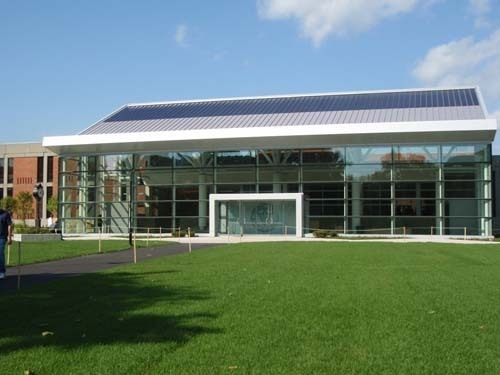
University students are finding their campuses a little greener this fall, and we’re not talking about the lawn. Colleges and universities throughout the state are taking steps to save energy, and their dollars.
Students at Providence College can see solar panels on an addition to the student union. Sharp-eyed students at Johnson & Wales University might notice new sensors that adjust the heat based on occupancy and dorm residents at Salve Regina University will see low-flow showerheads.
“I think we all need to take responsibility for climate change and colleges and universities have a huge impact on climate change,” said Gale Gennaro, the director of environmental and health safety at Providence College. “We’re like small cities ourselves. We generate and use a lot of electricity and we need to be accountable for that.”
To reduce its carbon footprint – and its electric bill – Providence College is spending $160,000 to install solar panels on its student union. The 10-kilowatt system will generate enough electricity to light the addition.
College officials hope to recoup some of the cost through federal stimulus grants. Gennaro said she also is seeking grant money to cover the cost of solar heating of the water for the college’s athletic pool, dining facility and cafeteria. That project could cost as much as $250,000 but save much more over the long term, Gennaro said.
Down the highway at the New England Institute of Technology, the school has become the poster child for energy projects. In July, it installed a 100-kilowatt, 156-foot tall wind turbine visible from Interstate 95. At a cost of $455,000, the turbine is not expected to pay for itself anytime soon, but the publicity and educational opportunity have been priceless, Vice President and General Counsel Philip Parson said.
The school also spent $255,000 to install solar panels and is exploring implementing a geothermal system.
At Bryant University, Assistant Vice President of Campus Management Brian Britton said the school took the extra step of installing carbon dioxide sensors in its interfaith worship center now under construction. When complete, the sensors will determine the room’s occupancy and adjust the ventilation accordingly, providing the university’s electric meter a rest.
Reducing the time the meter spins was also the intent at Johnson & Wales University, which has upgraded lighting using rebates from National Grid. It then placed sensors in classrooms to ensure the lights went off when students left.
“We’re always looking for ways to go green and save money,” Reynolds said. “We try and do the two at the same time. It’s always a nice combination.”
At the University of Rhode Island that’s not only the goal, but the mandate. The university’s funding for such projects is dependent upon officials being able to show the improvements pay for themselves within a reasonable amount of time, Assistant Vice President for Business Services Vernon Wyman said.
Wyman said the university has spent $11.1 million during the past two years to undertake energy-efficiency projects that include installing new insulation, window replacements and putting a cover on the school’s pool. The school anticipates spending on such projects will reach another $7 million by the time this fiscal year ends on June 30, 2010.
The Community College of Rhode Island is exploring hiring a firm to conduct an energy study with the goal of the improvements paying for themselves through energy savings. Ideas include installing new lighting, switching from electric heat to gas-fired heat at the Warwick campus, using automated flush toilets and replacing ventilation systems.
“These are all very nonsexy things but they save us money over the long haul,” said Robert Shea, vice president for business affairs and CFO at CCRI.
But not every project is large. Salve Regina University switched to 100 percent bleach-free napkins and put them in napkin holders. The napkins are more environmentally friendly and the holders reduce usage by as much as 20 percent. And at Brown University, the facilities department dispatches students through its Eco-reps program to inform their peers about energy conservation.
“The key thing is while many of these efforts have been ongoing and almost old hat for us, it’s always important we try and get the new class in here and make them aware and get them involved,” said Kurt Teichert, the manager of environmental initiatives at the school’s Center for Environmental Studies. •