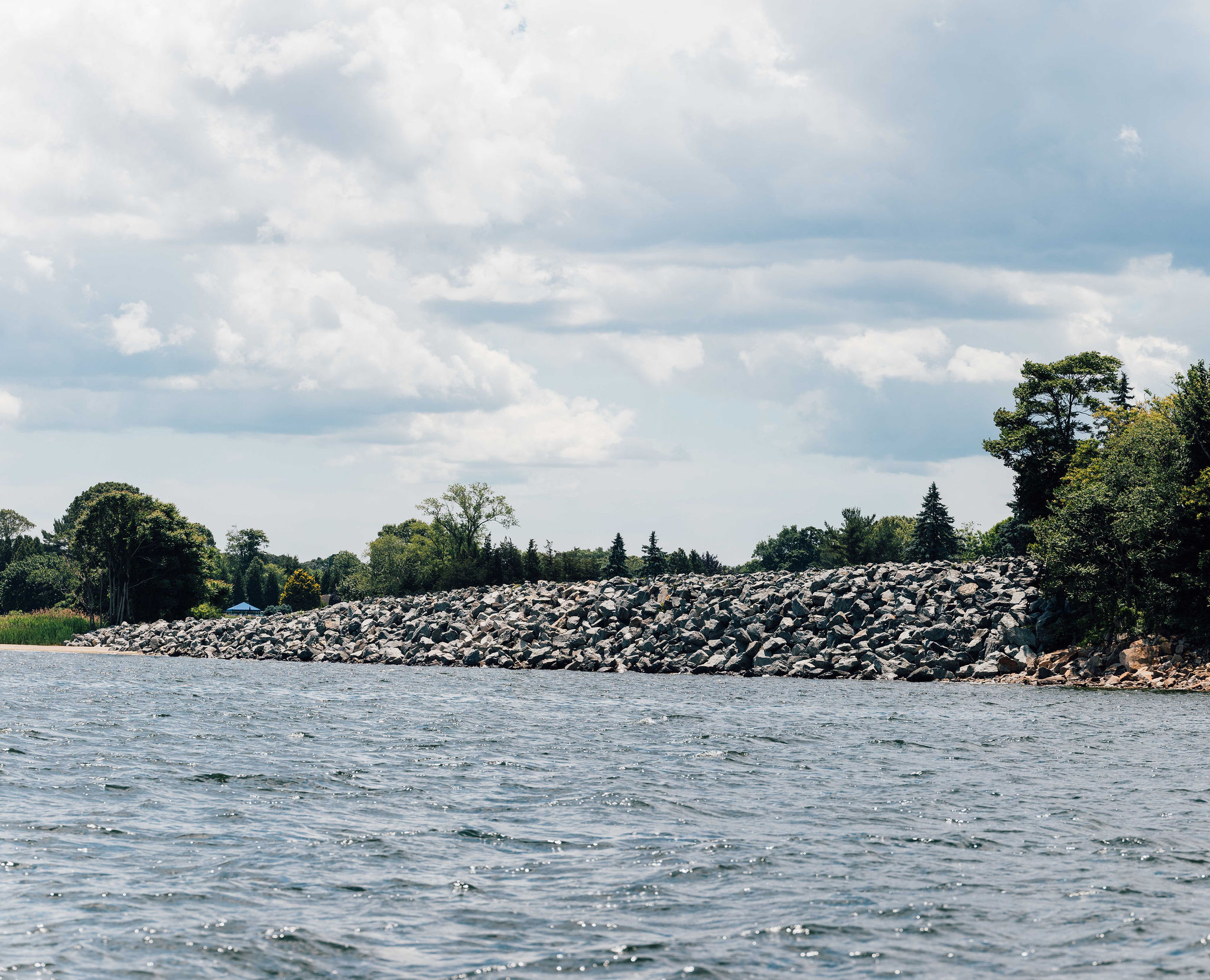
Time to lawyer up.
That’s the conclusion of the R.I. Coastal Resources Management Council, which voted unanimously at its Tuesday meeting to enlist its legal counsel to crack down on Quidnessett Country Club for failing to comply with state coastal rules.
ISO 9001:2026: A Practical Opportunity to Build for What’s Next
For Rhode Island manufacturers, ISO 9001 has been much more than a certificate on the…
Learn More
The decision comes after more than two years of warnings, negotiations and deadline extensions as coastal regulators tried to reach an agreement with the North Kingstown country club over the removal of a 600-foot-long rock wall built without permission along its shoreline.
Opposing sides continued to butt heads Tuesday over details of the required plan to remove the wall and restore the shoreline along Narragansett Bay to its natural state.
Jennifer Cervenka, an attorney representing the 1,000-member country club, continued to make the case for replacing the rock wall with a row of biodegradable, geotextile sandbags to shield the club’s golf course from rising sea levels. But coastal staff maintain the products from Florida company Trapbag violate state coastal restrictions, which expressly prohibit anything but non-structural barriers in environmentally sensitive coastal habits like the shoreline overlooking Narragansett Bay.
Also in dispute: how far inland to put any barrier to meet state public access law and other coastal requirements, and the type and amount of native vegetation that must be replanted after the stone wall is removed.
“The restoration criteria are not arbitrary,” Emily Hall, a CRMC coastal geologist, said Tuesday. “To disregard any of the three requirements would allow prohibited activities to continue on the shoreline.”
Yet Cervenka insisted the country club was not “recalcitrant,” pointing to the seven versions of a shoreline restoration plan submitted over the last year, even though all were rejected by agency staff for failing to meet coastal requirements.
“The last two [plans] in particular, we believe, struck a proper balance between what’s required under the program and the protection of our property,” said Cervenka, who previously chaired the appointed panel of coastal regulators.
Lurking unspoken but present in the debate: two lawsuits brought by Quidnessett against the CRMC. The first, filed in July in Providence County Superior Court, contests the procedural process the council followed in reviewing the case. On Sept. 8 came a second complaint, alleging the agency violated the country club’s constitutional property rights and asking a Superior Court judge to redesignate the coastal waters to allow for development.
The dispute over the water type designation started shortly after the CRMC issued a cease-and-desist order against the country club in August 2023, followed by a series of warnings threatening fines. The club initially defended the wall, built the previous winter, as an emergency measure necessary to protect its signature 14th hole.
After being sanctioned, the country club’s representatives said the “Type 1” designation for the section of Narragansett Bay along its shoreline was incorrect and pushed for a less restrictive label that could allow development such as a rock wall.
The CRMC rejected the application for the water type reclassification in January, shifting focus to details of the location and materials used to restore the shoreline to its pre-wall condition.
Hall acknowledged the multiple concessions made by coastal staff to accommodate Quidnessett. But it was obvious to CRMC Chair Ray Coia the two sides reached an impasse over the Trapbag solution.
“Where do we go from here?” Coia asked. Turning to Cervenka, he said, “I see no concession from Quidnessett because you feel, in your opinion, that Trapbags are allowed. And staff, in looking at the rules and regulations, strongly defend that they are not allowed.”
Council member Kevin Flynn suggested Quidnessett needed to reconfigure its golf course to meet state coastal requirements.
“We’re talking about grass and sand here, Flynn said. “We’re not talking about protecting a building here, or protecting a school.”
Flynn proposed turning the par-5 14th hole into a shorter, par-4 to avoid butting up against the eroding shoreline.
But Cervenka defended the preservation of the golf course in its original 1960 state, as designed by architect Geoffrey Cornish. The rock wall built two-and-a-half years ago was vital to protecting “imminent harm to property and persons,” she declared.
Michael Reuter, the newest appointee to the CRMC who was confirmed in March 2025, shrugged off Cervenka’s plea.
“If it was so vital, you should have come to us first,” he said. “Why not get an emergency permit?”
The council’s vote Tuesday does not specify how its legal counsel will seek to enforce its existing order requiring removal of the rock wall and restoration of the shoreline. And negotiations over plan details can still continue if Quidnessett is willing to work toward resolution, Anthony DeSisto, the council’s attorney, said.
The council’s June 10 order gave the country club three months — until Oct. 8 — to remove the wall and restore its shoreline.
Robin Main, another attorney representing Quidnessett, declined to comment in an emailed response Wednesday.
Jed Thorp, advocacy director for Save the Bay, said it’s still unclear how the case is going to play out in an interview Wednesday.
Thorp outlined various scenarios that could follow. One: a court order setting a deadline for Quidnessett to take the wall down and/or details of a restoration plan, a prospect he expected the country club would appeal. Or, a judge could side with Quidnessett in its initial lawsuit arguing that the CRMC should have referred the case to its hearing officer. That would force a redo of the entire review process before the agency’s designated lawyer for disputed cases. Finally, there remains the possibility of settlement outside court.
“What matters to us at the end of the day is when is this wall going to get taken down and when is the site going to get restored,” Thorp said. “Whatever option gets us to that quickest is what we’re going to want to see.”
The council ended its meeting with a scheduled, closed-door discussion about the lawsuits filed by Quidnessett. Members returned to open session after 10 minutes, voting unanimously to authorize its legal counsel to act on its behalf. The CRMC has not yet submitted responses to either of the Quidnessett lawsuits, according to public court dockets.
Nancy Lavin is a staff writer for the Rhode Island Current.