Amid all the talk about building a giant wind farm off the coast of Rhode Island, Bruce DiGennaro and his business partner are fixed on the potential of another, once-prominent power source – water. The two, who run the Essex Partnership, believe that the dams that dot Rhode Island and helped kick-start the state’s Industrial Revolution could, more than a century later, energize their business and help the economy.
Hydropower will never generate the thousands and thousands of megawatt-hours a massive, offshore wind farm could. But DiGennaro’s company, which has offices in Newport and Ivoryton, Conn., has run calculations that show rehabbing a dozen or so dams in the Blackstone and Pawtuxet river watersheds could generate about 3,000 megawatts, or enough electricity to power about 3,000 to 4,000 homes. DiGennaro said such a project could also offer developers a return on investment of about 11 percent.
“With wind, often … the best resource is not where the need is,” DiGennaro said. “You need to build transmission to where it needs to go and that’s hugely expense. But with hydro the infrastructure’s already there.”
About 700 dams, many abandoned, sit in rivers throughout Rhode Island. Mill workers constructed many of them during the 1880s to power textile complexes and, by extension, the dams supported the backbone of the state’s economy. While the equipment is either long gone or obsolete, the largest components, the dams, remain and, in many cases, are in great condition. Renovating them would not come easy, or cheap, however. Turbines to capture the water’s flow must often be custom designed and built, and then there’s the problem of scale.
For mill owners in the 1880s, a 10- or 15-foot-tall dam created sufficient water flow for their needs. But with the rise of electricity-hungry technology and residential complexes taking over abandoned mills, the dams are just too small, as Arkwright, a plastic-film manufacturer in Cranston, found out. A feasibility study found the price of converting an existing dam into hydropower too costly, Marketing Director Dan Halkyard said.
DiGennaro also thinks he can offer electricity cheaper than that produced from offshore wind farms. His estimates show that the Essex Partnership could sell electricity for about 14 cents a kilowatt-hour wholesale. Deepwater Wind, the developer of a proposed wind farm off the coast of Block Island, has pitched a wholesale price of 24.4 cents a kilowatt-hour. (Although that cost could slide down if the company builds another, larger farm as planned and realizes savings from economics of scale.)
Besides price, DiGennaro said the cultural tide is shifting in favor of renewable projects, including hydro. Federal investment tax credits help, a renewable energy friendly White House administration and a General Assembly and governor with keen interests in the green sector have turned a trickle of interest into a steady stream.
The R.I. Economic Development Corporation has awarded $80,000 to pay for two feasibility studies and $200,000 to Holliston Sand in North Smithfield to install two hydroturbines. East Providence received $50,000 to study hydropower along the Ten Mile River that it matched with $50,000 in federal stimulus money.
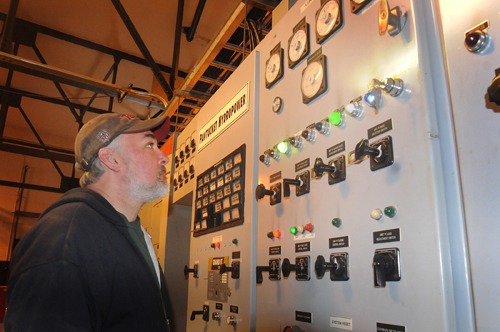
Director of Planning Jeanne Boyle said two hydropower plants, one by Hunt’s Mills and the other by Omega Pond, could save the city $300,000 annually in electricity. At Hunt’s Mills much of the original hydropower equipment remains in place about 40 years after the plant ceased operations.
The National Hydropower Association expects hydropower to provide 200,000 megawatts of generation capacity by 2030, double today’s capacity, thanks primarily to federal and state tax incentives and a renewed emphasis on green power, association spokeswoman Kristen Nelson said.
“What you’re seeing in Rhode Island is really something replicated in every state,” she said.
In Rhode Island, the concept of reviving the state’s scattered hydropower plants has received occasional attention from officials over the decades. DiGennaro said the interest in hydropower is often directly proportional to the cost of fossil fuels that drive electricity prices. When prices skyrocketed two years ago, DiGennaro saw interest from dam owners looking to turn the stone or concrete structures into moneymakers.
The Essex Partnership recently inked its first development deal. It will partner with a landowner in Plainfield, Conn. looking to rehab a former mill for mixed use, while utilizing the existing dam. Essex will build a hydropower plant, and the landlord and Essex will share in the proceeds from the sale of the power to the local utility.
Interest is also coming from nontraditional sources. The Conservation Law Foundation’s Rhode Island chapter recently received a $30,000 grant from the EDC and combined it with $25,000 of its own money to evaluate the possibility of hydropower along the Blackstone River.
The environmental group turned to the Essex Partnership to conduct the study.
Cordiality between environmental groups and hydropower developers is unusual. Environmental organizations often fight dams on grounds that they damage the environment. But Law Foundation Executive Director Tricia Jedele said that because the dams already exist it only makes sense to harness energy potential and use the rehab as an opportunity to construct fish ladders or take other steps to reduce the environmental impact of the dams.
If Phase 1 of the study shows at least some of the dams as viable for hydropower, the foundation plans to apply for additional money from the EDC and for federal stimulus money. Then it wants the northern Rhode Island municipalities to form a collaborative to implement hydropower.
Besides reducing greenhouse gas emissions, Jedele said that hydropower could provide an opportunity for communities far from wind resources to reap the benefits of renewable energy credits, federal stimulus money and the like. It could also spark interest in building other types of renewable energy systems.
“CLF’s goal in this is not to just set our mark on hydro and end our story there,” Jedele said. “We want to build a northern Rhode Island collaborative that can expand into other types of energy.”
Still, hurdles loom large, both for DiGennaro’s vision of a public-private partnership and the foundation’s separate interest in seeing municipalities form a collaborative.
DiGennaro said it can take two years or more to receive federal regulatory approval for a hydropower plant and that state and federal regulations pertaining to dams are tough and costly.
Charlie Rosenfield, owner of Putman Hydro, in Putnam, Conn., said officials will need to strike the right balance between regulations and environmental protection for hydro to really take off. But Rosenfield, whose company maintains two hydro plants in Rhode Island, said hydro once played a huge role in the state’s economy and officials could turn the remnants of history into tomorrow’s inexpensive power supply.
“People think just a diorama somewhere [of hydropower plants] is all that’s left and that’s just not true,” Rosenfield said. •