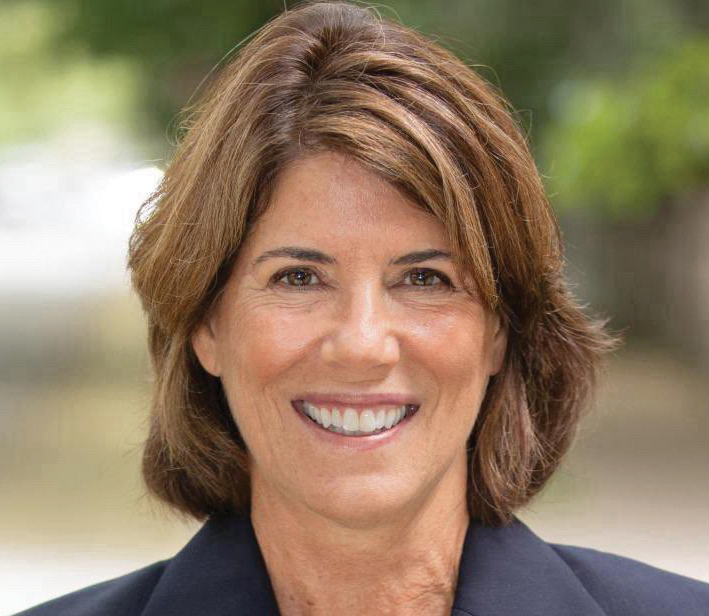
(Editor’s note: This is the first in an occasional series of stories speaking with this year’s gubernatorial candidates about their economic vision for Rhode Island.)
PROVIDENCE – Gubernatorial candidate Helena B. Foulkes says her vision for Rhode Island is expanding a middle-class she believes has been largely left behind. Foulkes, a Democrat, told Providence Business News her second campaign for the state's top executive is all about providing access to healthcare, housing and good-paying jobs.
A former CVS Health Corp. executive and CEO of Hudson’s Bay Co., Foulkes is once again running against incumbent Gov. Daniel J. McKee, who defeated her in 2022 by 3-percentage points. The Democratic primary will be held on Sept. 9. The general election is Nov 3.
Currently ahead in the polls, Foulkes has been successful with fundraising,
reporting $1.1 million in donations in the first three months of the year. She has also secured endorsements from several political advocacy organizations, unions and local Democrat committees.
On the campaign trial Foulkes has offered several big-ticket proposals, including borrowing $150 million to fund improvements to port infrastructure and supply chains to shore up the green and blue economies.
Perhaps the most ambitious is her “Rhode Home Program” housing plan that would create a revolving fund to finance the building 20,000 new homes and apartments supported by a proposed 3% income tax on individuals earning over $1 million, which the campaign projects would generate more than a billion dollars within eight years.
Though controversial in some business circles, Foulkes believes taxing the wealthy to help those with less financial means get an entry into what for many is the most important long-term investment is not only a moral obligation, but a fiscally prudent one.
"If people can’t afford to live here, then Rhode Island can’t afford to continue to grow," she said. "The high cost of housing is holding our state back, and the plans that we have seen so far to try to address it haven’t worked."
So-called millionaire's tax proposals put forth by you and Gov. McKee have been derided by much of the business community as anti-job growth. How do you respond? And regarding your own proposal, why should top earners, many of whom provide jobs, also be responsible for boosting affordable housing?
The number one issue facing our state is the high cost of housing. I worry about all the young people I’ve been talking to who are leaving the state because they can’t afford rent, the parents whose grown children with good jobs are still living at home because they can’t afford a place, the young families that are here, and the middle-class folks who can’t find somewhere to live that they can afford.
That’s why I’m proposing to put the millionaire’s tax toward a transformational investment in housing construction with my Rhode Home Program.
Everyone who will be subject to the millionaire’s tax that I proposed to pay for my Rhode Home program is someone who recently got a windfall tax cut from the federal government when Trump and Congressional Republicans passed a bill that gives tax breaks to the wealthy while cutting Medicaid, SNAP benefits, ACA subsidies, and more services that our people rely on; they can afford it.
What specific strategies do you propose to stimulate job growth and attract new businesses to Rhode Island?
As governor, I’m going to grow our economy and create good-paying jobs by leaning into our strengths and removing barriers to work. With 400 miles of coastline, world-class ports, and manufacturing facilities, our ocean economy is poised for growth, and I have a plan to make it happen, with a $150 million investment in infrastructure and facilities to allow companies working in the ocean economy to expand and locate in Rhode Island.
My housing plan will add thousands of jobs in building and construction trades, including by locating manufacturing facilities for modular homes right here in Rhode Island, so that we are supplying the materials for housing construction all over the northeast.
I will invest $100 million into career and technical education facilities at public high schools across the state, so that our students can gain career-track skills that they can put to use in good-paying jobs at Rhode Island companies as soon as they graduate high school.
Plus, no jobs plan is complete without understanding where people can afford to live, how they can afford to get to work, and whether they have affordable childcare to rely on. I will invest in a Rhode Island Employer-Matched Childcare Fund pilot program and expand RIPTA routes that connect workers to jobs - so parents can stay in the workforce, and people can afford to go to work!
What's the single biggest lesson you learned from your last gubernatorial run and how are you using that experience this time around?
When I ran in 2022, campaigning was still heavily shaped by COVID, and so much of it happened virtually. This time around, I’ve really enjoyed getting out to meet Rhode Islanders all over the state and hearing about both their worries and their hopes. Those conversations have deeply informed my campaign.
I think that the best leadership starts with listening. People want leaders who understand what they’re going through and are ready to fight for solutions that make a difference in their everyday lives.
How do you plan to help improve access to healthcare services in Rhode Island?
Everyone should be able to access high-quality and affordable healthcare in their community. In a state of only a million people, Rhode Island could be a bright, shining star for the rest of the country. We should be leading in healthcare innovation and access. Instead, too many Rhode Islanders are struggling to find a primary care doctor.
One of the biggest challenges we face is a shortage of healthcare professionals - primary care physicians, specialists, nurses and frontline workers. We also lose a great deal of our talent to neighboring states because our Medicare and Medicaid reimbursement rates are not competitive with states like Massachusetts and Connecticut. Rhode Island ranked dead last in 2024 in Medicaid rates compared to Medicare rates – hospitals and the entire healthcare system continue to feel the strain from rates as much as 30% lower than in neighboring states. Looming cuts to Medicaid from the Trump Administration only worsen those anxieties.
We need a comprehensive approach to strengthening both our healthcare workforce and access to care. That includes increasing our reimbursement rates to achieve parity with neighboring states, expanding CTE programs that can prepare our students for healthcare careers, and implementing incentives that can help us attract and retain medical talent.
The Trump administration and Republicans in Congress have changed federal health policy to create red tape and paperwork requirements designed to kick Americans off of their Medicaid coverage. My administration will form a new position: healthcare navigators. These state employees will help Rhode Islanders enroll in Medicaid and meet the government’s paperwork requirements so they can stay enrolled, meaning more people with coverage and more business for our healthcare industry. What’s more, the program will pay for itself and add revenue to Rhode Island’s state budget.
Is R.I. Commerce Corp. doing enough to boost local businesses and the state economy? If not, what would you like to see it do differently?
There’s always room for growth when it comes to supporting our local businesses while encouraging and attracting new ones. And this is especially true given the current chaos pressure added by the Trump administration and its tariffs.
One of the biggest challenges I hear about in this area is that people don’t know how to access the programs and funding we make available through R.I. Commerce. I think we need to make these programs a lot more transparent and accessible to people across the state.
What is the governor's role in building a better state business climate and growing the economy?
One of the governor’s most important responsibilities is to be Rhode Island’s chief marketing officer. As governor, I will be Rhode Island’s staunchest advocate, making the case for why businesses should choose to start, grow, and stay here.
The governor also has a responsibility to make state government work smoothly for Rhode Islanders. Too often, our small businesses face unnecessary hurdles and delays when they try to grow, hire or invest. I often think back to a conversation I had with a man who wanted to start a food truck; he told me he had to go to 14 different state and local agencies to get all the permits he needed to get off the ground. Neighboring states have created “one-stop shops” where business owners can navigate these processes in one place. That’s the kind of practical approach we can replicate here to enhance Rhode Island’s business climate.
Christopher Allen is a PBN staff writer. You may contact him at Allen@PBN.com.