“What cheer, netops?”
With those words, a greeting once used by New England Indians (the word “netop” meant friend), Roger Williams addressed the friendly Indians who greeted him when he arrived in Providence in the 1630s.
And these are the same words that Robert I. Burke, local restaurateur and history enthusiast, used to greet those who gathered for his recent announcement of the establishment of the Independence Trail, expected to be a landmark tourism site for all of Rhode Island.
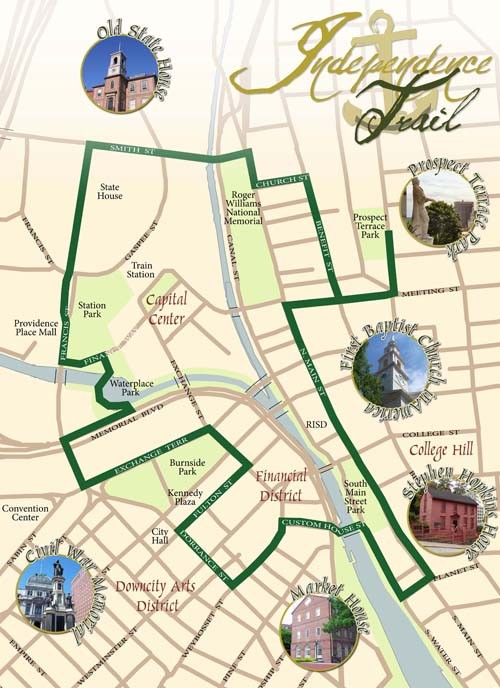
The trail, a three-mile route incorporating 400 years of state history, winds through downtown Providence from the Statehouse to the Financial District, offering approximately 75 historic sites ranging from Roger Williams’ tomb to the First Baptist Church and the now-dilapidated house where Stephen Hopkins, who signed the Declaration of Independence in 1776, lived on what is today South Main Street. A publicity video for the trail touts Providence as “America’s most historic city.”
Burke left no doubt that he believes establishment of the trail on a formal basis will lead to added business opportunities for new and existing downtown enterprises. “This is intended to bring more money to your business, your district, your neighborhood,” he told the assembled crowd of about 100 people at the Old State House on Benefit Street during the May 4 event.
In a subsequent interview with Providence Business News, Burke said the kinds of businesses he sees benefiting from the trail are retail shops along or near the route, as well as lodgings, restaurants and – because “people will want to be entertained” after visiting the trail, he said – theaters, museums, musical and cultural attractions.
“This is the quintessential Knowledge Economy business,” Burke said, “because everything we do is passing knowledge from one person to another.”
The self-guided trail, which Burke hopes to launch Independence Day July 4, will be free, with support coming from donations and grants in the future. Not only will the trail bring more visitors downtown, Burke said, he intends to expand the operation, so jobs will be created in the form of actors, costume makers, writers and others. He said he already is working on costume design with Marilyn Salvatore, former Trinity Repertory Company costume director.
Two leaders of the tourism industry in the state praised Burke and his plans for the trail.
“Certainly, heritage tourism is one of our biggest assets,” said Mark Brodeur, director of the tourism division within the Rhode Island Economic Development Corporation. “No other state in the country can claim the number of historical assets we have in one small area,” he added, referring to the three-mile trail’s 75 sites. He said he particularly likes the way the trail would present often-dry historical data in a “very accessible way” that tourists can visit at their leisure.
The Rhode Island tourism industry is the fourth largest in the state, raising gross annual revenue estimated at $5 billion, Martha Sheridan, president and CEO of the Providence Warwick Convention & Visitors Bureau, told the gathering. “I’ve worked with Bob Burke for many years and I know of no one more passionate about Providence,” she said.
In a subsequent interview, Sheridan explained that tourism is a highly competitive industry, with Providence competing for meetings and conventions most intensely with such second-tier cities as Baltimore, Md., and Charleston, South Carolina. All of New England, as well as New York, New Jersey and even Newport, compete with Providence for the leisure traveler, she said.
Regarding the Independence Trail, Burke said he is now in the process of organizing the painting of a green line along the sidewalks of the trail, a process he hopes to finish for the July 4 launch, but he noted “much depends on the weather.” Scout troops and students will be recruited to clean litter from the trail before the tentative July 4 opening.
The trail is self-guided. Trail-goers call a special telephone number with their cellphones to access historic details. Numbers will be painted on the trail’s green line, with each number conforming to the historic site in front of it. Trail-goers need only punch the site number into their phones to hear a description of the spot they are standing in front of, Burke explained. The description will be in the form of a story because, he said, “we all love to be told a story,” recounted by “familiar Rhode Island voices.”
He has been working on the trail for about five years, organizing an inaugural event May 4, 2007 (May 4, 1776, is Rhode Island Independence Day) that more than 1,000 people signed up for. Burke now offers the tour from Pot au Feu for free, on an occasional basis.
By the start of the next school year, Burke hopes to be able to offer the tours to schoolchildren from across the state and he said he is working with Rhode Island Education Commissioner Deborah A. Gist (who attended the May 4 event) on tailoring the tour to school curricula and lesson plans. •