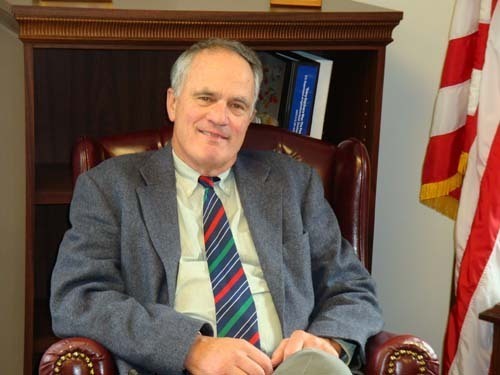
Jonathan “Jay” Healy is the state director for the U.S. Department of Agriculture office that covers Rhode Island, Massachusetts and Connecticut. President Barack Obama appointed Healy in July to the position that oversees six offices and approximately 60 employees. Healy recently spoke with Providence Business News about some of the lesser-known initiatives at USDA and the farming sector in general.
PBN: How are you finding the job and what are some of your responsibilities?
HEALY: Well, the job right now is on the edge of being overwhelming in terms of learning about our 40 programs and how they do or don’t apply in terms of three states. It is a challenge. Even though our three states aren’t like Iowa or Nebraska, there are different sets of people, different sets of programs we’re trying to do. So that in itself is a challenging learning curve.
There are also about 60 … people in Rural Development. Almost half of them [are] in our central office here in Amherst and then the other half in six regional offices over Rhode Island, Connecticut and Massachusetts. … Trying to work with developing cohesive teamwork and learning all the issues coming down the pike is a real challenge.
It’s fun but it also is pretty busy. [In addition to] … rural development, we do a lot of housing, we do a lot in farming and value-added enterprises as well. Last year I think we spent, between loans and grants, nearly $250 million in the three states. … There’s significant responsibility to not only help manage programs and get the word out to our customers, but also work with a fairly large staff.
Building a Strong Data Foundation in the Age of AI
Artificial intelligence (AI) has become a key priority in the boardroom and across management —…
Learn More
PBN: What are a couple of the key programs you oversee? PBN: Can you tell us about value-adding operations? PBN: What are some of the challenges for local farmers? INTERVIEW
HEALY: If you look at the agency as a whole we do a lot with community-development facilities, whether they be an expanded water and sewer system in a village or police station or a fire station. We get involved with helping the establishment of charter schools. …
We’re also all trying to grapple with how we can help with our carbon footprint and deal with problems with global warming. We have a fairly significant renewable energy program for small businesses and farms and we deal with some photovoltaics and some wind turbines.
Ironically a couple of years ago, before this job opened up or was even a possibility, I put up about a $150,000 photovoltaic system on our farm, on our saw-mill roof, that was funded by Rural Development – and going through that process is another story. But it gave me great insight into how valuable the program was, as well as how difficult it was sometimes to go through the myriad application forms from construction to the finish line and actually put the photovoltaics up.
So that whole renewable energy area with the carbon sequestration issues is something that I’ve been working pretty hard on and know a little bit about. [It] is relatively new, so we don’t have a huge amount of staff focused specifically on that area.
Secretary Tom Vilsack and Kathleen Merrigan, deputy secretary of agriculture, are also looking at local and regional food systems and figuring out how we can connect local farmers and local producers of agricultural products with local customers, by helping schools or helping farmers markets or grocery stores. It builds on those connections to keep our valuable, working landscapes operating and viable economically, as well as environmentally sound.
HEALY: The other day I was going down to Rhode Island and I think it was Route 78 – I can’t remember the name of the turkey farm – but it’s in extremely eastern Connecticut. It’s right near the Rhode Island border, a beautiful rural area. I stopped and had a turkey sandwich and an ice cream cone.
The ice cream in that cone – if you sold it as raw milk to a big cooperative – that milk would be worth maybe 10 cents for the unit of milk you put in an ice cream cone. The ice cream cone on the other hand is worth $2.50. So you’ve got a 25 times multiple of milk you would otherwise sell wholesale and through a middleman that goes to another middleman.
The innovative farmers who are entrepreneurs are key to so many things that are valuable to our society in our three states, and key to that is adding the value where you get the customer dollar.
HEALY: For better or for worse, in New England we have high energy costs, we have high labor costs, we have high land costs. To me the value-added key can help strengthen that land base. That’s so important to all sorts of economic development and … the quality of life for the farmers that live on that land and the people that go by and the tourism and all the environmental kinds of things.
So that’s what’s exciting to me and a real challenge: Knowing that we’re going to have growth and new houses and people that move in and businesses … but the New England countryside is something that millions of people around this world would give their eye teeth to be able to drive through on their way to work.
I think it’s important we keep those rural values up there and have good, strategic ways of thinking about them as valuable resources we can’t afford to lose. •
Jonathan Healy
POSITION: USDA state director, Rhode Island, Massachusetts and Connecticut
BACKGROUND: Former state legislator in Massachusetts, former Massachusetts commissioner of agriculture and farm consultant. Healy grew up on a farm in northwestern Massachusetts.
EDUCATION: B.A. in art history, Williams College, 1968, LLB, Suffolk Law School, 1981
FIRST JOB: He was a farm hand on the family farm at age 8, with duties that included killing mice for a penny apiece.
RESIDENCE:
Shelburne Falls, Mass.
AGE: 64