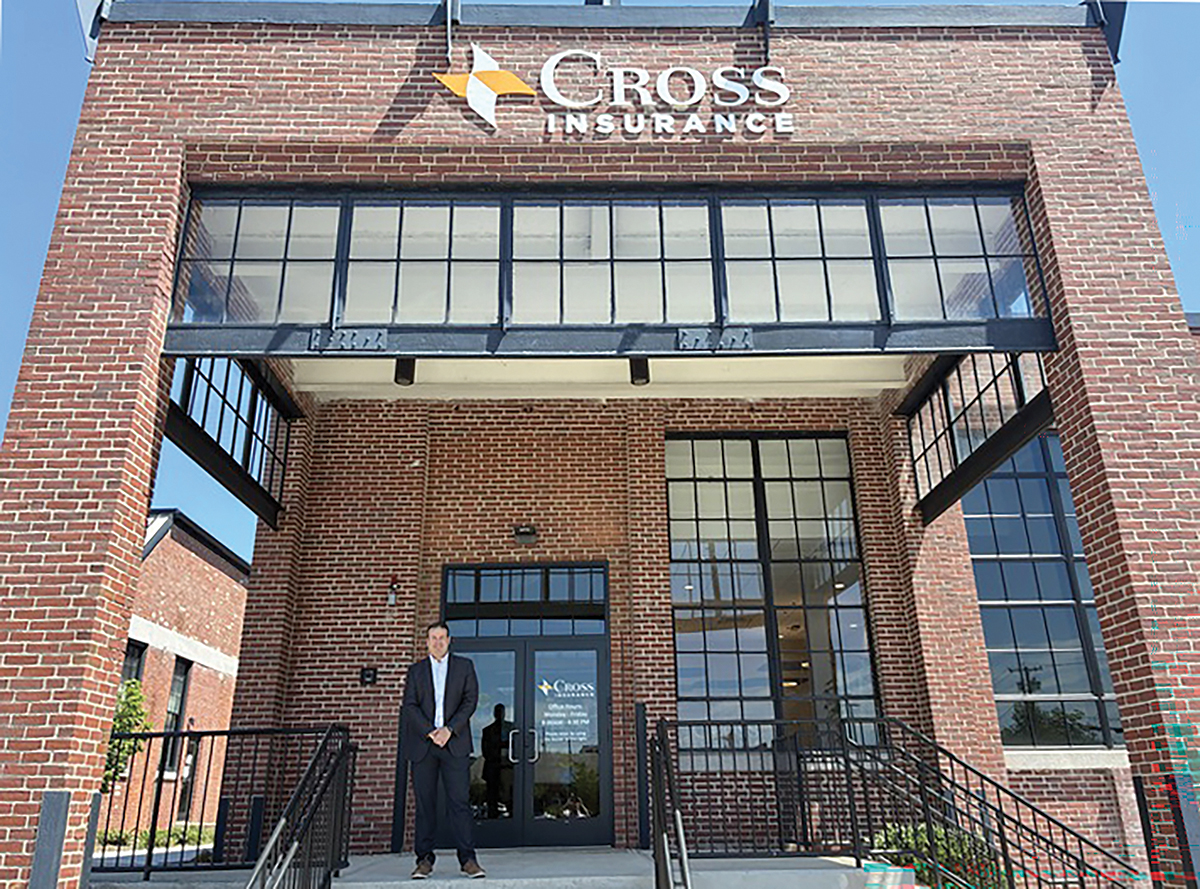
On a sunny summer morning at the Foundry in Providence, Cross Insurance Inc. employees move past exposed brick walls and soaring 14-foot ceilings before settling into meetings, client appointments and another day at the office.
The space at 291 Promenade St. is intentionally designed for interaction: a massive sunlit event room, casual gathering areas and office games such as cornhole boards illustrate what many companies now expect from their workplaces.
Last year, many of the 75 workers were based about 5 miles away in East Providence, in what Peter Gillespie, senior vice president and branch manager for Cross, described as “almost a strip mall setup.”
Today, the Maine-based insurance brokerage occupies 30,000 square feet at the Foundry, the 25-acre former Brown and Sharpe Manufacturing Co. complex made up of numerous brick buildings housing 700,000 square feet of offices and apartments.
The standalone space that Cross occupies mixes the building’s factory origins with modern office features, and it’s located close to Providence’s commercial center.
“It gives us the kind of environment that helps us attract people and stay connected to our clients,” Gillespie said. “We felt Providence gave us the opportunity to do both.”
Cross Insurance’s move reflects a shift underway in office buildings across Rhode Island.
Five years after the COVID-19 pandemic upended workplace habits and accelerated remote work, the existential fear of a collapse in the office market among landlords and lenders has subsided, but some of the underlying economic issues remain unresolved.
Those in the real estate sector say companies are still leasing office space, but they’re seeking something different from what they had before COVID-19. Many aren’t expanding; they’re upgrading.
They want buildings with amenities, parking, collaborative space and modern infrastructure – locations that help recruit workers and impress clients.
And in many cases, tenants are willing to pay more for those features even while taking less space overall, as they encourage attendance three or four days a week.
“Companies are trading up,” said Leeds Mitchell IV, principal broker and partner at MG Commercial Real Estate. “They may not need more space, but they want better space.
“Young talent wants to be in a nice office space,” he said. “Companies are competing for employees, and the workplace has become part of that competition.”
Demand isn’t exactly high, but – with some commercial buildings being converted to residential uses, combined with a lack of new construction in recent years – the supply of quality space is tight.
That situation differs from Boston, where the office market is massive and has been hurt by the cooling of the life sciences sector, and a glut of new construction has left millions of square feet of space empty.
Providence’s market is far more restrained. Vacancy rates are low, but so are rents compared with national averages.
“Right now, it’s low supply and low demand,” Mitchell said. “There are pockets of activity, but there’s no true organic growth. … It’s not really a growth story right now. It’s a repositioning story.”
[caption id="attachment_526060" align="aligncenter" width="1200"]

CHANGING MARKET: Leeds Mitchell IV, principal broker and partner at MG Commercial Real Estate, says the post-pandemic Providence office market is smaller but stable. Behind him is Brown University’s 300,000-square-foot integrated life sciences research facility.
PBN FILE PHOTO/MICHAEL SALERNO[/caption]
PICTURE OF STABILITY?
In some ways, the dynamics add up to healthier circumstances in the Providence area than in many larger cities.
According to national commercial real estate services firm Cushman & Wakefield, the vacancy rate in the local market sat just under 12.8% in the first quarter of 2026, while average asking rents stood at $22.79 per square foot.
Those numbers have remained relatively unchanged for several years.
By comparison, Cushman & Wakefield’s U.S. report for the first three months of 2026 shows that the vacancy rate nationwide is 20.2% and asking rents average $38.37 per square foot. (Boston’s vacancy rate was 18.5%, while the asking rent averaged $47.47 in the same period.)
Alden Anderson, vice president and commercial real estate broker at CBRE Inc.’s New England office, said the Providence market has largely settled down following years of disruption.
“The stability is there,” he said. “But demand has been coming in waves.”
Brokers say much of the current wave is tied to a pendulum swing away from remote work, and back toward in-office expectations, as many employers are once again requiring a more consistent on-site presence.
That’s a far cry from sentiment immediately after the COVID-19 pandemic, a time around 2021 that Anderson says was defined by a rush to reassess space needs, with suburban markets briefly benefiting from the churn as companies prioritized space that allowed for social distancing, more parking and plenty of flexibility.
By 2022, he says, attention shifted toward higher-quality assets, including adaptive-reuse projects and life sciences-driven development in Providence’s so-called Innovation District, which helped offset weakness in traditional downtown office space.
Market conditions then cooled in 2023 as rising interest rates and economic uncertainty slowed decision-making, with demand increasingly concentrated among healthcare, education and other institutional users, Anderson says.
More recently, leasing has become more selective, with newer and repositioned buildings outperforming older inventory.
A new shock never seems to be too far away, however.
In December 2023, Hasbro Inc. announced it was laying off 1,100 employees globally and vacating the 135,000-square-foot downtown Providence office building at 15 LaSalle Square after its lease expired in January 2025.
Soon it was empty, but not for long.
Brown University Health leased the Class A space – the top rating used to describe an office building’s quality, age, amenities and rental price – to consolidate several administrative offices across the city at that one location with hundreds of workers.
“People are really looking for Class A office space,” Mitchell said. “They want amenities, efficient floorplates and environments that help attract and retain talent.”
It remains to be seen what happens with Hasbro’s sprawling headquarters in Pawtucket when the company officially relocates to Boston near the end of the year. Hasbro has said it plans to list and sell the properties in the fourth quarter.
The commercial and industrial property is approximately 343,000 square feet and was appraised at $23.4 million in 2023. Pawtucket Mayor Donald R. Grebien said in January that developers have expressed interest in the property for manufacturing or housing.
FORCED TO ADAPT
Joseph R. Paolino Jr. acknowledges that the economic headwinds can be tough on landlords.
Paolino, CEO and managing partner of Paolino Properties LLC, is one of downtown’s largest property owners with holdings that include his flagship 20-story office building at 100 Westminster St., and the 138,000-square-foot Amica Building at 10 Weybosset St., which Paolino purchased for $12 million in 2024. (He is also leading an investor group buying Providence Place mall for $133 million.)
But constant mergers and acquisitions among professional services companies such as law practices and accounting firms have nibbled away at prospective tenants, observers say.
“The office market has never really been a growth market in downtown Providence,” Paolino said. “Over the years, companies have either merged, been acquired or moved away.”
Case in point: for years, local accounting firm Piccerelli, Gilstein & Co. rented offices for its five partners and 25 associates in the Lauderdale Building at 144 Westminster St. until 2022, when it was swallowed up by national firm Marcum LLP, which had offices in the Packet Building at 155 South Main St.
Two years later, Marcum was acquired by professional services firm CBIZ Inc., which centralized its Providence operations at Paolino’s 100 Westminster St.
Such consolidations may explain why Cushman & Wakefield reports a 66,000-square-foot decline in occupied office space in Providence in the first quarter of 2026.
Landlords have been forced to adapt, according to Paolino, a former Providence mayor.
At 100 Westminster St., Paolino has invested in amenities, including a fitness center, restaurant access and a direct connection to a neighboring boutique hotel called The Beatrice, which is also owned by Paolino.
“We’ve tried to do something different,” Paolino said. “People want amenities. They want convenience.”
Other properties are ripe for change, too. Numerous older buildings that have fallen out of Class A and B status are being removed from the office market through residential conversions and other redevelopment projects.
“We’ve actually shrunk the size of the commercial market in Providence,” Mitchell said. “A lot of that older stock just gets taken out of circulation.”
Paolino has participated in that evolution himself.
In addition to The Beatrice (a former bank office), Paolino has transformed the historic Case-Mead Building at 76 Dorrance St. into 44 microloft apartments and remodeled the Studley Building at 85 Weybosset St. into 65 residential units.
With very little new office construction in the pipeline, the conversions help explain why vacancy rates can appear relatively stable even when leasing activity remains subdued, according to Anderson.
“What makes a market recover is when demand picks back up,” Anderson said. “Otherwise, you’re just bumping along.”
For Mitchell, the 26-story Industrial Trust Co. Building – otherwise known as the “Superman” building – is one of the most visible reminders that the city’s post-pandemic market recovery remains incomplete.
He can see it outside of his office window.
The downtown landmark, which was last occupied by Bank of America Corp. in 2014, is slated to become a residential complex with hundreds of apartments, along with about 8,000 square feet of office and retail space on the lower floors. The project still has financing hurdles.
“It’s hard not to look at that building and see what’s still unresolved in the market,” Mitchell said. “It’s an apt visual – a lot hasn’t fully come back online yet.”
[caption id="attachment_526034" align="aligncenter" width="1200"]

ON SOLID GROUND? Alden Anderson, vice president and commercial real estate broker at CBRE Inc.’s New England office, says the local office market is relatively stable.
PBN PHOTO/MICHAEL SALERNO[/caption]
’BURBS BENEFIT
While downtown Providence works through some of the lingering effects of pandemic-era disruption, suburban office markets have, in many ways, progressed further ahead.
Mitchell pointed to several MG Commercial-managed suburban office properties, including the 141,000-square-foot Summit Office Park in Warwick and the 60,000-square-foot Lincoln Corporate Center in Lincoln, both Class A assets that remain highly occupied.
“In the suburbs, we’re seeing a lot of the activity,” he said. “We’re sitting at about 95% occupancy in some of those assets.”
Rents are rising there, too, Mitchell added.
And compared with Providence, parking in the suburbs is plentiful.
Much of the city’s office space still struggles with a lack of nearby parking, a constraint that continues to push some tenants toward suburban office parks, Mitchell says.
In parts of downtown, minimum parking requirements have been eliminated altogether, a policy shift that reflects the cost of accommodating cars in the urban core.
Recent bank leasing activity in the area shows it has been a key issue to work around.
In March, Massachusetts-based Bristol County Savings Bank opened a full-service branch at 5 Exchange St., converting a former commercial lending office into a retail and business banking location as part of its broader Rhode Island expansion.
That new branch offers valet service through an adjacent hotel property.
Last year, Centreville Bank, too, said it’s planning to open its first downtown Providence branch at 142 Westminster St. – a storefront in the Lauderdale Building once occupied by longtime men’s clothing shop Franklin Rogers Ltd.
That location includes access to private customer parking behind the building.
MASSIVE MOVE
One of the biggest votes of confidence in the future of Providence office space came in February when FM, one of the world’s largest commercial property insurers, purchased the 10-story office building at 10 Memorial Blvd. for $68.5 million.
The 200,000-square-foot building, completed in 2006, is a Class A space that houses Brightstar Global Solutions Corp. Brightstar will remain a tenant.
FM, which has been based in Johnston since its founding 190 years ago, saw the building overlooking Waterplace Park as a great place to expand, in part because its location near the train station makes trips along the Northeast rail corridor easier.
“We can be in a meeting in Boston and back in Providence before lunch,” said Randall Hodge, FM’s chief operating officer.
The 10 Memorial Blvd. location also placed FM within walking distance of hotels, restaurants and Interstate 95, a combination Hodge says was important for employees, visiting teams and client meetings.
FM is still finalizing how the space will be allocated, including staffing and floor assignments, but expects it will function as an expansion of its Johnston headquarters rather than a relocation.
“We haven’t landed on exactly who’s going to go there yet,” Hodge said.
Cushman & Wakefield noted in its quarterly report that the $68.5 million price was one of the largest “user purchases” in the market’s history. But, the report also said it takes nearly 90,000 square feet of Class A space off the market in downtown Providence.
Class A is where the demand is, observers say.
“It’s the Class B market that’s really taken it on the chin,” Mitchell said. “There’s almost no demand for it right now.”
Edwin “Ted” Carr, Providence’s director of economic development, notes that much of the new construction in the city right now is addressing a mix of uses.
The 195 District, developed on former Interstate 195 land over the past decade, remains one of the clearest examples.
The 195 District, as well as the Jewelry District, now includes life science facilities, research space, collaborative office environments and organizations such as Brown University and the CIC Providence building at 225 Dyer St.
“That whole district continues to be a success,” Carr said. “It’s become the most dynamic expansion zone in the city.”
For that reason, rather than measuring success solely through office leasing, Carr says the city increasingly evaluates downtown real estate through a broader lens that includes housing, research, education and mixed-use development.
“We’re not losing anything downtown,” he said. “We’re just evolving what downtown does.”
‛VIBRANT CITY’
While Paolino doesn’t expect a future office boom, he does foresee institutions such as banks, insurers and healthcare organizations continuing to value a physical downtown presence even without significant expansion needs.
Meanwhile, he says, growth will likely come through adaptive reuse, institutional investment and mixed-use development rather than traditional speculative office construction.
For Cross Insurance, the Foundry on the west side of Interstate 95 offered the features the company was looking for: highway access, parking, meeting space, event space and room for expansion.
Gillespie says the location has also helped support recruiting efforts and provide a more collaborative workplace.
“We wanted an office that reflected where we are as a company,” he said.
Rather than following the outward pull toward suburban office parks, the firm chose to move closer to Providence, just outside downtown, a spot that featured ample parking, Gillespie says.
“Providence is a vibrant city with a lot of character and culture,” Gillespie said. “Being part of that is important.”