PROVIDENCE – After again falling short of mandated minimums for contracts and purchases with women and minority-owned businesses in fiscal 2021, the state rebounded with a record share of dollars awarded to these groups last fiscal year.
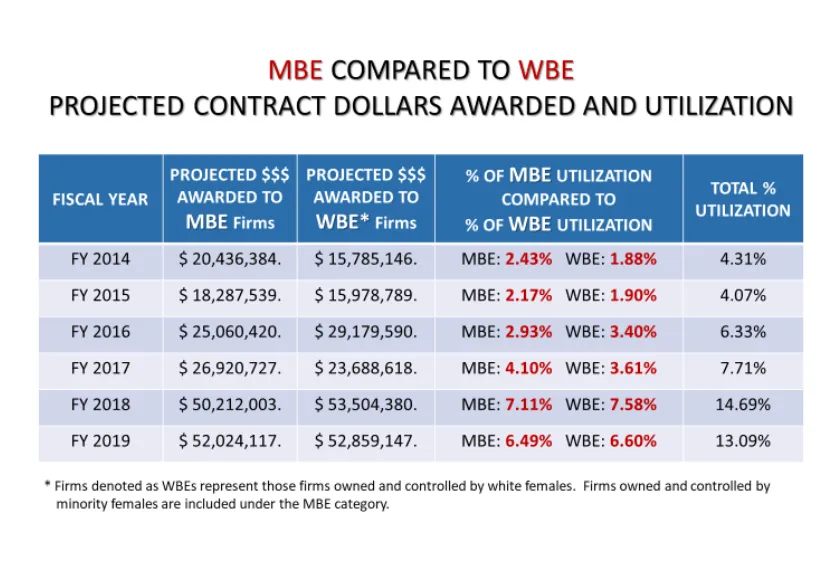
The 15.3% of state contracts awarded to women and minority-owned businesses in fiscal 2022 not only exceeds the 10% requirement but marks the highest amount in the 34 years since the state law was passed, according to preliminary numbers shared with Providence Business News by the R.I. Department of Administration. The high point comes after a year in the state again failed to meet the 10% participation law, with just 7.8% of contracts and purchases awarded to women and minority-owned businesses in fiscal 2021.
Rhode Island's Market Has Changed. Developers, Builders, Investors and Sellers Must Change With It.
By Emilio DiSpirito IV License Partner | Engel & Völkers Oceanside Leader | The DiSpirito…
Learn More
State officials have blamed the low participation in fiscal 2021 on the pandemic. During the first half of that fiscal year, from July 1 to Dec. 30, 2020, the state wasn’t even trying to hit its minimum 10% MBE participation, having had the mandate waived under former Gov. Gina Raimondo as part of an emergency order.
Matthew Sheaff, a spokesman for Gov. Daniel J. McKee, pointed to the more-than-doubling of the share of dollars awarded to these certified minority business enterprises in fiscal 2022 as evidence of the state’s commitment to revamping the program.
“We are pleased that the data shows that the intentional work of this effort is paying off and the governor and his team are committed to continuing this positive momentum for the MBE program,” Sheaff said in an emailed statement.
But some community leaders remain skeptical that a single year of positive data is more than just a lucky break.
“It’s only as good as if we keep it there,” said Rep. Karen Alzate, D-Pawtucket, who chairs the R.I. Black and Latino Legislative Caucus.
Alzate chalked up the fiscal 2022 data to a combination of pressure from lawmakers and community advocates and the windfall of federal stimulus dollars. It’s easier to make sure money goes to businesses of all types when there’s enough to go around, Alzate explained.
Although the state coffers were flush with cash from a budget surplus and American Rescue Plan Act dollars, the actual dollars spent on contracts and purchases in fiscal 2022 was actually less than the year prior, according to DOA data.
About $770 million was awarded in contracts and purchases in fiscal 2022, with $117.8 million going to women and minority-owned businesses. In fiscal 2021, the state awarded $920.4 million in contracts and purchases, though just $71.8 million went to women and minority-owned businesses.
But now that the pandemic has eased and the influx of federal money is drying up, Alzate worries that the state will fall back to its historic pattern of failing to meet the 10% MBE participation law.
“It looks good to say it went up to 15%, but the real work is going to need to happen now,” she said. “We need to make sure this isn’t just pandemic-relief numbers.”
That work, according to Alzate, includes structural changes to the program. Indeed, a state-commissioned report released in 2021 laid bare a host of problems with the program and ways to fix them. Among them: more detailed tracking of the businesses that received state dollars, especially subcontractors; penalties for contractors who fail to include at least 10% participation from MBE subcontractors; and a faster payment system once contracts are awarded.
Tomás Ávila, associate director for the R.I. Office of Diversity, Equity and Opportunity, told PBN in July that the state has been working to tackle many of these recommended changes, including new software to track awarded contracts and subcontracts. Under Avila’s leadership, the state has also looked to the $1.3 billion in upcoming school construction projects as an inroad to boosting MBE participation.
But enforcement remains a pain point. Even Ávila acknowledged in July that punishments had not been happening.
Lisa Ranglin, executive director for the R.I. Black Business Association, is continuing to push for the R.I. Office of the Attorney General to get involved in some kind of sanction against contractors, and the state itself, when the law isn’t met. However, the law mandating the 10% minimum authorizes only the director of administration to enforce it.
Ranglin would like to have a separate office, led by RIBBA and the attorney general, to ensure compliance with the MBE law.
Alzate isn’t sold on the attorney general’s involvement but agrees that lack of oversight is still a problem.
“They have to follow their own regulations and their own laws,” she said. “Right now, there really isn’t any oversight.”
Laura Hart, a spokesperson for DOA, did not respond directly to requests for comment about lack of enforcement by the director of administration. Instead, Hart reiterated the department’s efforts to increase MBE participation through school-building projects, bilingual outreach to eligible businesses and community events.
Alzate, meanwhile, said the Black and Latino caucus ia reviewing possible legislative changes to enhance the program in the upcoming session, though lawmakers had not coalesced around top priorities.
Nancy Lavin is a PBN staff writer. Email her at Lavin@PBN.com.