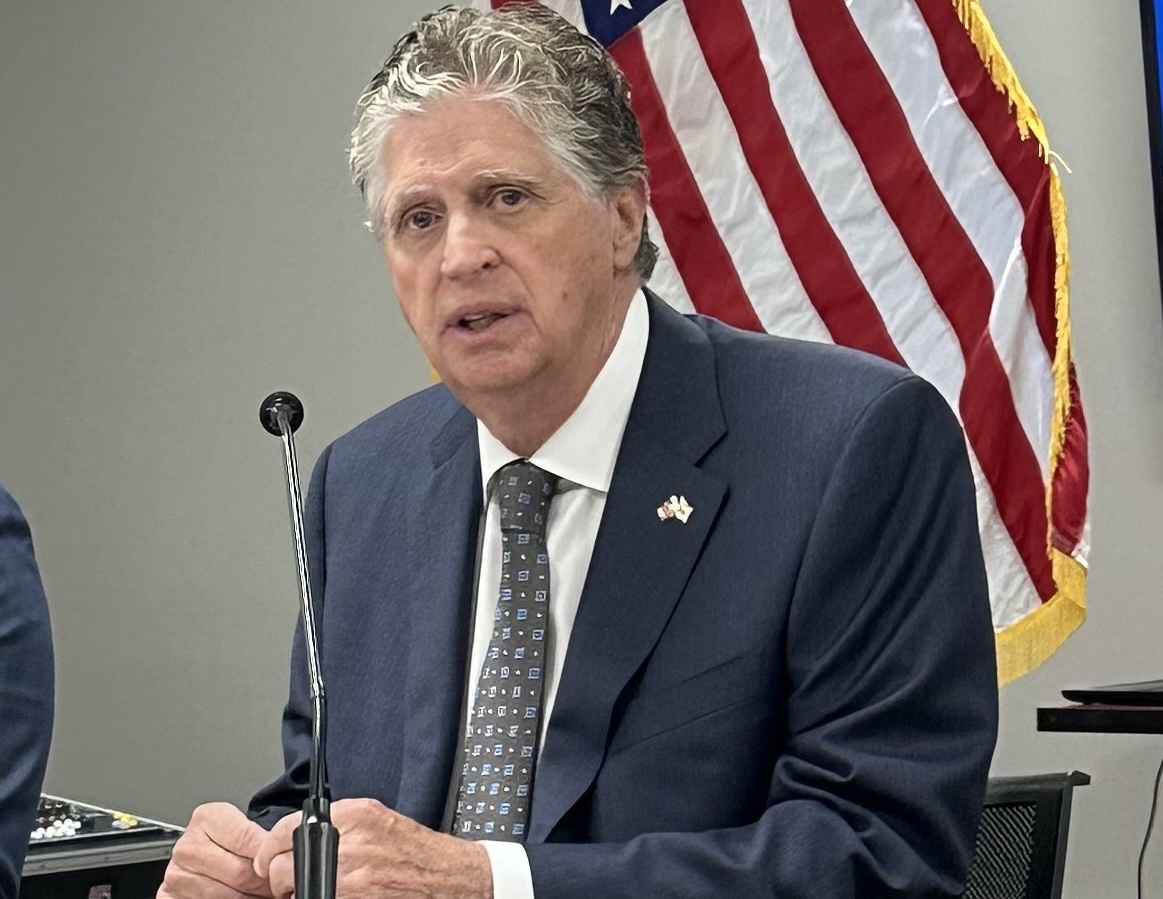
PROVIDENCE – Gov. Daniel J. McKee on Wednesday announced he will not sign nor veto the $14.3 billion state budget approved by Smith Hill lawmakers, saying “it taxes people and raises fees unnecessarily.”
"At this moment in time there wasn’t a need to raise taxes on anyone," he said. “This is a budget I’m not going to sign. This is a bad budget.”
During a press conference at the R.I. Department of Administration, McKee said the budget, which the General Assembly approved on June 20, places an undue burden on Rhode Island residents – from tax and fee raises on cars and health insurance to real estate – at a time of rising costs and uncertainty at the federal level.
In a letter transmitted to the R.I. Secretary of State's office and both House and Senate leaders, McKee, who stopped short of vowing to veto the budget bill, wrote “it is my responsibility to speak up for those without a lobbyist or loud voice on Smith Hill ... As a clear and deliberate statement of my strong opposition to the cost increases it imposes on Rhode Islanders.”
McKee said he decided to go public with his “many concerns” with the General Assembly's approved budget and hopes Rhode Island voters lobby their representatives to reconvene and amend the current plan.
"I’m not folding," he said. "I want the people to know.”
Brian Daniels, director of the R.I. Office of Management and Budget, said the General Assembly's revised budget adds $65 million to McKee's proposal, a growth of 3.8%.
The General Assembly's budget institutes a real estate conveyance tax, raises the parking sales tax and DMV fees, and adds two cents per gallon to the gasoline tax. There is also a 18% spike in traffic fines.
Daniels said the $30 million in additional funding to hospitals will raise healthcare costs $4 per member per month on average at a time when insurers are already seeking to raise premiums by more than 20%.
Asked why he is choosing not to veto the budget, McKee said it was because he has no line item veto and the assembly would override it regardless.
“I deal in the world that is in reality," he said. "We will let the general public determine if they feel as I do. I don’t want to tax people unless I know why I’m taxing them.”
As for what he would have cut if given the chance, McKee cited as one example the gas tax that is designed to increase state funding to RIPTA.
With 18 months before the next gubernatorial election, McKee said the announcement wasn’t political but practical.
“The people need to talk to their General Assembly members," he said.
In response House Minority Leader Michael Chippendale said he agreed with McKee in principle that the approved budget includes too many tax and fee increases.
“I can’t ignore the fact that his own budget proposal in January was packed with similar increases and new taxes,” he said. “It is still unsustainable and ridiculously high.”
But the “well-known tax-and-spend Democrat,” said Chippendale, is responding to sagging polling numbers and the looming election.
“It is transparently political,” he said. “If he truly felt this budget was unacceptable and was acting on principle, he would have vetoed it, not staged a PR move. It takes genuine leadership to make the hard decisions to right-size our budget.”
Former Republican Gov. Donald Carcieri has the distinction of being both the last governor to veto a budget - which he did in 2007 - and the most recent chief executive to allow a revised budget to become law without a signature, which took place in 2010, according to State Librarian Kate Wells.
Wells added that the budget has passed without a governor's signature seven times since 1910, the first occurring in 1960 by Gov. Christopher Del Sesto. Prior to 1910, annual appropriations only required concurrence of the House and the Senate.
House Speaker K. Joseph Shekarchi and Senate President Valarie J. Lawson issued a joint statement pushing back against McKee’s criticism of the approved spending plan. The leaders pointed out its bipartisan support and the months of public testimony they said highlighted “the ways in which the budget submitted in January did not address these priorities and included items that were simply unworkable.”
There were also “major miscalculations” by the administration of the funding needs for items such as public education as well as underfunded collective bargaining agreements inked with employee unions after McKee submitted his proposal.
“We were fortunate that an uptick in revenues was available to cover some of the shortfall,” they said. “But we could not deny that issues such as healthcare, transportation, and housing problems needed sustainable solutions, some of which came in the form of targeted revenue enhancements.”
(ADDS graph 20 with additional background from state librarian.)
Christopher Allen is a staff writer for PBN. He can be contacted at Allen@PBN.com.