When Mass. Gov. Deval L. Patrick named 35 municipalities “Green Communities,” not a single community in Bristol County was among them. It turns out that none applied for the designation, which opens the door to grants for energy projects.
Lisa Capone, press secretary for the Mass. Executive Office of Energy and Environmental Affairs, expects communities from Bristol County would apply for the designation when the commonwealth starts a second round in the fall. It takes time, she said, for communities to adopt changes required to apply for the designation.
“We were sort of pleasantly surprised at the number of communities that got the designation this time around,” she said.
Capone said 38 out of Massachusetts’ 351 municipalities applied for the designation during the first round. Officials deemed three applications incomplete and awarded the rest of the communities the green label.
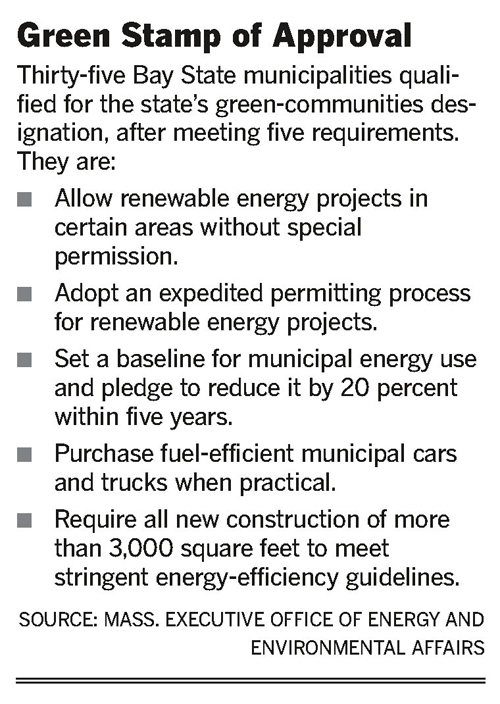
To qualify, communities needed to meet five criteria, including local governments adopting rules to allow renewable energy projects in certain areas without special permission.
In Mansfield, Director of Public Works Lee Azinheira said the town cared about its environmental impact, but its pocketbook only stretched so deep.
“I think a lot of it had to do with the cost and the state of the economy,” Azinheira said, explaining the decision not to apply. “It’s not from lack of wanting to be a green community.”
In New Bedford, the requirement to adopt a new building code – known as the Stretch Building Code – scuttled an application, Mayor Scott Lang said. Lang said he successfully urged the City Council to delay implementing the code until the city could better understand how it would affect developments. Everyone, Lang said, decided they wanted to know how much additional cost the code would put on developers and whether it would scare off investment in the city.
“I didn’t want to get caught sprinting up the ladder without making sure the rungs are there,” Lang said.
He said the city nonetheless is speeding ahead with plans to become more green-friendly. It already counts solar panels on municipal buildings and wants to add more. City officials have also been working to weatherize municipal buildings.
“I think we are doing everything quite frankly and more required to be designated a green community,” Lang said.
New Bedford has requested help from the commonwealth under its planning-assistance program that will help guide it through the requirements for the official green designation. Easton and Fairhaven, also in Bristol County, have also requested the assistance. The three communities are the only ones in Bristol County that applied for such help, according to the Executive Office of Energy and Environmental Affairs.
Meeting the designation requirements wasn’t easy, said Reginald “Buzz” Stapczynski, town manager of Andover, one of the communities that did so.
Stapczynski said town officials, including him, were initially skeptical about seeking the designation. They changed their tune when they saw the potential for grant money and after realizing they were already meeting, or close to meeting, many of the requirements. Stapczynski said Andover was also blessed with a supportive population and enough staff to put together the application.
“If the communities in Bristol County are thinly staffed, if they’re stretched to the max, they’re going to view this as a luxury,” Stapczynski said.
For Andover’s efforts, the state will reward the town with at least $163,000, which it plans to use to install energy-efficient lighting and ventilation systems at municipal buildings. Other communities will ask the state to pay for similar projects.
Communities labeled “Green” had until June 4 to submit their grant requests.
“These 35 cities and towns have already distinguished themselves as leaders,” said Energy and Environmental Affairs Secretary Ian Bowles while announcing the designated communities. “With the help of Green Communities grant funding, they’ll be able to go further – saving energy costs for their residents [and] reducing the environmental impact of municipal operations.”
The $8.1 million in grant money comes from the sale of carbon-emission credits under the Regional Greenhouse Gas Initiative. Emitters of carbon dioxide, such as power plants, are required to purchase the credits and the money flows back to state governments. •