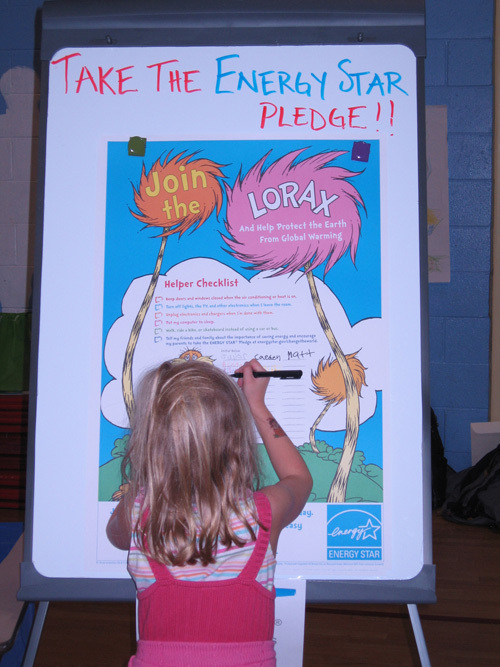
An educated customer is your best customer, or so the saying goes. National Grid is taking that philosophy quite literally in Newport and working with fifth graders – the company’s future customers – to teach them ways to reduce their energy consumption.
The Power to Save program launched in September at Thompson Middle School with the aim of reducing not only the school’s energy bills, but also those being sent to parents. For the last two months National Grid staff has worked with educators to arrange assemblies, introduce lessons, design newsletters and sponsor contests that teach energy-efficiency tips. The state’s largest utility company hopes the tips find their way to dinner table discussions and create a multiplier effect in Newport.
The program marks a departure from the traditional emphasis on a building energy audit, where consultants study lighting levels, insulation and ventilation systems, although Power to Save incorporates an audit as well.
“You don’t just look at the shell of a building or the mechanics of the building,” said National Grid Program Manager Anita Hagspiel, who coordinates Power to Save. “You look at the people coming in and out of the building every day and how they can become more efficient.”
School Principal Eric Thomas said the Power to Save program fit neatly into the school that welcomed about 125 fifth graders for the first time in September. Thomas was looking for ways to engage the school’s youngest students while knocking down the building’s utility bills. A program teaching energy efficiency appeared a perfect fit for the school with 500 students on Aquidneck Island, where three wind turbines dot the landscape.
“I think it’s becoming more and more prevalent and people are talking about [energy consumption] more and this is just a way for us to help with that,” Thomas said.
Earlier this school year Hagspiel showed the film “The Lorax” to the fifth graders to start them thinking about the environment. The film explores the environmental consequences of exploiting natural resources for commercial gain.
At the same assembly she held up a florescent light bulb and students quickly recognized its importance in energy-reduction efforts.
The school also held a poster contest with a green theme. The winners received a trip to Boston to tour a life-size, energy-efficient house brought to the World Trade Center by the U.S. Environmental Protection Agency as part of a national tour.
Every winter he’s reminded about the cost of energy after he turns on his electric heat and then his electricity bill arrives. “Every year it’s like, ‘ouch,’ ” Thomas said. And before the town completely rebuilt Thompson Middle School, Thomas remembers the wholly inadequate heating system in the math wing.
When the rebuilt school opened in September 2002, many of those problems were fixed. But just to be sure, National Grid arranged for a free lighting audit and a mechanical audit. The utility paid half the cost of the mechanical audit, and will pick up the full tab if the school district agrees to implement the recommendations.
Once the report arrives, National Grid staffers write up an “action plan” for the school with a series of recommendations that can range from as little as setting computer screens to automatically turn off when idle, to installing a new boiler. The process is similar to National Grid’s procedure when it analyzes the energy consumption of a business.
The difference here is that the program does not stop at the CEO; it extends to a host of school and town officials, teachers, parents and students.
The program started last year in Millville, Mass. as a pilot. Hagspiel said the program was so successful that National Grid received an outstanding-achievement award from the Association of Energy Services Professionals and management soon decided to continue the program. National Grid selected Thompson Middle School as the first foray into Rhode Island because the utility was already working with the town to find ways to reduce energy consumption at its buildings. Power to Save appeared as a natural extension of that effort, Hagspiel said.
“We’re very passionate about our work and care a lot of about energy efficiency,” Hagspiel said. “I think it’s really refreshing to know that we all believe it is more than project work. You also really need to get people involved. You can put in energy-efficient lighting but you need to be able to shut off the lights as well.” •