For all the talk about renewable energy in Rhode Island, the state’s largest utility is doubling down on natural gas.
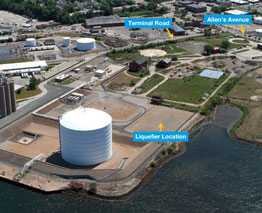
Without announcements or fanfare, National Grid Rhode Island has started construction of a controversial natural gas liquefaction facility at Fields Point on Providence’s waterfront, where the Providence River meets Narragansett Bay.
Construction began in the spring and National Grid expects the site to be in service in 2021.
The utility started work on the estimated $180 million facility after the Federal Energy Regulatory Commission dispelled concerns from local neighborhood and environmental groups and approved the project last October.
National Grid already has a 600,000-barrel liquified natural gas storage tank at Fields Point. But the company successfully argued that a liquefaction facility there is needed to better meet the needs of major customers such as Narragansett Electric Co. (a National Grid subsidiary), Boston Gas. Co., and other gas and utility companies, for at least the next 20 years.
“We’re simply changing the way we fill the existing liquified natural gas tank at Fields Point to provide reliable supply to our customers – going from truck delivery to pipeline delivery utilizing existing infrastructure and then liquefying the gas on-site,” National Grid spokesman Ted Kresse said in an email. “Over time, there will likely be savings in the more-efficient form of delivery.”
Despite studies projecting that demand for natural gas for electricity and heating will wane as wind- and solar-energy farms gain momentum in coming years, FERC concluded: “We will not reject a pending proposal for which a current need has been shown, based on speculation that the project may no longer be needed at some point.”
According to National Grid, the project will not have a direct impact on the public’s electricity rates.
FERC conducted an environmental assessment of the project. But it rejected requests by Save The Bay Inc. and others for a more detailed environmental impact statement to be done, concluding the project would not significantly affect “the quality of the human environment.”
“We don’t really have much recourse” to continue fighting the project, said Topher Hamblett, Save The Bay’s director of advocacy.
Providence Mayor Jorge O. Elorza has called the project “an affront to our city’s climate, energy and racial-equity goals” – the last part referring to predominantly minority, low-income neighborhoods near the site.
Washington Park resident Monica Huertas, coordinator for No LNG in PVD, a group of residents who fought the project, said the group is considering a petition drive to ask Gov. Gina M. Raimondo to stop the project.
“Washington Park has been a dumping ground for Rhode Island,” Huertas said. “We’re not going to let this project just go through” without resisting it.
Scott Blake is a PBN staff writer. Contact him at Blake@PBN.com.