Styrofoam, a Dow Chemical Co. trademark for expanded polystyrene foam (EPS), is one of the most useful materials created in the 20th century, but it also is one of the toughest to get rid of because few landfills, if any, accept it.
A North Smithfield company, however, currently is recycling an average of 40,000 pounds of the foam every month and company owners say they could process more of the material, as much as 80,000 to 120,000 pounds each month. They are looking to develop regular sources of Styrofoam waste from local businesses, individuals and municipalities so they can expand their operation.
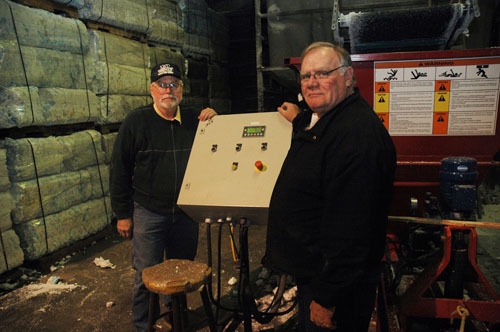
Ron Kollross and David R. Sherman, owners and operators of KWD Inc./ReFoamIt on Great Road, said much of the material they recycle comes in the form of construction waste, such as roofing, insulation and exterior materials. They also obtain leftover Styrofoam from manufacturers that make items such as beverage coolers.
The Kollross-Sherman operation takes the Styrofoam waste, compacts it to make it as dense as possible and then chops the now-hardened and compressed foam into blocks cut at about 48 inches long and about 2 feet wide, weighing anywhere from 75 pounds to 125 pounds per block.
KWD Inc./ReFoamIt sells the recycled material, which is reprocessed usually in the form of pellets to make a variety of synthetic, polymer-based goods, including turf for golf courses, picture frames, interior house moldings and the tough plastic cases that enclose computer components, according to Kollross and Sherman. Buyers include outfits in North Carolina, Tennessee, even overseas in China and Korea, the owners said.
Kollross said he entered the Styrofoam-recycling business about four years ago when someone he knew came up with a small-scale recycling method that Kollross said needed improvement. More volume was needed to justify the expense, he explained. So, Kollross said, he located a bigger machine to compact more foam in a shorter period of time and searched out waste sources to increase the amount recycled. “We created a volume system,” Kollross said.
Adding an eye-opening impetus to their plans was an October public service event at the Grace Congregational Church in Framingham, Mass., where KWD Inc./ReFoamIt sponsored a Styrofoam collection day. More than 100 people attended the event, according to Barbara Sherman, David’s wife, who reported strong interest among the public in getting rid of Styrofoam. “People were collecting Styrofoam for years in their attics. They didn’t want to put it in a landfill because it never breaks down,” she said.
Sarah Kite, director of recycling services at the R.I. Resource Recovery Corporation (RIRRC), confirmed that Styrofoam is not accepted at the state landfill and is not included in any state-sponsored recycling programs. Styrofoam is “the hardest of all to recycle,” she said, because the light, spongy material can easily break into tiny pieces and is tough to collect.
She confirmed that it is not easy to find Styrofoam recyclers. “It is unusual,” she said. “There are not many in the country.” Kollross and the Shermans maintain that their operation is one of the few in the Northeast.
If special collection days or collection points are established in local towns, Kite warned that organizers should make it clear to the public that no food containers would be accepted due to the difficulty of sanitizing them. Kollross and David Sherman say the foam they receive now is monitored because they must watch out for labels, such as those affixed to beverage coolers, and they accept no material used with food.
Manufactured from petroleum, expanded polystyrene foam takes a long time to break down in a landfill, is flammable and can give off toxic chemicals when burned at low temperatures. The recycling rate in the United States for EPS is about 10 percent to 12 percent annually, according to www.greenlivingtips.com, a Web site devoted to protecting the environment. Asked what the best solution is to get rid of Styrofoam, Kite took a hard line, answering: “It is not good to create Styrofoam in the first place.” •
COMPANY PROFILE
KWD Inc./ReFoamIt
OWNERS: Ron Kollross and
David R. Sherman
TYPE OF BUSINESS: Recycling expanded polystyrene foam, also known by the Dow Chemical Co. trademark Styrofoam
LOCATION: 590 Great Road,
North Smithfield
EMPLOYEES: 3
YEAR ESTABLISHED: 2006
ANNUAL SALES: WND
Building a Strong Data Foundation in the Age of AI
Artificial intelligence (AI) has become a key priority in the boardroom and across management —…
Learn More