Data from two oceanic-research vessels soon will regularly stream into the University of Rhode Island’s Inner Space Center in Narragansett. The center’s founder and chief scientist, Robert Ballard, sees it as an opportunity for researchers to learn more about the world’s oceans, and for local businesses to expand on the communications technology that delivers real-time information from the ships to Rhode Island and points around the globe.
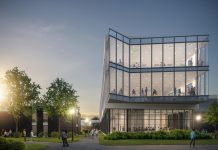
One of the incoming satellite feeds at the center will come from the Okeanos Explorer, a National Oceanic and Atmospheric Administration (NOAA) vessel that will soon call Quonset Business Park home. Last month, officials gathered at the park in North Kingstown to officially break ground for an 8,400-square-foot support center for the ship that formally begins operations next year.
The facility will sit on 1.3 acres of land near Pier One in the park, and the lease with the Quonset Development Corporation (QDC) also includes access to a 224-foot-long berthing space. QDC Managing Director Steven King said NOAA has signed a 10-year lease valued at $6.32 million.
But the real excitement for Ballard was 13 miles down the road at the URI Graduate School of Oceanography. At the Inner Space Center, researchers are ramping up to continuously monitor feeds from the Okeanos Explorer and Ballard’s ship, the Nautilus. And there may be a third ship if the state can persuade the federal government to select Rhode Island as the host for the replacement for the research vessel Endeavor, which currently operates from the URI Narragansett Bay campus.
“This state then becomes a magnet,” Ballard said.
Just as American innovators built on NASA technology that put men on the moon, Rhode Island businesses can turn technology showcased at the center into private ventures, Ballard said.
State officials hope he is right. John Riendeau, the R.I. Economic Development Corporation’s defense-industry manager, said the Okeanos Explorer creates an opportunity for the state to marry private industry, academic resources and federal labs in what is already known as a strong marine-research state.
The ship, presently on shake-down trials in the Pacific Ocean, will officially call Rhode Island home after heavy lobbying by state and federal elected officials. Gov. Donald L. Carcieri urged NOAA administrators in Washington to select Rhode Island, while U.S. Sen. Jack Reed, D-R.I., worked Congress.
“[Reed] really had to fight off some very powerful forces … who wanted the Okeanos Explorer to never see the Atlantic Ocean,” Ballard said.
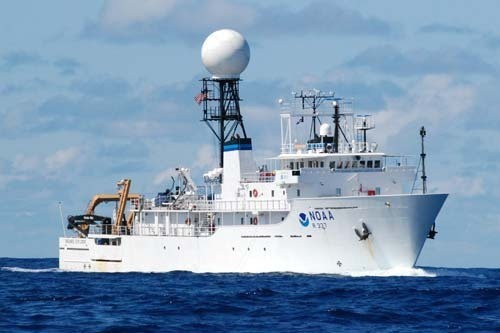
The ship is NOAA’s first vessel dedicated exclusively to exploration. NOAA acquired the ship from the U.S. Navy in 2005 and rechristened the former surveillance vessel as the Okeanos Explorer. The overhauled ship carries a hull-mounted, multibeam sonar system that produces high-resolution maps of the seafloor down to 6,000 meters. Crew will also lower an onboard, remotely operated vehicle (ROV) to explore areas that pique the interest of researchers.
A large, golf ball-shaped enclosure atop a tower on the vessel contains a satellite dish that will send the images up to space, where they can be beamed back to URI and virtually anywhere with an Internet connection. NOAA is also preparing to partner with scientists in Indonesia. Ballard said the partnerships and technology allow NOAA and URI to increase “oceanic literacy” in a world where humans know more about the surface of Mars than the depths of the ocean.
“What’s going to happen now is going to be truly magical,” Ballard said. •