If a child growing up on Aquidneck Island entered kindergarten in the year that Middletown and Newport first broached the idea of merging school districts, they would now be close to shopping for a cap and gown for high school graduation.
That’s why it was a surprise to many when officials from the R.I. Department of Education met with the Middletown Town Council and the Newport City Council on Jan. 12 to further explore an issue that has yet to attain majority support by voters, despite several attempts.
The biggest motivator for the renewed merger efforts is the state’s significantly higher reimbursement rate for construction projects if districts regionalize.
Middletown resident Paul Hafner Jr. moved from Newport in part so his son could attend schools in Middletown and has watched as each community has since borrowed a combined $300 million to upgrade their facilities.
He finds the reemergence of the discussion absurd.
“This makes no sense,” he said. “They have [already] spent almost half a billion dollars on new schools.”
In 2014, Newport voters approved a nonbinding referendum related to creating a unified high school with Middletown to the north. But Middletown struck down the proposal by a 54.4% to 45.6% margin.
Brought back to the ballot again in 2022, the outcome was a reversal of 2014. Newport voters rejected administrative regionalization by a margin of 52.8% to 47.2%.
On the agenda of the Jan. 12 meeting was the potential to put differences aside and dust off the shelved 2022 state legislation that authorized Newport and Middletown to establish a regional school district.
Newport Mayor Charlie Holder said this time around, there should be no half measures. “At the end of the day, we have to have full regionalization,” he said.
Provincial tensions have increased because of a recent battle over bus routing decisions by the R.I. Department of Transportation not to go along with the request of Newport officials to implement truck weight restrictions on Admiral Kalbfus Road due to safety concerns for pedestrians, including students walking to Pell Elementary School.
Middletown officials opposed the restrictions, concerned that redirecting heavy trucks on their roads would create similar safety hazards.
Newport Councilor Ellen Pinnock viewed the debate as a sign of noncooperation and sought assurances that all students receive fair treatment and equal resources.
“How do we make sure that Middletown is looking out for us?” Pinnock asked. “I’m concerned about accountability and equity in this process.”
After running their respective school districts separately for centuries, rising costs and declining enrollment have made the thought of combining efforts – and finances – a tough one to disregard.
Incorporated in 1743, the town of Middletown was born out of anger by northern residents of Newport over what they saw as unjust taxation and unfair treatment, leading to a petition to the General Assembly for independence. The land that Middletown occupies was set apart in 1731.
While families and students today have strong community ties, the town and the city are still at odds over the latest merger plan that could go before voters in November.
The Newport City Council approved a resolution in August requesting that voters reconsider a ballot question on administrative regionalization as early as April 2026.
Supporters argue that the marriage would improve student educational opportunities, save millions of dollars in operational costs, along with boosting state reimbursement rates. The R.I. Department of Education estimates the arrangement would raise the state’s reimbursement for the new Rogers High School in Newport and the addition to the Pell Elementary School from 52.5% to 80.5%.
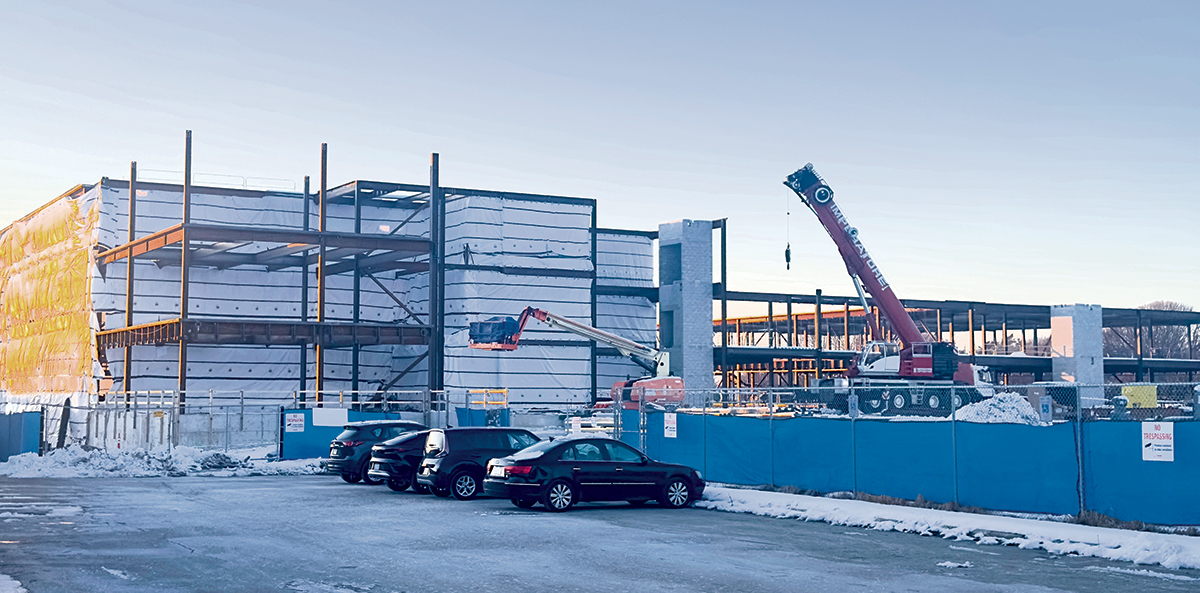
The new Rogers High School was completed in 2024 and opened last fall, while construction is currently underway for Middletown High School and Middle School.
Opponents say other examples of regionalization in Rhode Island have never produced the promised results.
Newport is still responsible for its $108 million school building bond and construction costs that have gone repeatedly over budget. And Middletown will be obligated to pay its $190 million school bond, passed by its voters in 2023.
Newport City Councilor Xaykham “Xay” Khamsyvoravong believes a merger could create more opportunities for students, save money and help address declining enrollment figures.
“Both communities acknowledged the basic fact that our kids aren’t getting the education they deserve,” he said.
Another hurdle is the limited buy-in from the Middletown School Committee, which voted unanimously not to pursue regionalization in August, citing in part the dismal finances of the Newport Public Schools. The school department is currently facing a $3.5 million budget deficit.
The councils opted to continue talks in February.
“I have full confidence in our communities to elect people to make these decisions for us,” said Middletown Town Council member Charlie Roberts Jr. “We are going to have to build trust as two communities. ... Our kids are already regionalized in so many ways. But we need to be clear to the municipalities over what they are voting for.”
A draft memorandum of agreement for a “Newport County Unified High School” from December 2013 included the line: “It’s not about the money. It’s about the kids.”
But Newport resident Penelope Hunt raised questions about the implications of bond debt assignments across communities.
Hunt, who made an unsuccessful bid for the Newport School Committee in 2024, said that money matters.
“Is it feasible for taxpayers in each community to pay for different scopes of work? I see that as a major hurdle,” she said.