When the average person hears the phrase, “the Bay Area,” their thoughts typically turn to San Francisco Bay.
Ben Sorkin, CEO of Flux Marine Ltd., wants to disrupt that conversation.
“My dream is that, when people start talking about the Bay Area, the next question is, which one?” Sorkin said.
Daniela Fairchild, chief strategy officer for the R.I. Commerce Corp., holds the state and its innovation potential to a similarly lofty standard.
“We hear it as the Silicon Valley of … the blue tech ocean economy,” Fairchild said of the growing Rhode Island sector.
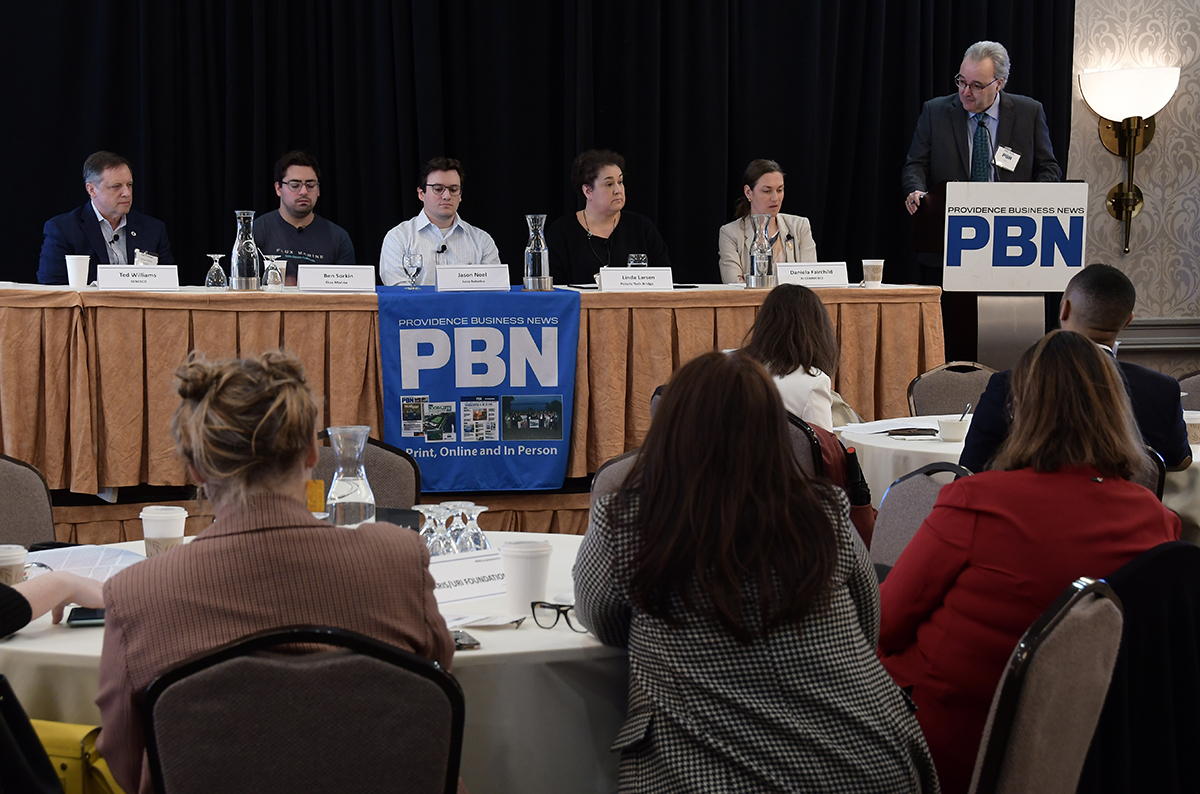
Sorkin and Fairchild spoke on a blue economy panel at Providence Business News’ 2026 Emerging Industries Summit, which took place March 11 at the Providence Marriott Downtown.
The panel discussion also included Linda Larsen, maritime and industry engagement manager for Polaris Tech Bridge; Jason Noel, operations executive at Juice Robotics Inc.; and Ted Williams, president of Senesco Marine LLC.
Fairchild backed her high ambitions for the state’s blue economy with a competitive federal designation. In 2023, a Rhode Island and Massachusetts partnership, the Ocean Tech Hub, won designation as one of 31 federally designated tech hubs under an initiative by then-President Joe Biden, and was the only such hub dedicated to maritime autonomy.
Rhode Island and Massachusetts officials celebrated the Ocean Tech Hub’s rise to the top of a pool of hundreds of tech hub applicants. But the mood dimmed the following year when the partnership missed out on funding from a $504 million grant round, which leaders had eyed as a major source of financing for the extensive blue-economy projects and infrastructure that they had outlined in the hub’s original proposal.
[caption id="attachment_519319" align="aligncenter" width="1200"]

Ted Williams,
Senesco Marine LLC president / PBN PHOTO/MIKE SKORSKI[/caption]
With former R.I. Gov. Gina M. Raimondo serving as U.S. commerce secretary at the time, some in the Ocean State took that development as a particularly heavy blow.
Though acquiring the money to make those proposals a reality has required more leg work than many may have anticipated, Fairchild said the Ocean Tech Hub has forged ahead. Recently, she added, it was one of 11 tech hubs declared eligible to apply for up to $50 million in additional funding.
The Rhode Island-Massachusetts partnership has also pieced together funding from investors within the region.
“The [tech hub] designation itself has led to a lot of scale and capacity-building locally,” she said. “We’ve seen a lot of investment locally, then there’s still opportunity for more federal engagement.”
Williams said Rhode Island’s ease of access to the ocean doesn’t mean that building up the blue economy is all smooth sailing.
Employers in the burgeoning Ocean State industry currently contend with a skills gap, he said. All of Senesco Marine’s propulsion systems, for instance, are imported.
For “all of these vessels, we’re getting the propulsion systems from Europe,” Williams said. The ability to build these essential components is “not a skill set we have in the U.S.”
Other coastal areas of the U.S., like the southeastern seaboard, have meanwhile fostered a workforce that enables local production. But with Rhode Island’s high cost of living, it’s hard to coax those skilled workers north.
Meanwhile, Williams added, the West Coast of the U.S. leads Rhode Island in production of hybrid and electric vessels.
And building this workforce locally will take time.
“I don’t turn a shipbuilder into a shipbuilder overnight,” Williams said. “It takes three to five years to get someone competent enough to be able to work on these vessels. So where do they come from? That’s the big challenge.
“I know there are a lot of great opportunities that we’re working on in Rhode Island,” he continued, “and we’re getting there, but it’s a problem.”
Larsen said industry leaders need to take advantage of the area’s higher education landscape to amend this skills gap but must also partner with institutions in other areas of the U.S.
She highlighted the state’s RISE-UP program – a collaboration between the University of Rhode Island Research Foundation, the University of Alaska Fairbanks and the University of Hawai‘i – as a leading example.
Noel said Rhode Island leaders need to shift the state’s reputation as a “vacation state” to become more expansive.
“People kind of have this idea of Rhode Island that it’s this vacation or living state,” Noel said. “We’re stuck in between Boston and New York but don’t seem to benefit from this proximity.”
And while Rhode Island may be home to workers who live in those states, he said, they seem more reluctant to base their businesses in the Ocean State.
“Those kind of [places] attract the money,” Noel said of neighboring cities. “Those attract the big business. And Rhode Island, while it’s on the way between those two, doesn’t really seem to get a lot of those benefits.”
But amid the challenges, Sorkin doesn’t take Narragansett Bay for granted. On days when he has to commute from the company’s North Kingstown facility to Providence, he typically travels on one of the electric boats designed and built by his company.
While Sorkin appreciates the relative solitude of the route – a far cry from the congestion that vexes drivers on the Washington Bridge and other major roadways – he can’t help but feel some dismay that it’s often just him and the occasional quahog fishing boat as he travels up Narragansett Bay.
“There’s so much incredible coastline,” he said. “I would love to find a way to enable more people to use boats.”
RI is a great state but we need to lower the taxes and make it more business friendly.
I agree with with Paulette. But as important is improving our education infrastructure with an eye toward the blue economy and associated technology, particularly the K-12 public schools in our state.