The smallest state in the nation – just 37 miles wide, east to west – is home to eight separate bike paths, from Quonset to Woonsocket, totaling 54 miles of paved trails. Plans are in the works for two more in Newport and an extension of the Blackstone River Bikeway into Pawtucket, although construction could be some years ahead in both cases.
Rhode Islanders clearly love their bike paths, though their impact on the economy so far has been limited in most cases to small operations such as ice cream shops and bicycle stores, which cater on a seasonal basis to the bikers, hikers and joggers.
Robert Foulkes, co-owner with his wife Helen of East Providence Cycle on Warren Avenue, not too far from the East Bay Bike Path, reports that about half of his daily bicycle rentals are to folks traversing the 14.5-mile bikeway that runs from Providence to Bristol.
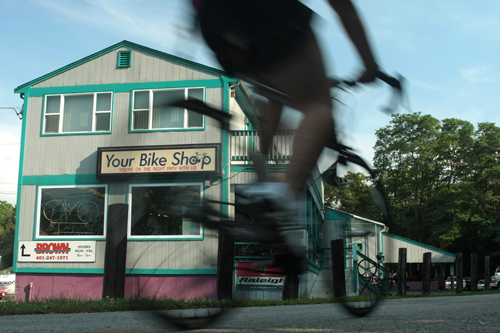
The family-owned cycle shop, however, dates to 1951 and was in existence long before any of the modern bike paths, Foulkes said. He could not estimate how much of his business is dependent on the bike path, but said it is “logical to conclude” that the more people biking, the better it is for his business and others like it.
“We do get a lot of bikers” at the Daily Scoop, an ice cream shop in Warren located right off the East Bay path, said Ari Abram, a two-year employee. Most of the bicyclists are families that stop for ice cream or lemonade and usually they don’t spend a lot of money. “We’re toward the end of the bike path, so they stop for ice cream and then they keep on biking,” she said.
Even a larger business like Shaw’s Supermarket on County Road in Barrington benefits from the cyclists, although again only to a small extent. “It helps, it’s good,” Steve Carter, a manager at the store, said of the nearby bike path. “People stop by and grab things, quick impulse purchases. You can see them in their bike shorts and helmets,” he said.
Robert D. Billington, president of the Blackstone Valley Tourism Council and a frequent user of the bike paths, said he knows of only two businesses that have set up shop as a result of the Blackstone Valley path, one in Woonsocket and one at the Cumberland/Lincoln line in Lonsdale. “They’ve seen the future, and they’re moving toward it,” he said of the two.
“We really haven’t done that well, the opportunity is so vast,” he said. “We’re getting to the point now where people [on the bike path] are going to require things,” such as refreshment, bathrooms or help with blown bike tires.
One of the businesses cited by Billington is Blackstone Valley Outfitters, owned by Don Martin and Mark Pawlitschek, which opened in 2006. “As the popularity of the bike path grows, I see more families walking into our store to check us out and buy gear that fits their needs,” Martin said. The store runs guided tours of the bikeway for schools and day camps and hopes to add its own day camp program next year.
Now located in a shopping plaza at 2 Mendon Road in Cumberland, the business is moving around the corner to a former factory at 25 Carrington St. in Lincoln – still close to the bike path.
Local real estate professionals say the bike paths can be a selling point. “It would depend on the property in each particular incidence, but if I were selling a property along a bike path, I’d certainly be touting that as a marketing feature,” said Paul Leys, president of the Warwick-based Rhode Island Association of Realtors.
The value of a property for sale can depend on many factors, but in general, proximity to a bike path would be “a decided plus,” said Carol Wardwell, office manager at the Harper, Ramos and Sheridan agency in Bristol.
River Lofts at the Ashton Mill Apartments in Cumberland, a 197-unit apartment complex where monthly rents range from $914 to $1,700, includes the nearby “bike/run path” among the amenities listed on its Web site, along with a fitness center and outdoor barbecue.
“It definitely does help us,” Katelyn Singleton, leasing consultant, said of the bike path. “We get a lot of people [from the bike path] coming in to take a tour of River Lofts and they end up renting here. If we were located a couple of miles away, they wouldn’t be looking at us.” She says River Lofts, located in a former Fiberglas factory, is 90.2 percent occupied.
The East Bay path ranked fifth behind trails in Virginia, Massachusetts, Florida and Washington state, with 1.1 million users per year, the conservancy said. (The state’s population, as of a July 2008 census estimate, was slightly smaller, at 1,050,788.)
Through June of this year, 166,239 people have been to the Blackstone Valley Visitors Center on Interstate 295 in Lincoln that is located near the bike path, according to figures supplied by Robert J. Paquette, chief of the division of parks and recreation with the R.I. Department of Environmental Management (DEM).
However, in addition to bike path users, the figure includes other visitors such as patrons of a coffee shop inside the 24/7 center and truckers who park in its truck stop. The Blackstone Valley path currently runs 11.6 miles from River’s Edge Park in Woonsocket to Cumberland Town Hall at the Central Falls line.
Larry Mouradjian, associate director of natural resources at DEM, said his department has no figures on usage of the two bike paths under its care – Blackstone Valley and East Bay – but asserted that they are “extremely popular.”
A 2002 Bicycle Transportation Survey conducted by the University of Rhode Island in cooperation with the R.I. Department of Transportation found that visitors to bike paths in the state come from all age groups and all parts of Rhode Island. “In fact, 99.12 percent of respondents answered ‘yes’ when asked if bike path construction constituted a good use of tax dollars,” the report said.
The paths are used mostly for biking and walking, with most people using the paths more than 30 times per year and spending one to two hours each visit. The most popular time for use of the paths was weekends in spring, summer and fall. “The economic impact of the paths was minimal,” the report said, citing a 1996 East Bay survey that said 88 percent of path visitors spent an average of $5 per outing, most commonly for food or drink. •