Despite the state’s ongoing shortage of primary care providers, Rhode Island’s largest health system has seen success in recruiting doctors from surrounding states. However, other practices are struggling.
Brown University Health can offer primary care physicians, nurse practitioners and physician assistants salaries and benefits that are competitive with those offered in western Connecticut and the Boston area, said Dr. Edward McGookin, chief of primary care at Brown Health Medical Group Primary Care, formerly known as Coastal Medical.
But he acknowledged the health system’s success is not enough to cure the state’s weakened ability to attract and keep health care workers.
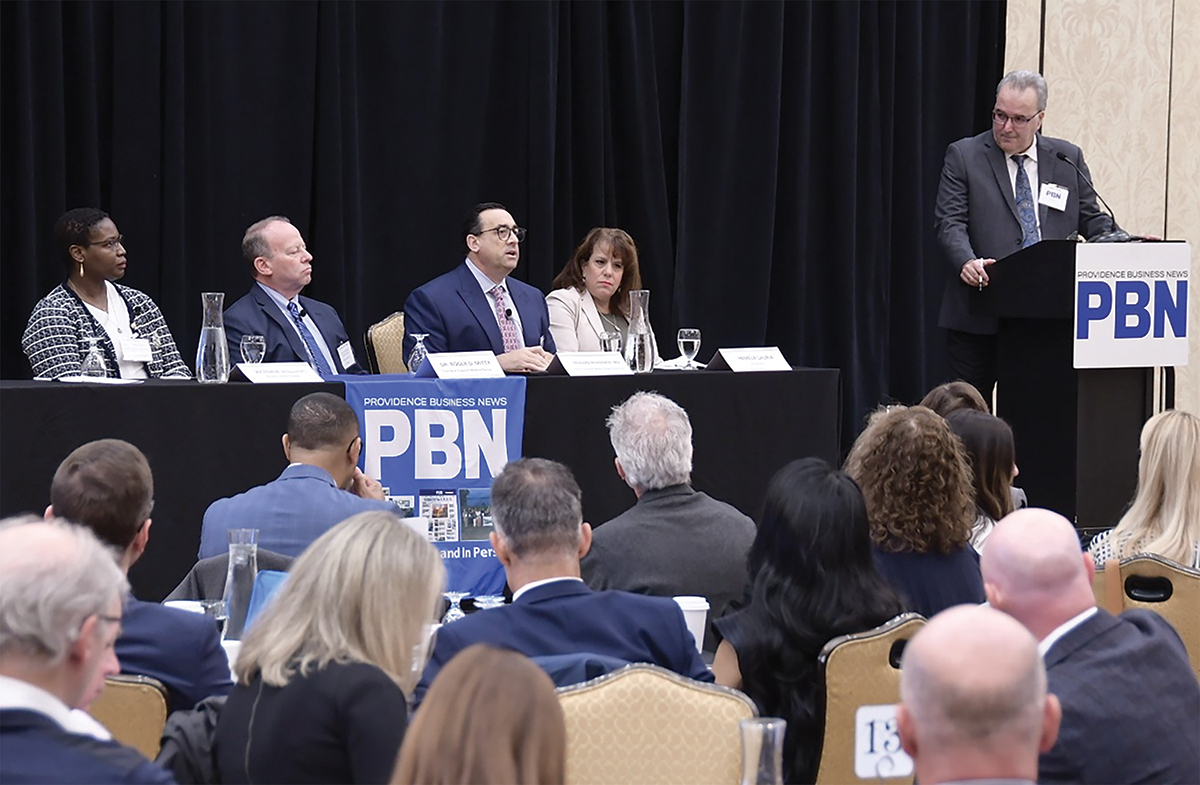
“We need to find a way to make recruitment better for everybody, and that doesn’t even bring us to the issue of retention,” McGookin said Oct. 30 during Providence Business News’ Fall Health Care Summit: Shaping the Future of Care held at the Crowne Plaza Providence-Warwick.
Troubles with recruitment and retention are especially true given that Rhode Island’s Medicaid reimbursements are lower than Massachusetts, putting financial strain on Ocean State practices.
McGookin said he has seen doctors make $130,000 more in base salary in Massachusetts than in Rhode Island.
“While people may love living here, we need to make it easier, more affordable to work here,” he said.
McGookin was one of four panelists who discussed several topics pertaining to the state of health care in Rhode Island, including access to primary care, legislative and policy changes, workforce development and continuing education. A second panel discussion focused on the rising costs of health care insurance, the persistence of health care inequality and where the state stands on addressing substance abuse and access to mental health.
Fellow panelist Dr. Roger Mitty, president and chief operating officer of Care New England Medical Group LLC, said people of all professions – including health care – respond to incentives. And if the state wants to boost the number of primary care providers, the salaries need to be higher or there must be assistance to make their jobs easier.
It’s difficult for practices in the state to offer higher pay right now, but Mitty said Care New England has invested in ways to lessen primary care doctors’ administrative burdens.
Along with seeing and treating patients, doctors also have to spend time documenting patient notes, which can be time consuming, especially for doctors who have a roster of as many as 1,500 to 2,000 patients. So, Care New England began using artificial intelligence technology that records and takes notes on patient visits for doctors, Mitty said.
Victoria Williams, assistant professor of health care administration at Rhode Island College, also said it’s important to look at how other states have been recruiting and retaining doctors.
“If we want to be the best, if we want to innovate, we have to look outside to see what other places and other states are doing as well,” Williams said.
Sen. Pamela Lauria, D-Barrington, who has also been a nurse practitioner for 28 years, also noted that research shows primary care providers are more likely to practice in the state where they were trained.
The state has been working to increase its ability to train primary care doctors by establishing a Primary Care Training Sites Program within the R.I. Department of Health. The program was created by the General Assembly in 2024 and offers grant funding for primary care practices to expand their ability to train doctors.
During the most recent legislative session, state lawmakers also raised Medicaid reimbursement rates to match Medicare rates for primary care services. And lawmakers added a primary rate review to be completed by R.I. Health Insurance Commissioner Cory King by September 2026, as opposed to the original deadline of 2027. These changes to Medicaid are “incredibly important,” Lauria said.
Also, Lauria pointed out that the state is one of two in the nation without a public medical school. But state leaders are assessing the possibility of establishing a public medical school at the University of Rhode Island. A feasibility study released in October said establishing the school is “viable” and “necessary” to address a looming primary care crisis.
Lauria, a member of the commission studying the feasibility of the medical school, said the economic benefits that come with the school outweigh the costs of establishing and operating the school, which are estimated to include $175 million in startup costs and $22.5 million annually from the state.
“We punch above our weight as far as people wanting to go to medical school,” Lauria said. “Obviously, these are difficult economic times for the state, but I believe there is a path where this is economically feasible.”