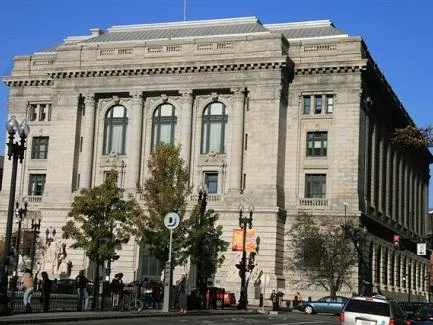
A quartet of performing arts groups has won a legal faceoff with the National Endowment for the Arts after a federal judge in Providence found the agency flouted free speech rights.
In his Sept. 19 ruling, Senior U.S. District Judge William E. Smith in the U.S. District Court for the District of Rhode Island agreed with most, but not all, legal arguments brought by four arts organizations filing suit against the feds in March over imposing grant funding conditions based on artwork content.
Your Business Has Gone Global. Has Your Insurance?
A decade ago, “doing business internationally” was mostly a large-company concern. Today, a manufacturer in…
Learn More
Smith vacated an NEA “Final Notice” on grant policy as it “promises to penalize artists based on their speech,” especially if those applicants feature LGBTQ+ content in their projects.
Marta V. Martínez, executive director of Rhode Island Latino Arts, the lead plaintiff organization and the only one based in Rhode Island, cheered the ruling in a statement: “This decision affirms what we have always believed: the freedom to create, to express one’s truth, and to tell our stories is a right protected by the First Amendment.”
The other three plaintiffs are National Queer Theater, Boston’s The Theater Offensive, and Theatre Communications Group, a New York-based member organization which counts more than 500 theaters among its members.
Smith, a George W. Bush appointee, found that the federal agency violated the First Amendment and the Administrative Procedure Act in its application of Executive Order 14168, which was signed by President Donald Trump on Jan. 20, his first day back in office. Among the order’s provisions are a ban on using federal money to “promote gender ideology.”
That “ideology” is one which avoids a gender binary and “[replaces] the immutable biological reality of sex with an internal, fluid, and subjective sense of self unmoored from biological facts,” according to the order.
Smith set aside the NEA Final Notice, which stops the agency from using the policy to discriminate against or disfavor applications for projects which could fall under the administration’s ideological label – a concern for plaintiffs, who regularly produce content showcasing LGBTQ+ narratives or lives, which are often at odds with the order’s notion that “sexes are not changeable and are grounded in fundamental and incontrovertible reality.”
Smith ruled that the NEA is barred from requiring plaintiffs to comply with the executive order if they receive grants. The plaintiffs can request broader relief within 14 days. The feds have seven days to respond after that, with the plaintiffs given another seven days to follow-up on the feds’ response.
In February, the NEA added new language to applications for its most popular variety of competitive subsidy, Grants for Arts Projects, which funds works across media including the performing arts. The NEA added a compliance checkbox to applications and asked applicants to certify that any grant funding they received would not be used for projects involving so-called “gender ideology.”
The NEA’s maneuver kicked off a legal challenge in Rhode Island’s federal district court, with lawyers from the national and local ACLU banding together to represent the four arts organizations.
NEA funding has helped subsidize productions like those by plaintiff The Theater Offensive, which bills itself as making “liberating art by, for, and about queer and trans people of color that transcends artistic boundaries, celebrates cultural abundance, and dismantles oppression.”
Such art could be denied grants under the NEA’s modified policy, so the artist groups worried they would either need to forego funding or change their plans for productions — which are often shaped months in advance — to match the new policy. Plaintiffs also worried about potential legal repercussions if they certified compliance while still producing LGBTQ+ content.
The legal challenge prodded NEA to remove the compliance checkbox, but the agency also argued it hadn’t instituted any final rules yet.
Smith’s latest judgment follows his April 4 decision in which he denied the plaintiffs preliminary relief and allowed the NEA to carry out its administrative process. The case, originally filed in March, sought to stop the NEA from instituting the guidelines ahead of an April grant application deadline. The moment was premature, Smith wrote in April, and the court could not disallow the NEA from taking an action it had not yet taken.
“Because that process has since concluded, this consideration no longer applies,” Smith wrote in his latest ruling. “And the public interest is not on the government’s side when it uses a program designed to promote free expression to squash it instead.”
The court did deny the plaintiffs’ Fifth Amendment-based claim that the applications’ language was “unconstitutionally vague.”
Smith said the NEA might engage in arbitrary or discriminatory enforcement by having the chairperson exercise final control of Trump’s mandate. That might indeed contradict free speech or administrative procedure laws, Smith wrote, but the government’s admission of the chair’s intent isn’t vague, but specific.
After Smith’s last ruling, on April 30 the NEA finalized its new policy and redirected the power to adhere to Trump’s order to its chairperson.
A July 16 cross motion signed by Assistant U.S. Attorney Kevin Bolan outlines the feds’ case and describes how the agency implemented the order, and that “the NEA rejected a categorical application,” Bolan wrote.
“Only the Chair would consider whether a given project might ‘promote…gender ideology,’” Bolan wrote. He cited earlier NEA court documents which claimed, “If the NEA Chair concludes that a proposed project ‘promotes gender ideology,’ that factor could weigh against the project’s final approval.”
Projects would be reviewed on a “case-by-case” basis by the chair, the motion states, and the chair would not be reviewing applications until October. Furthermore, the government can consider value judgments and exercise discretion in providing competitive subsidies like NEA grants, Bolan wrote.
Underlining the federal rationale in court is that the NEA’s grantees produce government speech – a category not shielded by the First Amendment.
“First, no one could mistake the NEA’s funding decisions as private speech,” Bolan’s motion stated. “The very existence of the NEA as a federally funded grant-making body that implements a structured competitive process shows that only the government is speaking.”
Yes, Smith agreed broadly in his ruling: “There is no question that, historically, art has been used as a medium to communicate the government’s messages and that often the government has relied on the work of private artists to achieve that goal.”
The judge continued, “But the Court is wary of painting with too broad a brush.”
That’s because NEA has always functioned as “a vehicle for private expression” since its inception in 1965, Smith wrote, and was not intended as “an instrument of political communication.”
Amendments made to the agency’s statute in 1990 followed a controversial season in which two NEA-funded exhibitions – one which included “Piss Christ” by Andres Serrano, and the other a retrospective of works by gay male photographer Robert Mapplethorpe – led Congress to add an obscenity clause to the NEA statute.
The feds argued that this revision of law only reinforced the idea that the public knows the NEA is government speech.
“[E]nough of the public knew what NEA funding meant to motivate Congress in 1990 to amend the Act based on only two photography exhibitions,” the July motion reads.
But that obscenity clause received a different treatment from Smith, who wrote that it only furthers the idea that “Congress intended to preserve the NEA as a vehicle for private speech, despite the potential for public controversy.”
“[T]he Court finds it unlikely that members of the public would think that NEA-funded artists speak for anyone but themselves, and certainly not for the government,” Smith wrote. “That is especially true given the diversity of views reflected in the projects that the NEA – even when accounting for changes in presidential administrations – has decided to fund.”
“In short, the government may speak for itself when it approves an artist’s work, but that does not mean the artist speaks for the government when it produces that work,” Smith wrote.
The NEA did not respond to a request for comment.
Alexander Castro is a staff writer for The Rhode Island Current.