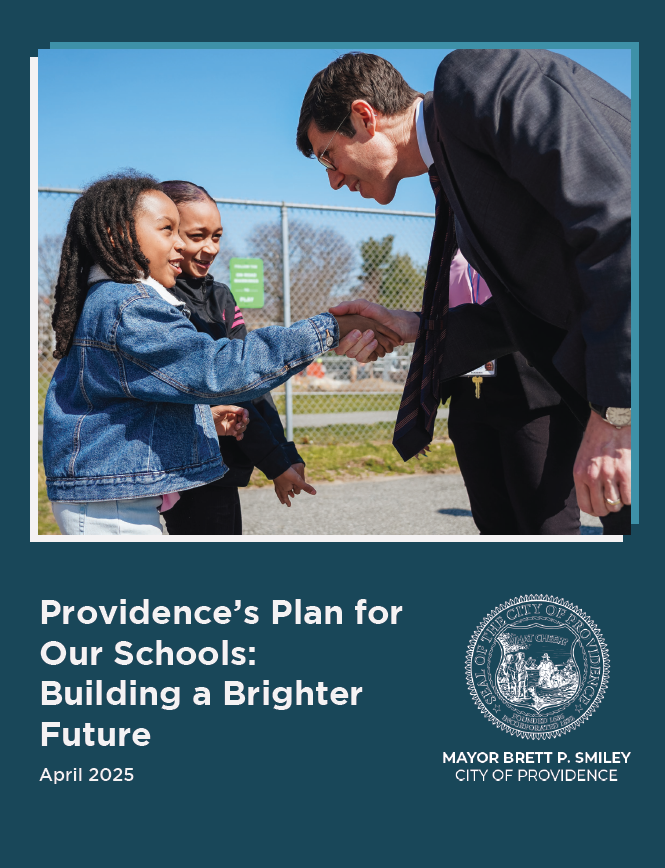
PROVIDENCE – City and school leaders on Thursday unveiled their turnaround action plan for the Providence Public School District in its push to bring the city’s schools back under local control after being under state intervention
since November 2019.
The new plan, brought forth by Mayor Brett P. Smiley, City Council Pro Tempore Juan M. Pichardo and Providence School Board President Ty’Relle Stephens, outlines several priority actions both PPSD and the city need to meet to get the schools back from the R.I. Department of Education by 2027, if not sooner.
The 65-page plan, titled “
Providence’s Plan for Our Schools: Building a Brighter Future,” notes eight priority actions: Community Engagement; Supporting Learning at PPSD; Funding, Finances and city of Providence Budget Support; Supporting Talent at PPSD; Procurement; Data and Data Management Systems; and Facilities. The plan was made through community collaboration with students and their families, city and school leaders.
Smiley on Thursday told reporters at the Zucculo Recreation Center the sense of hope within the city and school community is high and everyone is “more eager than ever” on collaboration to make the transition work. He also called this plan a “turning point” for both the city and PPSD and are “determined to get it right.”
“[Everyone] is eager for greater transparency, and we all want a greater and renewed focus on student success,” Smiley said. “We will continue to expand outreach efforts to guarantee that families and caregivers are meaningfully included in the decision-making process.”
One notable education piece in the plan is for PPSD to support implementation of the Pre-kindergarten through 8 school model. With this model, the plan states students’ continuity with the same learning community and in the same school building “will help improve student outcomes and increase student achievement” in middle school.
According to the plan, research indicates that one of the key strengths of the Pre-K through 8 model is that this approach allows middle school academic interventions to be implemented with “much more fidelity” than in traditional middle schools that serve students in grades 6-8. The plan also calls for more support for city-wide summer and afterschool programming, special education services, additional services for multilingual learners and committing to universal pre-K.
Unlike
the 2020 plan unveiled by RIDE and then-Providence Superintendent Harrison Peters, the new plan does not mention which education benchmarks need to be hit for the district to be returned to city control.
Regarding funding the district, the city, according to the plan, is committed to “exploring private funding opportunities” to complement federal, state and city investments in education and especially priorities relating to after-school and summer programming. When the city gets the schools back, both PPSD’s and the city’s respective grants teams will collaborate for “more impactful grant proposals and grant management” to support PPSD, the plan states.
On supporting the district’s teachers and staff, the plan calls for PPSD to remove seniority-only mandates to help advance faculty diversity within the district. Rhode Island, the plan says, is one of the few states that still maintains seniority-only mandates for educators. Plus, gains in diversity “may be eliminated” through layoffs based exclusively on seniority, according to the plan.
The plan also recommends PPSD to introduce a pay scale that allows for career-level pay sooner and additional compensation for educators with dual certifications, offering educators more competitive wages. Additionally, the city, per the plan, will explore providing a higher stipend for educators with dual certification, including educators with certification in special education and multilingual learners and ensure that these stipends account for inflation and cost-of-living.
The new plan’s unveiling comes two months after state elected and education leaders announced
a “Path to Local Control” plan, outlining from the state’s perspective what needs to occur for PPSD to be given back to the city. That framework R.I. Education Commissioner Angelica Infante-Green outlined for the city to get its schools back at that time, among other requirements, includes the city agreeing to “fully honor”
the settlement agreement between PPSD, RIDE and the city to increase local school funding by the same percentage as state aid. The state’s plan also requires the city to publish a transition plan for PPSD – which was the case Thursday.
Also, last month, seven state representatives
filed legislation within the R.I. General Assembly calling for PPSD to return to local control as soon as this summer. If passed, the legislation would “nullify” the R.I. Department of Education’s plan to keep PPSD under state control through 2027.
“By working together, we can react to what we heard loud and clear: It’s time to bring our schools back,” Smiley said, “and they need to come back with improved community engagement.”
James Bessette is the PBN special projects editor, and also covers the nonprofit and education sectors. You may reach him at Bessette@PBN.com. You may also follow him on X at @James_Bessette.