Imagine pulling your car into your garage, unwinding an extension cord and plugging your car into an electrical socket. The next day you drive to work and repeat the process, but this time at your employer-owned charging station. Ultimate cost of commuting to work: pennies on the dollar compared to a car with an engine running solely on gasoline.
Such a scenario is not a pipedream, says a coalition of Rhode Island environmental groups, utilities and public officials that have formed under the umbrella of Project Get Ready, to promote plug-in electric vehicles in Rhode Island. The group’s goal is to put 10,000 of the vehicles – equal to 2 percent of the state’s registered vehicles – on Rhode Island roads within five years.
“We have an opportunity,” said Albert Dahlberg, coordinator of the Rhode Island affiliate of Project Get Ready and director of state and community relations at Brown University. “Now, we have to pull all the stakeholders together.”
Plug-in, all-electric vehicles utilize a battery in lieu of a gasoline engine. Plug-in, hybrid vehicles contain more batteries than a conventional hybrid and typically allow local all-electric, zero-emission driving. An internal combustion engine kicks in for longer distances. Proponents argue vehicles charged with electricity receive better mileage and emit fewer greenhouse gases than pure gasoline-powered vehicles.
Dahlberg and Abigail Anthony, a policy analyst for coalition member Environment Northeast, say the pieces are coming together to move plug-in vehicles from the drawing board to American garages. The governors of 11 Northeast and mid-Atlantic states, including Rhode Island and Massachusetts, agreed in December to work toward a low-carbon fuel standards program that, if implemented, would likely drive up the cost of traditional gasoline.
Project Get Ready will lobby lawmakers, companies and average citizens to support the infrastructure necessary for plug-ins. The group wants charging stations, tax credits for vehicle purchases, participation in low-carbon fuel standards, loan guarantees for retrofitting vehicle assembly lines to support the hybrids, and utility standards for delivering the electricity required.
Independent think tank Rocky Mountain Institute launched Project Get Ready in February 2009 and has since expanded to nine cities and Rhode Island. The institute provides a policy framework that Dahlberg took and modified to fit Rhode Island. He also brought on partners like Providence Mayor David N. Cicilline and National Grid.
For National Grid, the project represents the potential to accomplish many goals at once, said Ron Gulmi, manager of new product and service and development.
“As the electric and gas provider and major energy provider, it’s a key platform for us for carbon reduction and energy efficiency and at the same time provides potential for revenue,” Gulmi said.
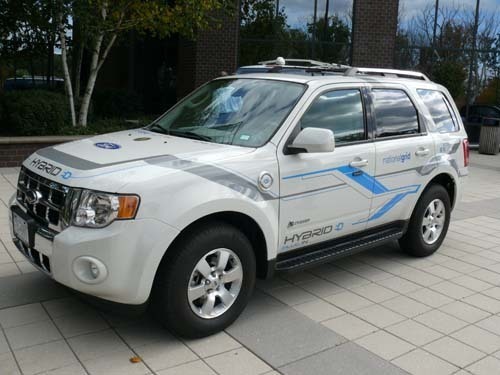
National Grid plans to bring a demonstration plug-in, hybrid Ford Escape to Providence to coincide with the Northeast International Auto Show, which starts Jan. 21 at the R.I. Convention Center. Ford and National Grid tout the Escape as achieving 120 miles per gallon after a charge via a standard home electrical socket.
Gulmi said utilities like National Grid would likely need to persuade lawmakers to allow changes in how the grid operates and how customers pay for electricity to encourage charging vehicles during off-peak hours.
National Grid and its partners will also need to win over consumers leery of the potential upfront costs of plug-in vehicles. Anthony estimates that operating a plug-in vehicle like the soon-to-be-introduced Chevy Volt will cost about $1,500 annually compared to a traditional SUV, which costs about $4,600 a year. Besides purchasing less gasoline, owners of plug-in vehicles will also save on maintenance costs because plug-ins typically contain fewer parts than their gasoline cousins, proponents say.
Anthony and Dahlberg add that Rhode Island in particular is perfectly situated for a fleet of plug-in vehicles. The state is geographically small and Rhode Islanders tend to have relatively short commutes when compared with people in larger states. That means Rhode Island commuters can get to and from work on a single charge. And if Project Get Ready can persuade companies to install charging stations at work, commuters could “fill up” while at their desks.
Anthony and Dahlberg say the vehicles could also create a multiplier economic effect. Licensed electricians would be required to install the charging stations at homes and businesses; car dealers would see a new line of vehicles; and consumers would have more discretionary spending power thanks to savings on gas.
“The economic multiplier … is probably the most important factor,” Anthony said. •