In one area of Providence Place mall, a couple of small children are working intently in a toddler-size veterinary clinic, treating a gray stuffed animal. A short distance away, women are talking and laughing over plates of Thai food. Beyond, young men are taking aim at an arcade game, unleashing a mad cacophony of lights and buzzers.
The evolution of the one-time behemoths on the retail landscape – the traditional indoor shopping mall – is on full display here, and entertainment that goes far beyond apparel stores, standard cineplexes and tired fast-food chains has become an essential factor for survival.
For more than a decade, experts have predicted the decline and disappearance of the indoor shopping mall, right behind the extinction of brick-and-mortar stores, all of them flushed down the drain by a surge in online shopping.
Not so, according to the managers of malls and shopping centers in Rhode Island.
Most certainly, the retail picture is changing, as it has continuously, from the frontier hardware store to the porch-busting Sears Roebuck catalog to Amazon.com Inc. And weak, mismanaged, repetitive or overextended stores and malls will, indeed, find themselves emptied and shuttered.
But the fittest among the malls are surviving, and even thriving, where management is smart, perceptive, quick, flexible and sensitive to customer tastes.
“Brick-and-mortar is here to stay,” declared Lisa Garabedian, a vice president of Bliss Properties Inc., one of the operating managers of the Warwick Mall in Warwick. “There may be fewer malls in the future, but people still want to have experiences; they want to socialize. Shopping is digital, it’s omni channel, and brick-and-mortar is needed to fill the loop. You cannot take away people’s need to socialize,” she said.
Indeed, decades ago, malls could succeed with a few key elements, such as a good location and strong anchor stores. Now, though, malls are evolving into a community’s village square, where people gather to socialize, dine, see movies, get exercise, get spa treatments, browse … and maybe shop, too.
Malls that offer fun things for people to do – from niche restaurants to trampoline parks – among the retail stores continue to attract solid retailers and the customers who want the whole panoply of fun and shopping in one place.
At Providence Place, which is owned by Brookfield Property Partners LP, General Manager Mark Dunbar points to the IMAX theater, restaurant and gaming arcade Dave & Busters, exercise studio CycleBar and food-court outlets such as Ruby Thai Kitchen as unique attractions.
Garabedian called such mall features “shoppertainment.”
[caption id="attachment_309365" align="aligncenter" width="696"]

HERE TO STAY: Aram Garabedian, center, president of Bliss Properties, one of the operating managers of Warwick Mall in Warwick, with his daughter, Lisa, and son, Gary, both of whom are vice presidents at Bliss, at the mall. Lisa Garabedian says even though there may be fewer malls in the future, brick-and-mortar stores will survive because people still want to have an experience and socialize. PBN PHOTO/DAVE HANSEN[/caption]
At Warwick Mall, special events are crucial to the effort to draw shoppers away from their computer screens and smartphones.
Garabedian said the mall has scheduled karaoke nights and contests; puppet shows and face paintings during school vacations; and health-related events such as guest speakers and screenings on World Diabetes Day. More frequent “shoppertainment” includes ball games broadcast on the big-screen TV in the food court and a pianist playing at the center of the mall.
Malls are “moving from a place where you are buying things to a place where you are doing things,” said P. David Bramble, managing partner at MCB Real Estate, which is one of three owners of the former Rhode Island Mall property, now called Midland Commons.
INTERNET? NO PROBLEM
This holiday shopping season, mall and store managers do not seem as intimidated as in previous years by the specter of people doing all their shopping online and turning malls into ghost towns. In fact, hybrids of online and brick-and-mortar shopping are a growing trend.
One version is BOPIS, short for “buy online, pick up in store.” The established brick-and-mortar stores offering such features are betting that shoppers making the pickups will stick around, browse and buy more.
BOPIS has become widespread at malls and standalone stores, including in Rhode Island, said Garabedian. Participants at Warwick Mall include Macy’s, Target Corp. and JC Penney Co. Garabedian said officials at Macy’s have noted additional sales from customers coming to the store to pick up online orders.
In a reversal of the BOPIS option, some retailers are opening outlets that amount to showrooms with little or no stock. Shoppers may browse, try on and buy clothing, but they leave empty-handed; their purchase arrives later at their door by delivery.
And yet another blurring of the line between in-store and online shopping is represented by the catchy phrase “clicks to bricks,” referring to companies that started out entirely online but are now opening physical stores. A local example of this is Adore Me, a women’s intimates e-retailer based in New York City that opened a location in Providence Place earlier this year.
Greg Maloney, CEO and president of national retail real estate firm JLL Retail, predicted in a Forbes article last month that “the top 100 digitally native brands have announced plans for at least 850 stores over the next five years.”
Clicks-to-bricks and showroom stores have not made much of an appearance – other than short-term or seasonal pop-up ventures – in Rhode Island, said Garabedian. So far, these innovations are confined more to bigger cities, such as New York City.
[caption id="attachment_309363" align="alignleft" width="226"]

HOLIDAY TOUCH: Brian Taylor, who has worked in Boscov’s corporate visual merchandising for 22 years, decorates a Christmas tree in the store. The family-owned department store chain opened a location in Providence Place mall a few months ago. / PBN PHOTO/MICHAEL SALERNO[/caption]
CONSTRUCTION FLAT
Despite the newfangled ways to shop and new entertainment offered, traditional indoor mall survivors are not what they used to be. Statistics show the net number of U.S. malls has flattened in recent years.
According to the International Council of Shopping Centers data, the U.S. in 1970 had 35,000 shopping centers, including 287 malls, which accounted for 0.8% of all shopping centers. The number of malls in 2010 reached 1,151, or about 1% of all shopping centers. The number and proportion of malls stayed flat at 1% through 2019, when the U.S. had 115,000 shopping centers of all kinds, including 1,170 malls.
In terms of gross leasable area, malls occupied 16.8% of the space of all types of shopping centers in 1970. That proportion is down to 14.3% in 2019, according to ICSC data.
Kevin Cody, senior consultant at CoStar Group Inc., which studies commercial real estate, said the 50-year rising-and-flattening profile of malls’ presence in the retail space indicates they are holding their own, even if they are no longer devouring acres of countryside.
“We are seeing mall demolitions pick up, but it is still a small share of existing malls,” Cody said by email. “The amount of mall space being delivered over the past 10 years has still outpaced the amount of mall space being demolished. Additionally, the amount of mall space being renovated is picking up.”
Cody said a strong indicator of malls’ fiscal health is not whether they shut down completely, but how many store spaces may be vacant.
“A better measure to show the deteriorating health of malls would be vacancy rates, which have been expanding,” he said. “This is due to the high concentration of retail store closures that are in malls. The retailers that have been struggling the most are those with high competition from e-commerce [such as apparel and department stores], and malls have a high concentration of those types of tenants.”
In many cases, mall owners hold that information close to the vest. Dunbar has declined to release Providence Place’s vacancy rate, saying it’s proprietary. However, a December 2017 mall financial statement that was released publicly said the rate was 7.6% at the end of 2017. At the time, mall vacancy rates averaged 8.3% nationally, according to industry data.
“Malls are certainly not dead,” Cody said. “We are seeing strong performance for high-quality and well-located malls.”
Still, financial-services company UBS Group AG took a dim view of brick-and-mortar retail earlier this year, releasing a report concluding that a huge restructuring and downsizing was overdue and imminent. UBS predicted that 75,000 stores would close by 2026, driven by the growth of online shopping.
A general supposition was that malls would suffer secondhand damage, especially because of their heavy concentration of clothing and electronics stores, the retail categories that are considered the most oversaturated.
And sure enough, among the companies that announced dozens to hundreds of store closings in 2019 were ubiquitous mall tenants Kay Jewelers, Zales, Payless ShoeSource Inc., Gymboree, Charlotte Russe and Victoria’s Secret.
Rhode Island malls have felt some effect of these store location closings. Sears left Rhode Island Mall two years ago. Bed Bath & Beyond Inc. announced in September that it was closing its Providence Place location. Payless closed in Warwick Mall. Gymboree left Warwick Mall and Emerald Square Mall in North Attleborough. Charlotte Russe shut down hundreds of locations nationally, but then reopened some of them, including at Warwick Mall.
Nevertheless, Dunbar sounds unbothered by all the handwringing about the future of traditional malls.
“Malls will always be an avenue for people who want to shop in person,” he said. “There is a change going on in retail and that affects malls. Some are suffering. There is going to be a portion of all retail that will not survive.”
Panic over new retailing trends is not new and not necessarily warranted, Dunbar said, adding that two to three decades ago, catalog sales were going strong. “But the percentage of online sales as a whole is not greater than catalog sales were 30 to 40 years ago,” he said.
Among the strengths of Providence Place, Dunbar said, is that “one-quarter of its stores are unique to this area.” One example: the mall’s Apple Inc. store, the only one in Rhode Island.
[caption id="attachment_309364" align="aligncenter" width="696"]

SOLE SEARCHING: Anders Ohman, of Boston, speaks with shoe department sales associate Nicole Lassiter at Boscov’s department store in Providence Place mall. / PBN PHOTO/MICHAEL SALERNO[/caption]
BOSCOV’S BOOST
Then there’s Boscov’s Inc. In September, a three-level anchor space at the north end of the mall, previously occupied by Nordstrom Inc., was filled by the family-owned department store chain that’s based in Pennsylvania and has 48 locations in eight states.
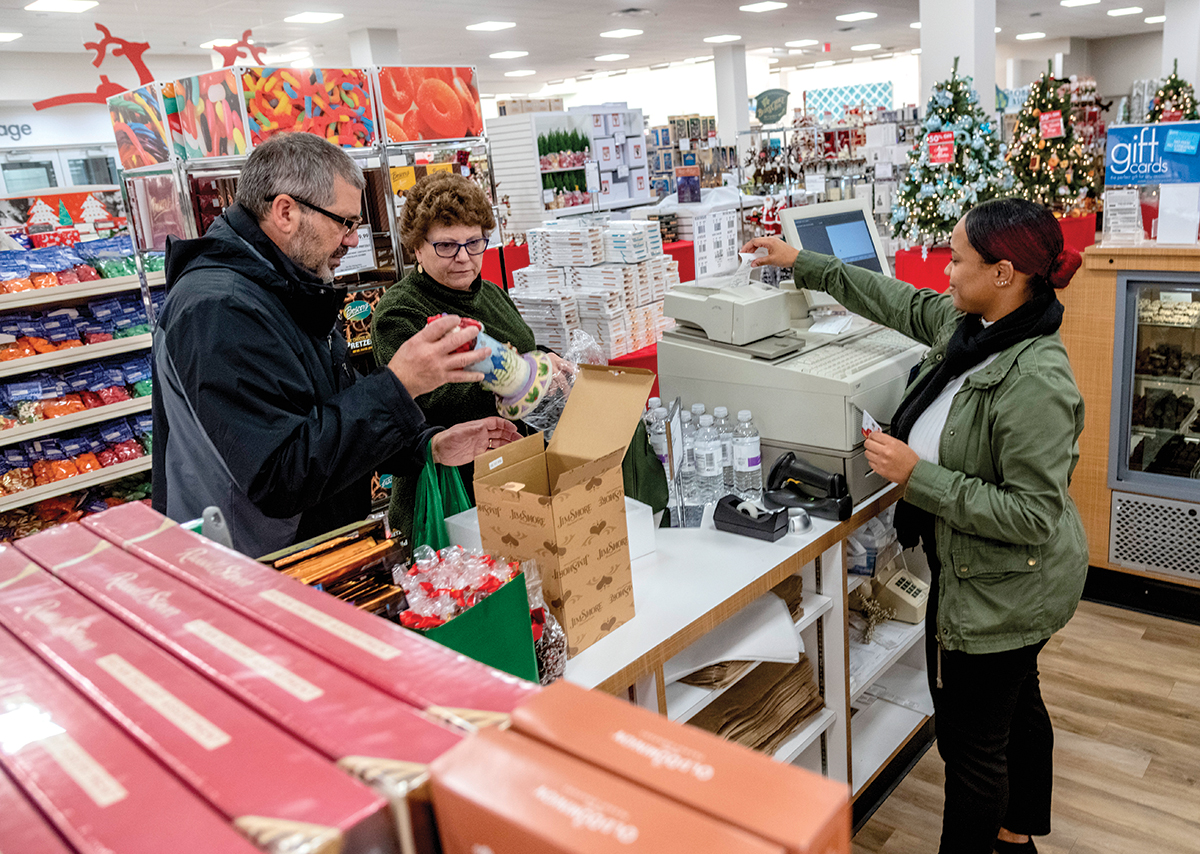
Boscov’s arrival in Providence Place in September, led by its ebullient CEO, Jim Boscov, created a lot of buzz and has given the mall a shot in the arm. The store sells clothing, cosmetics, furniture, toys, appliances, housewares and features a candy counter with a nostalgic feel.
Boscov said his company has $1.2 billion in annual sales, with an anticipated sales increase of 3% to 6% this holiday season. He said the industry estimates 4,800 individual stores would close in 2019, but he remained upbeat about brick-and-mortar shopping. In fact, Boscov’s is in growth mode, with plans to open one store each year.
“Shopping in a store is a social experience,” Jim Boscov said.
Much like the traditional malls, Boscov’s strives to give customers inducements to visit the department store, with a community flavor.
In recent weeks, the store hosted a fashion show with Dress for Success, an organization that helps women with low incomes tune up their wardrobes for job interviews and workplaces. A portion of some of the day’s sales went to the local chapter of Dress for Success.
The store has students in the early-childhood education program at Rhode Island College come in to read with young kids in the toy section. When the store opened in September, Debbie Boone and Elvis Presley Jr. entertained customers at two shows every day for a week. A chef working with Boscov’s is doing live cooking demonstrations of holiday appetizers.
In January, cooks from the public TV show “America’s Test Kitchen” will perform cooking demos and sign books as part of a celebration of the show’s 20th anniversary. The event will also serve as a fundraiser for Rhode Island PBS, according to Johanna Corcoran, the Providence store’s community relations manager.
Boscov said he’s unworried by online shopping, which, he said, can dovetail with visits to stores and malls. “Sometimes people will peruse our website and see what we have and then come into the store,” he said.
Jacob Stein, Boscov’s vice president of real estate, looks at the state of traditional malls from a historical perspective.
Starting after World War II, Stein said, malls started becoming the “mecca of all things retail-related in every community,” playing a big role in communities’ commerce, development, highway routes and traffic. “But in the last decade,” Stein said, “the evolution has gone into overdrive.”
Stein attributes two factors to the success or failure of malls.
[caption id="attachment_309362" align="alignright" width="210"]

EVOLVING: Shoppers pass through the common areas of the Providence Place mall. The mall features entertainment that goes beyond apparel stores, cineplexes and fast-food chains, such as a kids’ veterinary clinic with stuffed animals, a Thai restaurant and arcade games. / PBN PHOTO/MICHAEL SALERNO[/caption]
The first is a mall owner that has the financial wherewithal to keep continuously reinvesting in the property. “As soon as you stop investing in these properties, they start to decline,” Stein said.
The second factor is a management staff with deep expertise in mall development, and that includes long-standing relationships with retailers, producers and municipalities. “You need experienced developers who know how to work with cities and towns,” Stein said. Boscov’s liked management’s track record at Providence Place.
NEW DIRECTION
The owners of the former Rhode Island Mall, located a short distance from Warwick Mall, have found success by taking a different route.
Bramble, one of the managing partners of what is now called Midland Commons, said Rhode Island Mall was faltering several years ago. Sears, one of the anchors, closed in September 2017, and the rest of the mall languished almost to the point of no return, until it was purchased as a joint venture of MCB Real Estate and Acadia Realty Trust, Bramble said.
“Sears was underperforming; it was a bad anchor,” Bramble said. “Malls are difficult to redevelop, both physically and legally, especially when the parcels are owned by more than one owner.”
Ultimately, MCB Real Estate re-created the property as a series of “junior box” stores – including Kohl’s Corp., Walmart Inc., Burlington Stores Inc., Raymour & Flanagan, Planet Fitness Inc. and At Home Inc. – and eliminated the indoor common areas, wiping out its identity as a traditional mall.
The new layout with junior box stores is doing well, Bramble said. “Retail is not dead; it is just changing,” he said. “Folks in business have to constantly find more ways to make themselves attractive to businesses and customers.”
Special events and entertainment may be a worthwhile investment of effort for destinations such as Warwick Mall, but for Midland Commons, the best path to survival came in reinventing the location.
“The reality is that not all malls are created equal,” Bramble said. “Lots of malls are doing great. The weak ones need to go away. We are seeing a thinning of retail. Nobody needs two malls with 30 yogurt shops.”