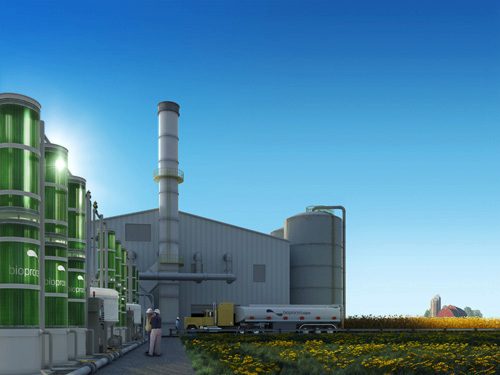
In late 2005, researchers from Portsmouth-based BioProcessH20 presented a paper in Florida detailing their latest insights into removing nitrogen from dairy-farm waste. Afterwards, U.S. Department of Agriculture officials asked if the company had ever explored creating similar technology to scrub carbon dioxide emissions and use the greenhouse gas to grow algae. BioProcessH20 CEO Tim Burns quickly saw a business opportunity.
Four years later a spin-off of BioProcessH20, BioProcessAlgae, is running a demonstration project in Iowa. The system captures carbon dioxide released from a Green Plains Renewable Energy Co. ethanol plant in Shenandoah, Iowa, and uses it to feed the growth of algae. Burns said that someday power plants could utilize that algae as a biofuel source and, with additional modification, it could offer an alternative to traditional gasoline. Algae are also often used in the pharmaceutical, nutraceutical and cosmetic industries, or as a key ingredient for high-quality animal feed.
“The market out there is enormous. You have 188 ethanol facilities in the U.S. generating 45 million tons of carbon dioxide, so now that ability for them to make a crop, make a product of that, is tremendous,” Burns said. “Then you have on top of it the power industry, the coal-power-fired plants.”
Coal-burning plants in the United States produce close to 2 billion tons of carbon dioxide annually, according to the Pew Center on Global Climate Change. The emissions could serve as a potentially huge untapped market, said Will Thurmond, president of Emerging Markets Online, which completed a study in June looking at the market.
And thanks to more than $300 million in public and private investments in 2008 alone, Thurmond said that algae biofuel technology has progressed further than other renewable ventures such as hydrogen-powered cars.
In October, BioProcessAlgae installed a pilot project in Iowa, with the help of up to a $2.1 million grant from that state through its Power Fund to Green Plains Renewable Energy Co. to develop the project. All told, BioProcessAlgae has invested close to $5 million developing the technology.
“We kind of looked at each other and said we have a plant and a grant from the state of Iowa, you have a platform,” Becker said. “We all kind of got together in a room and said we want to build a company.”
If all goes well, BioProcessAlgae anticipates launching additional demonstration projects at a coal-fired power plant and an industrial site next year, Burns said. Those projects would set the stage for BioProcessAlgae to design and manufacture industrial-sized reactors, giant cylinders that could reach 30 feet in the air and span 10 feet in diameter.
“We’ve built phase 1 and we’ve scaled up,” Burns said.
Burns said his company is one of the few looking to grow algae in a contained system rather than an open pond. A closed system would protect the algae from infiltration of compounds that can kill the algae and lower the overall cost of production.
The systems, resembling something like high-tech, fuel storage tanks, would be manufactured at the BioProcessAlgae facility in Portsmouth. Burns and Becker said full-scale production would mean adding between 40 and 60 jobs.
BioProcessAlgae is not the only Rhode Island company that sees a potential market. The R.I. Economic Development Corporation recently awarded Tomorrow Biofuels $250,000 that is part loan, part grant, to develop a system that captures greenhouse gases and uses it as feed to grow algae to convert into biofuel. The company is testing such a system at its Howard Industrial Park location in Cranston. •