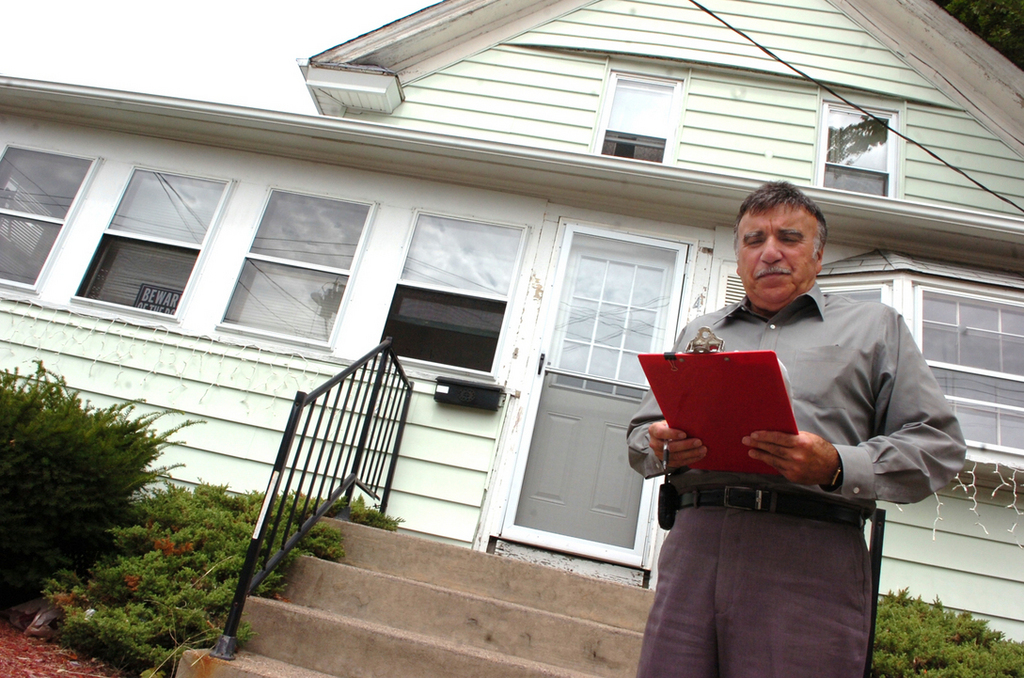
Last Wednesday at 1 p.m., auctioneer Skip Ponte of Irving Shechtman and Co. stood with a red clipboard outside a Pawtucket house next to a car repair business.
The house, at 440 Benefit St., had been purchased with a mortgage in June of last year, but now the lender had foreclosed, and Ponte was there to sell the property. Ponte read the foreclosure legal notice aloud, but the only bidder was the lender – with a bid of $191,250.
More and more Rhode Island properties are going through this process as the nationwide subprime mortgage crisis continues to take its toll.
In July, foreclosures in the state surged 37 percent compared with June, giving Rhode Island the highest percentage hike in the nation for that month, according to an August report by Bargain Network Inc., a California-based company providing national foreclosure data.
At the end of July, 119 Rhode Island homes were in some stage of foreclosure, but the state’s per-home rate – 1 of 3,697 properties is in foreclosure – was still lower than the rates in 34 other states.
But the Ocean State is doing worse than both Connecticut, with a foreclosure rate of 1 in 9,119, and Massachusetts, with 1 in 4,474. The national average was 1 of every 879 homes, according to Bargain Network.
“What’s happened with the subprime adjustable loans is that folks have gotten into loans that, in some instances, they couldn’t afford to begin with,” said Susan Bodington, deputy director for programs for the Housing Policy Division at Rhode Island Housing.
“In many instances,” she added, “as the interest rates go up, they just don’t have the income to be able to pay those interest rates.”
Variable-rate subprime mortgages account for less than 10 percent of mortgages in Rhode Island, but accounted for more than 50 percent of the foreclosures in the first quarter of 2007. Conversely, fixed-rate prime mortgages account for more than 70 percent and less than 20 percent of foreclosures during the first quarter, according to data from Rhode Island Housing.
Rhode Island foreclosure figures are traditionally tougher to track than those in states where judicial action is required, said Alan Pasnik, a data analyst with The Warren Group, a Boston-based real estate data provider.
In Rhode Island, most figures come directly from a count of newspaper legal ads for home auctions. “Before that, everything’s private,” said Pasnik. “It’s private communication between the lender and the borrower.
“The stipulations on how to foreclose are embedded in the mortgage deed, and other than advertising the auction, there doesn’t seem to be any place to be able to see if we have distressed property.”
Rhode Island Housing, too, tracks those newspaper ads. From August 2006 through May 2007, it counted 875 foreclosure notices for the 244,836 owner-occupied homes in the state. But many of those ads don’t lead to foreclosures, noted agency spokeswoman Jo-Ann Ryan.
Pasnik said The Warren Group couldn’t release data for Rhode Island foreclosures, but added that the state is probably in a position similar to that of Connecticut and Massachusetts.
“I can’t imagine that it’s any better in Rhode Island than it is elsewhere,” said Pasnik. “You have the same kinds of problems where housing prices went up fast, and we squeezed credit out of the mortgage system.”
In Providence, Ward 12 Councilman Terrance M. Hassett said he sees distressed properties as a growing problem in the Smith Hill neighborhood, where there are 24 foreclosed homes with boarded-up windows. The properties should be cleaned up by the lenders who now own them, he said.
“They’re being advised that as landowners, they have an equal responsibility [to what] any other homeowner would have,” Hassett said. “In other words, we’re not giving any distinction to them as a bank or a mortgage company. This means taking out the garbage, no debris on the property, cutting the grass, things like that.” •