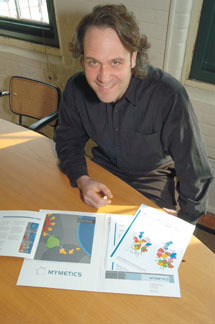
of Mymetics.
Mymetics Corp., a biotech company developing retrovirus therapies, has said goodbye to Maryland and hello to the Ocean State.
The startup business, which was originally founded in France as HippoCampe in 2001, reinvented itself as Mymetics, a United States-based company with research and development facilities in Europe. In the same year, the company merged with MFC Bancorp Ltd., a financial services company in Dublin, Ireland that provided the capital for Mymetics to become an American company.
The 15-person company, in its pre-clinical phase, first launched its U.S. office in Annapolis, Md. to be closer to government health organizations including the National Institute of Health (NIH) and the Food and Drug Administration (FDA), which are both based in Maryland.
Your Business Has Gone Global. Has Your Insurance?
A decade ago, “doing business internationally” was mostly a large-company concern. Today, a manufacturer in…
Learn More
Becoming an American company was important for Mymetics because it would provide capital and access to the capital market, and would allow the company to get closer to the FDA, and would provide an easier channel to expertise.
“For a company with HIV therapies to succeed, it needs to play in the United States and operate by American rules,” said Michael Allio, chairman and acting chief executive officer.
Earlier this month, the company made another strategic move by relocating its U.S. operations to 150 Chestnut St. in Providence’s Jewelry District, an up-and-coming area for biomedical research.
“The move to Providence will allow us to set up shop here and build a management team,” Allio said.
The executive said the reason behind the move was to take advantage of the biotech activity in Rhode Island and Massachusetts and to be closer to the universities and other biotech companies in the region.
Already, the company has been in touch with Brown University and recently presented at the 10th Annual Conference on Retrovirus and Opportunistic Infections in Boston.
Founded on research by Dr. Pierre-Francois Serres, who has worked at the Institut Pasteur and whose research includes immunology and organ transplantation, metabolic diseases, hemophilia, HIV and AIDS, Mymetics is three years out of the clinic and is moving into the pre-clinical stage.
“One of the strategies in moving from France to the United States was to move from research to development,” Allio said.
Mymetics, named after mimicry, which in biological terms refers to a protective resemblance that certain animals, viruses, or plants develop to adapt to their environment, is developing technology that will look at therapies for victims of retroviruses and vaccines for potential victims.
The company is working on both therapies and vaccines for several applications including HIV, Feline Immunodeficiency Virus (FIV), which cats can acquire, and Simian Immunodeficiency Virus (SIV), which monkeys can acquire.
The therapies and vaccines will also be applied in blood leukemia.
Although it is a crowded market, the increase in AIDS patients over the last three decades allows for plenty of room for Mymetics.
The AIDS epidemic has affected more than 900,000 people in the United States who are living with the HIV infection. Another 460,000 HIV-infected people in the nation have died, according to a 2002 report by Anthony Fauci, director of the NIH’s National Institute of Allergy and Infectious Diseases.
The epidemic is much worse throughout the world. Nearly 40 million people are living with HIV/AIDS and 22 million HIV-infected individuals have already died.
Allio says the crowded market has already generated 16 approved drugs for treating HIV. The key differentiator between what is out there today and what Mymetics is doing, Allio says, is that all of existing products on the market work to slow down the viruses, but none of them cure the virus.
“And that’s what we hope to do,” he said.
Mymetics is testing a class of anti-retrovirus agents designed to disrupt molecular mimicry, an interaction between a retrovirus and host cells, which contributes to the disease progression.
“We are working to stop it before it will attack.”
In the company’s opinion, Mymetics has one major competitor, Trimeris, a Durham, N.C., company which has developed a similar approach.
Mymetics has moved past testing in vitro and is currently testing its approach on cats.
Mymetics plans to enter in clinical trials in May 2004.
“The idea is to create a globally relevant vaccine and drug that can be administered to people wherever they live,” he said.
For the complete current issue, visit our subscription Web site, or call (401) 273-2201, ext. 227 or 234.