PROVIDENCE – Concerning trends across several key indicators suggest "growing headwinds" for Rhode Island’s economy, according to a new report from the Rhode Island Public Expenditure Council and the Center for Global and Regional Economic Studies at Bryant University.
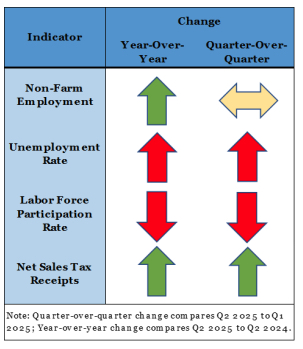
The state experienced a softening labor market and steep drop in the number of employed Rhode Islanders during the second quarter, RIPEC said in the report released on Wednesday. However, Rhode Island-based jobs held steady and net sales tax receipts saw a modest increase, according to the report.
“The data this quarter ... merit attention from Rhode Island policymakers and businesses,” said Michael DiBiase, CEO and president of RIPEC. “While some sectors continue to add jobs and net sales tax receipts indicate some growth in consumer demand, the broader trend in employment and labor force participation suggests that we are entering a period of increased uncertainty.”
Rhode Island’s labor force participation rate declined for the fourth consecutive quarter, reaching 63.7%.
The number of employed Rhode Islanders fell 0.6% quarter over quarter and 1.2% year over year to 559,000, reversing gains made during 2023 and the first two quarters of 2024, RIPEC said.
Rhode Island’s unemployment rate rose slightly to 4.9% and has now either risen or remained unchanged for eight straight quarters. Rhode Island’s unemployment rate exceeded both New England and the U.S., which were 4.2% each, for the sixth consecutive quarter, according to RIPEC.
The number of unemployed Rhode Islanders was 28,700 in the second quarter, an increase of 800 quarter-over-quarter, and 3,300 year-over-year.
Nonfarm employment remained steady at historically high levels at 514,900, while preliminary net sales tax receipts – a key demand indicator – increased 2.5% in the second quarter, reversing a 2.4% decline from the first quarter of 2025.
Only two of the state’s nine major industry sectors saw job gains in the second quarter: professional and business services, which added 2,600 jobs, and education and health services, which added 600 jobs. Employment losses were concentrated in leisure and hospitality, down 1,400; trade, transportation, and utilities, down 1,300; and government, down 700 jobs. The remaining sectors – construction, manufacturing, information and financial services remained largely unchanged, having experienced marginal declines, RIPEC said.
In the first quarter of 2025, Rhode Island’s Gross Domestic Product declined by 0.2% following four consecutive quarters of growth. Still, Rhode Island outperformed both the New England region and the U.S., which respectively saw GDP drops of 0.8% and 0.5% in the first quarter. GDP data from the second quarter is not yet available.
“Rhode Island’s economy held steady in Q2 2025, with nonfarm employment remaining near historic highs and consumer demand showing modest growth," remarked Edinaldo Tebaldi, professor of economics and vice president of strategy at Bryant. "However, several concerning trends are emerging. The indicators presented in this briefing suggest that, despite surface-level stability, the state’s economic momentum is weakening,”