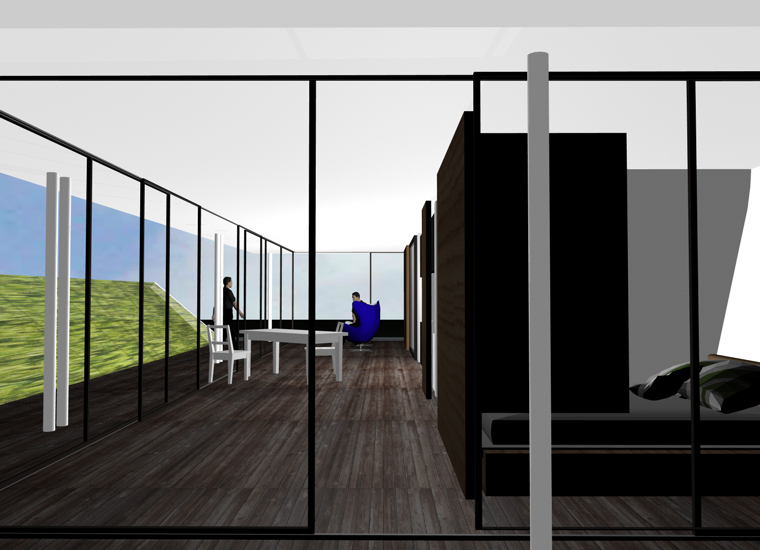
Modular homes, built in sections in factories as opposed to on site, are an eco-friendly option for new home purchasers, but pricey. Now a research project at Rhode Island School of Design is hoping to make them an option for the average consumer.
A traditionally designed modular home typically costs the buyer $400,000, said Maura McCarthy, a partner in the project who is doing market research that aims to use students’ modular home designs to build a new business concept. Custom-designed modular homes cost even more, ranging from $500,000 to $1 million or more, she said.
ISO 9001:2026: A Practical Opportunity to Build for What’s Next
For Rhode Island manufacturers, ISO 9001 has been much more than a certificate on the…
Learn More
In 2004, modular homes made up about 4 percent of the new home market, but the hope is that by the end of its research, the RISD group will have produced plans that can be turned into a 700- to 1,100-square-foot modular home that will cost a builder no more than $90,000 to manufacture, putting it in the range of the average retail U.S. home price of $210,000 to $230,000, according to Liliane Wong, professor of interior architecture at RISD.
“We will be studying students’ designs,” she said. “We’re spending the summer finding out if there is a viable option … to turn this into some sort of business.”
This past spring was the second time Wong taught a 12-week modular housing studio class funded by a grant from Bill Haney, an award-winning documentary filmmaker interested in social and environmental change.
Wong said she met Haney “out of the blue at a party.” The idea for the studio grew out of a shared concern about the environment and lack of affordable housing in the United States.
“The parameters of the class yielded some good designs,” McCarthy said.
But good design doesn’t necessarily make it good for mass production in the modular housing industry. Sometimes, though it’s designed well, a home plan might not appeal to a mass audience.
“Our objective is to pull from both sides and create a model that has the modular aspect but a much more contemporary design, but not contemporary to the point that nobody’s going to buy it,” McCarthy said. “And it will have a price point that’s reasonable.”
The more pragmatic designs are being analyzed for their market potential, McCarthy said. They include a traditional single-family home made with modular components so a family could add on to it as it grows.
Students also designed a mountain retreat-style modular home, she said, and a modular home with a strong core meant to withstand hurricane conditions.
“The big market question right now is … is there a community in Austin, Texas, that wants to buy a home that looks like this?” McCarthy said as an example of the potential markets for the product.
She said there seems to be more interest from the general public in buying green products, which she attributes to media coverage of global warming. Because the RISD student-designed modular homes are smaller than the average modular home, which ranges from 2,000 to 5,000 square feet, they use less energy and waste less material in the manufacturing process. In addition to price, that could be a selling point.
But finding a manufacturer to test run the designs could be problematic because “a lot of modular manufacturers are not interested in doing a small project,” McCarthy said. “They would rather work with a construction company that does X amount of houses per year.”
Also, if the design requires a different type of material such as a composite instead of plywood, it requires the manufacturers to retrain people to cut things differently, which could be another barrier to entry for the project.
“A lot hinges on the manufacturing process and demand,” McCarthy said. “The price point … and what you get as far as architecture and eco-friendliness [are] better than what you get from buying a traditional home.”
By the end of the summer, McCarthy said, the team will know whether the project is feasible.