Laura Briggs saw the writing on the wall. Rhode Island lawmakers had eliminated the state Historic Preservation Investment Tax Credit. The real estate market reeled from a crash. Credit dried up. Investors left town.
Briggs, with a bachelor’s in historic preservation from Roger Williams University, predicted fewer historic rehabilitation projects and fewer jobs for people like her.
So this fall she returned to her alma mater to enroll in the university’s new master’s program in historic preservation. The only such program in Rhode Island – and one of just a handful in the Northeast – Roger Williams and Briggs say the degree provides an edge to job applicants competing for a finite number of historic-preservation jobs.
“Most companies or organizations really want you to have that master’s,” said Briggs, who works at a Tiverton lumberyard selling windows.
Philip Marshall, the program’s coordinator, said Roger Williams saw a market for a master’s degree years ago. For more than three decades, the school has offered an undergraduate degree tied closely to its architecture school. Professors saw many graduates head to other schools and then complain about repeating coursework completed at Roger Williams. Other graduates said outright that if Roger Williams offered a master’s degree in historic preservation they would stay put at the Bristol school after graduation, Marshall said.
The new program has attracted a number of former students, including Briggs. The program counts seven full-time students and two part-time students, all told. The full-time students holding undergraduate degrees in historic preservation expect to obtain a master’s degree in a year. Next year, the university will launch a two-year program for students with no formal preservation background.
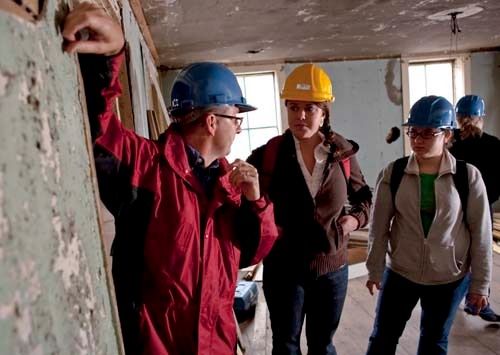
The tours are led by visiting professor Arnold Robinson, a former historic preservationist at Newport Collaborative Architects. In the classroom and on-site, he tells students historic preservation is as much about history as it is loans, tax credits and grants.
“I love to see the light that goes on when a student realizes that economic dynamics make the decision whether the project moves forward or the building gets demolished,” Robinson said.
Robinson expects his students to land jobs with development companies, advocacy groups and in government. Even those in the nonprofit and municipal worlds will need to understand the economics of preservation to craft effective policies.
“You have to do more than just have the conservation background. You need to have the political skills, the public-policy skills, the fundraising skills,” he said.
And Robinson said that unlike many preservationists, he teaches students that rehabbed buildings need to work as part of the economy and are rarely taken on as projects of passion for restoration.
“I’m a big believer that preservationists can’t say, ‘Let’s save the building because it’s beautiful,’ ” he said. “There is a certainly a value to heritage but it’s also real estate that has to function in the economy.”
The building also needs to stand up. The master’s program provides architectural instruction in a relationship with the architecture department Marshall called extremely close. The graduate program, like the undergraduate one, sits within the university’s School of Architecture, Art and Historic Preservation. For students like Briggs it means getting a taste of architecture without actually entering the field.
The 52-credit master’s of science costs $37,500 but Marshall said he expected most students to recoup that money within a few years. He also expects at least some will remain in Rhode Island, a state with plenty of historic buildings and a populous keen on preserving them.
Indeed, a newfound interest – especially from young people – of reusing old buildings appears to be fueling an interest in historic-preservation programs around the country, said Ted Ligibel, chairman of National Council for Preservation Education.
“I think what we’re seeing nationwide is a really strong and growing interest in preservation of the built environment both as a cultural and historical place but also what it means for sustainability,” Ligibel said, who is a professor historic preservation at Eastern Michigan University.
About 23 schools around the country offer a master’s degree in historic preservation and another 22 offer graduate degrees with a specialty in historic preservation, according to the council. And the emphasis is clearly on graduate-level education because just 10 schools offer undergraduate degrees in historic preservation.
“While you may get a job with an undergraduate degree working in a museum or at historic site … if you really want to advance in that field its almost imperative that you go get the master’s,” Ligibel said. •