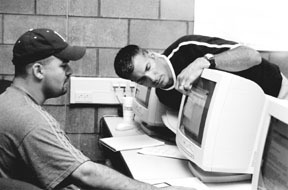
with in-depth computer training.
Schools in the Ocean State have found creative ways to keep their teachers and administrators technologically savvy, but are they making the grade?
With the influx of computers and technology in the classroom comes an increase in the need for technology training and professional development – and schools are finding different means and money to do both.
John Bilotta, technology director for the South Kingstown School District, is responsible for the networks and computers used at all of South Kingstown’s schools including South Kingstown High School.
Rhode Island's Market Has Changed. Developers, Builders, Investors and Sellers Must Change With It.
By Emilio DiSpirito IV License Partner | Engel & Völkers Oceanside Leader | The DiSpirito…
Learn More
Bilotta, with a staff of two, has had to revert to other means of training both teachers and administrators on how to use the computers, software and other hardware used in the high school’s more than a half-dozen computer labs.
Nearly five years ago, the school had only two or three computer labs. One was used for keyboarding practice, another for learning spreadsheets and other business software and a third for general purposes. Today, the school has a lab for computer-assisted drafting, four labs for the business department and one lab for the auto shop.
If that isn’t enough to keep Bilotta busy, there is also a video-conferencing capability in the school, which allows teachers to make contact with professors at different colleges and universities via video conferencing.
“I do a lot of the training myself,” he said. “But we also bring in outside folks.”
South Kingstown High School has tapped Richard Dillahunt, a local Web designer, to come in and train teachers on Macromedia’s Dreamweaver, a software for Web developers.
“In this particular case, while I use Dreamweaver myself, it made sense to bring in someone with that much more knowledge,” Bilotta said. “And it’s helpful for teachers to hear from someone who is a professional and designs Web pages.”
Teachers typically take in-service days to learn how to use technology in the school, but, in other instances, teachers come in on their days off, such as Election Day. The school pays for the training using state aid and other local funds.
The most effective way of training and professional development comes when teachers teach each other.
Nearly 100 teachers in South Kingstown took advantage of the Rhode Island Foundation’s Teachers & Technology program, a program started in 1997 which provided two weeks worth of all-day training to teachers.
“While a company may come in and teach you how to use Microsoft Word, we found it more effective if you have teachers training teachers,” Bilotta said. “And they’ve had one heck of an impact.”
The Teachers & Technology program may have had a positive effect on teacher training, but is it enough?
Katherine O’Dea, executive director of the Rhode Island Technology Council, said technology training for teachers is a difficult issue and is something that needs to be addressed.
O’Dea said putting technology in the classroom and schools isn’t the problem – it’s training teachers on how to use them and how to incorporate them into the teaching.
There are requirements in place that mandate that teachers are able to use technology in order to be certified, but there aren’t any follow-on requirements once they have been certified.
The growing problem can be blamed on a few things – not having enough dollars in the budget to support the professional development and not giving the teachers proper training before they enter the profession.
Data shows that new teachers are no better prepared to use technology than veteran teachers with 15 to 20 years in the business are, said O’Dea, citing a report by Education Week, an online education newspaper. “That’s the scary part,” she said.
Education Week’s report, Quality Counts 2001, found that while 42 states pay for some professional development for teachers, less than half provide money for every district or school.
The state of Rhode Island received a D-plus on improvement of teacher quality, according to the report.
Another problem is that the state does not have one standard across all school districts when it comes to the use and training of technology.
“You can have teachers in one district using Macs and other teachers in other districts with PCs,” O’Dea said. “The fact that there is no standard on technology across the state compounds the issue.”
Still, schools continue to do what they can to improve the use of technology in the classroom – with or without help.
Renee Griffin, library media specialist and technology coordinator at Hope High School in Providence, also took part in the program that provided her with a computer for the classroom and credits at the University of Rhode Island.
Most of the teachers at Hope High School received their training as a result of the foundation’s program, according to Griffin.
Although most teachers are familiar with PCs and Macintosh computers, there are a few who need assistance from Griffin, she said.
“Since those two programs in the summer of 2000 and 2001, I haven’t done any major (training) lately,” she said.
For the complete current issue, visit our subscription Web site, or call (401) 273-2201, ext. 227 or 234.