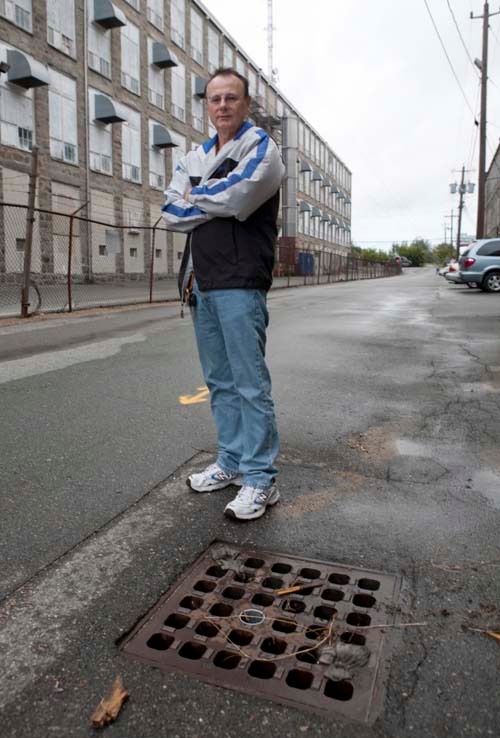
The last thing Commonwealth Soap & Toiletries needs is another bill. The Fall River manufacturer already faces a down economy and stiff competition. So corporate accountant Roland Byam cringes when he opens the company’s sewer bill each quarter and sees the $3,055 stormwater fee tacked on the bottom.
“This is absolutely outrageous,” Byam said. “Our little business [has been] paying $12,000 a year for the last two years, whereas we had none of these fees before.”
The fee stems from a two-decades-old project to separate the city’s piping system that collects rainwater and sewage into two. Currently, one system collects both, leading to overflowing, raw sewage during heavy rainstorms.
Fall River hands over $7.92 million annually – or 45 percent of the sewer department’s budget – to pay off the project’s debt. To cope, the city raised rates to $4.50 per 100 cubic feet of sewage, up from 96 cents when the city started planning the project in 1984. And two years ago, the city introduced a fee for commercial property owners, who now pay $140 annually for every 2,800 square feet of impervious surface such as parking lots, roofs and the like.
The charges have rankled the business community and renewed a push by public officials to find new ways to pay for the project. Last month, Mayor William Flanagan visited some of the state’s congressional members in Washington, D.C., to plead for money. The city contends federal regulations forced it to undertake the project and thus the federal government should contribute more to a cost expected to reach $185 million – or slightly less than half the city’s entire annual budget. Since 1993, the federal government has chipped in about $14 million in grants, or about 7.7 percent of the project’s anticipated cost.
City officials face pressure from the business community to roll back the stormwater fees. A coalition of business owners organized by the Fall River Area Chamber of Commerce and Industry loudly protested the fee two years ago. Today, the Chamber warns that continued high rates and fees will drive out businesses just as the city attempts to reinvigorate itself as a hub of 21st-century technology.
Mellion said the rates and fees especially discourage life sciences companies that require thousands of gallons of water daily and expansive parking lots for employees.
Then, Mellion said, there are the small mom-and-pop shops, nonprofit organizations and churches that require parking lots but lack the cash to pay the fees.
“It does create a burden on business [when] every penny counts in this economy right now,” Mellion said.
Many business owners have little choice but to pay. Byam, the accountant for the soap maker, points out the company’s driveways permit tractor trailers to pick up products. Without the driveways, there would be no trucks and no income.
Commonwealth Soap & Toiletries also maintains a paved parking lot for its 50 or so employees. And the roof over the three-story building, which has a footprint of 70,500 square feet, is far from optional.
And Byam is not sure what the company stands to gain from the stormwater surcharge.
“We’re paying a lot of money for something … we [might not] get anything out of,” he said.
Ultimately, the project is supposed to improve the environment for everyone by reducing sewage overflows. Currently, the city’s combined sewage and rainwater system spills about 1.3 billion gallons of sewage and rainwater into Mount Hope Bay each year. That is the equivalent of about 2,000 Olympic-sized swimming pools.
Future plans call for the installation of three screening and disinfection facilities and the separation of sewer and stormwater lines along the shore.
The project is similar to one being undertaken by the Narragansett Bay Commission in Providence. Like Fall River, the agency is separating systems that collect rainwater and sewage in an effort to stop sewage from overflowing.
And like Fall River, the Rhode Island project – ultimately expected to cost close to $1 billion – has driven up sewage rates. The sewage bill for the average single-family home has reached $400 annually, up from $130 a decade ago. In Fall River, the average home bill is now $590 year, up from $96 in 1984.
Narragansett Bay Commission spokeswoman Jamie Samons said the agency also considered implementing a stormwater fee similar to the one in Fall River. However, the R.I. Public Utilities Commission rejected the fee. The commission did approve a series of rate increases that left customers paying $2.63 per 100 cubic feet, compared with Fall River’s $4.50.
And while the Providence rates appear lower than Fall River’s, there are a number of distinctions. The Fall River charge includes the cost of maintaining the piping network. In the Rhode Island system, municipalities pay most of those costs and wrap them into taxes. Fall River also has a smaller customer base: 20,000 customers as opposed to the commission’s 80,000.
But like Fall River, the commission is paying for the project with little federal cash. Of the $350 million spent so far, just $9 million has come from the federal government. •