There has been a lot of talk these days about net-zero emissions – removing more greenhouse gases than produced – but Jeffrey Hall says his nonprofit is taking action.
The Audubon Society of Rhode Island recently gave the go-ahead for the construction of two solar carports at its properties in Bristol and Smithfield that Hall, the ASRI executive director, says will get the organization closer to reaching net zero in the coming years.
The price tag: $2 million.
“We’re an environmental organization walking the talk,’’ Hall said recently. “This is our commitment to say that we believe everybody should try to get off fossil-fuel heat and cooling, and we’re doing it by example.’’
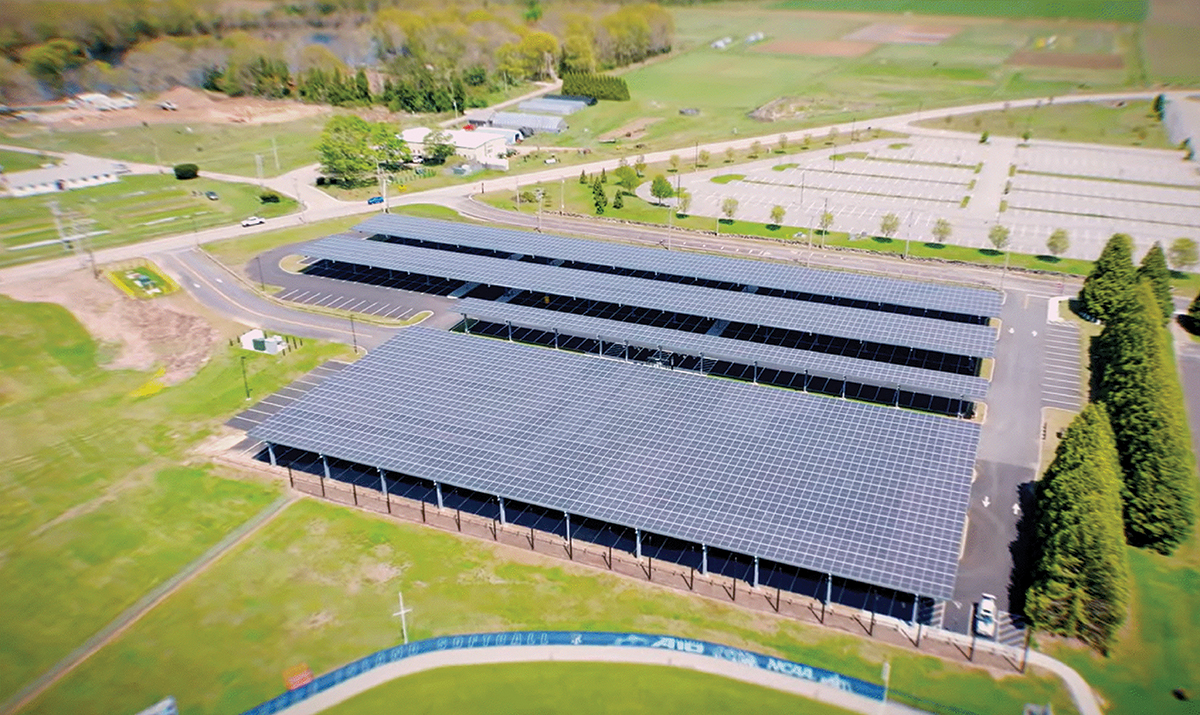
When construction gets underway in Bristol in April, the Audubon will be the latest organization to erect solar carports in Rhode Island – solar panel farms that are typically built over parking lots, where sunlight is captured and converted into electricity that can either power specific buildings, charge electric vehicles, be stored in batteries, or flow back into the power grid.
Rhode Island’s first solar carport, funded by R.I. Commerce Corp., was built in 2013 for the Quonset Business Park in North Kingstown. Since then, at least three more carports have been erected, according to Michael Dalo, manager of external communications at Rhode Island Energy, the state’s largest utility company. Dalo said 763 megawatts of the state’s clean energy currently comes from solar energy overall.
“We also have seven additional carport projects in the interconnection pipeline,’’ Dalo said. “These upcoming projects represent a combined 37 MW of new capacity and are either in active study or preparing for construction.’’
Christopher Kearns, acting commissioner of the R.I. Office of Energy Resources, said that when it comes to generating energy, solar carports are not as popular as ground-mounted or roof-mounted solar panels. That’s because building a carport requires a lot more funding, planning and coordination than simply putting solar panels on the ground or a roof.
To offset those costs, Rhode Island offers various incentives for solar carports to increase the production of clean energy in the state. The Office of Energy Resources provides a carport incentive through its state renewable energy fund that it administers in partnership with R.I. Commerce.
“We offer a grant-rebate incentive, but the state doesn’t have any state-level tax credits,’’ Kearns said.
In addition, he noted that the repeal of the 30% renewable energy tax credit “is going to pose some challenges” for prospective solar development in Rhode Island and across the country, referring to the Trump administration cutting the credit as part of the so-called One Big Beautiful Bill Act.
Solar carport projects have materialized in various parts of the state.
In 2023, the University of Rhode Island built a large solar canopy over the Plains Road commuter parking lot on its main campus in South Kingstown. The school partnered with Kearsarge Energy LLC, a renewable energy company in Boston. Kearsarge provided all the steel for the structure.
The canopy was built over a 417-space parking lot. Kenneth Burke, assistant director of capital projects at URI, said the carport cost about $3.5 million to construct and was funded by the university.
For Burke, the decision to install the solar carport on the campus was an easy one, noting it aligned with the state’s green energy mandate and the university’s desire to go carbon neutral “as best they can for any new construction.’’ A series of new transformers and switches then allows that renewable energy to enter the grid, powering nearby buildings.
“It was an easy lift for us – save the university money, save the state money – and it was a direct benefit to students,” Burke said.
At the Audubon Society of Rhode Island, the organization has launched a campaign called RePower Audubon to raise $1 million to help pay for the two solar carports.
When completed, the carport at its Powder Mill Ledges Wildlife Refuge headquarters in Smithfield will have 324 solar panels and a capacity of 187.9 kilowatts of clean energy, enough to power approximately 20 to 25 homes. The carport at its nature center in Bristol will be slightly smaller, with 288 panels and a capacity of 167 kilowatts, about enough to power 17 to 20 homes.
Hall predicted that when it comes to carbon emissions, his group could be the first organization that could be completely net zero by 2030.’’
“And the way we’re going, that date is going to be shorter than 2030,” he said.
The contractor for the carports is Newport Electric Construction Corp. The Audubon Society plans to break ground in Bristol at the beginning of April and is waiting for access to the power grid before it can begin construction in Smithfield.
Hall said that the organization received incentives from the state to construct one of the two carports and should be able to pay nearly the entire cost of the second carport with the money it saved on the first one. It’s estimated that the two carports will save nearly $2.5 million in utility costs over the course of the structures’ 25-year life cycle.
“The climate is changing,” Hall said. “Everybody needs to do their part to try to lower their emissions.’’