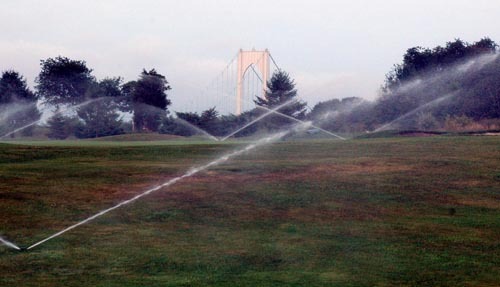
When the sprinklers at Jamestown Golf Course pop up every night, they draw water from an unusual source. About a half-mile away a wastewater treatment plant sends its treated discharge to the course. The course receives much-needed water otherwise unavailable and the treatment plant recycles water that would otherwise land in Narragansett Bay.
The arrangement works well and state officials, armed with $103,190 in federal stimulus money, want to see more like it. In May, the R.I. Department of Environmental Management awarded a contract to the Sandwich, Mass.-based Horsley Witten Group to explore uses for the treated water coming from wastewater plants.
“It’s kind of a paradigm shift in looking at the wastewater not as a waste but as a possible resource that can meet a need,” said Susan Kiernan, deputy chief of the DEM Office of Water Resources.
In all, the state’s 19 municipal wastewater treatment plants produce about 129 million gallons of treated water, known as effluent, during an average day in the busy summer months, according to DEM. Virtually all of that lands in rivers, Narragansett Bay or the Atlantic Ocean.
DEM already permits the effluent – or graywater – to be used for irrigation and certain industrial uses, but that’s rarely done. Kiernan said the state needs to look at recycling the effluent as development puts an increasing strain on the state’s aquifers, especially in the southern half of the state. In its request for proposals to undertake the project, the DEM identified high-priority watersheds, including the Hunt, Chipuxet and Annaquatucket rivers; the south branch of the Pawtuxet River; Abbott Run Brook and the drinking water supply systems for Jamestown, Westerly and Woonsocket.
The strain comes not only from physical development but from a change in society, which more and more demands water for watering lawns, longer showers or complicated industrial processes, Kiernan said.
“There’s a limit to what you can take out to sustain that supply for the future as well as keep that watershed healthy,” Kiernan said.
Southwest states discovered that years ago. Booming development overtaxed rivers and officials turned to recycling effluent on a grand scale. Municipal water systems in California made headlines during the past few years by treating wastewater and then sending it into aquifers drawn on by municipal drinking supplies. Eventually the water would be pumped back up to the surface and used for drinking water.
So Rhode Island will start with baby steps. Kiernan said Horsley Witten Group – along with engineering firm Hazen and Sawyer – will explore scenarios for using the treated effluent for watering state parks or for a limited scope of industrial purposes.
Richard Claytor, a principle engineer at the Horsley Witten Group, will lead the Rhode Island project. Claytor said the team will start by looking at computer-based maps of the state, identifying the locations of wastewater-treatment plants and studying the surrounding land uses. The team will attempt to identify 10 projects and then whittle down the list to the most viable three, which will receive more extensive review, including rough cost estimates. The study is expected to take about a year.
“I think the objective is [to see] where this make economic sense and from a business perspective where it would benefit the local businesses,” Claytor said.
A cross section of people, including the two contractors, the DEM and the U.S. Environmental Protection Agency, which awarded the money to the state, will review the options. Claytor said one of the most significant hurdles could be the cost of laying the pipes to bring the effluent where it needs to go, because right now pipes are laid out to carry the water one way and one way only – to the wastewater-treatment plants.
The Jamestown Golf Course spent about $200,000 to build the infrastructure required to move the water one-half mile from the treatment plant, but Superintendent Joe Mistowski called it well-worth the cost.
The only other option, he said, is capturing rain in a retention pond. Before the hookup to the sewer plant, that pond often went dry by August in years that saw little rain. The effluent changed all that.
“There are golf courses out in the Southwest that actually fight for this stuff,” he said. •