The winding pipes of the Warwick sewage system serve as ground zero for the war on grease. If left untreated in sewer lines, the grease from kitchens across the city forms solid balls and clogs the system, leading to unwelcome backups and added expense for the city that must dispatch workers to clear out the unwelcome goo.
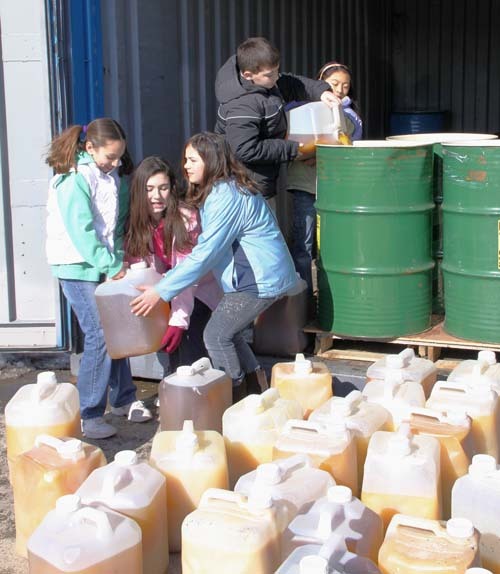
To the rescue charges a group of sixth grade students from Westerly, who bring a plan that they first launched in Westerly. Project Turn Grease Into Fuel – or T.G.I.F. for short – encourages residents to take their kitchen grease to a central collection point set up by the students at the local transfer station in November 2008. Students also arranged for a local company to pick up used oil from about 70 local restaurants. A refiner recycles the grease into biodiesel fuel. The proceeds from the sale of the grease pay for “Bioheat” at local shelters.
In May, the U.S. Environmental Protection Agency awarded the students the 2010 President’s Environmental Youth Award. They met President Barack Obama and EPA Administrator Lisa Jackson at the White House. They also presented their program to both of Rhode Island’s U.S. senators, Sheldon Whitehouse and Jack Reed. They were the only students from New England to receive the award.
To date, the project has collected more than 36,000 gallons of waste oil, leading to the creation of 30,000 gallons of biodiesel. The effort offset 600,000 pounds of carbon dioxide from being released into the atmosphere.
“I am so impressed with the commitment these students showed by taking action to improve the environment,” said Curt Spalding, regional administrator of EPA’s New England office. “We have serious environmental problems, but with the creativity and commitment displayed by these students, we can find ways to effectively work toward a cleaner and healthier world.”
In Warwick alone, residents send so much cooking grease down the drain that if every home reduced the grease it put down the kitchen sink by one teaspoon a day it would translate to 596 gallons a month. Annually, that’s enough grease to fill about 50 backyard children’s pools.
“It’s just mind-boggling when you think of all of the oil that could remain out of our collection system,” said Betty Anne Rossi, pretreatment coordinator and laboritory director for the Warwick Sewer Authority. “It’s huge.”
The team’s coordinator, Jason Lin, said Project T.G.I.F. started after his daughter, Cassandra, returned from a Green Expo at the University of Rhode Island in 2008. She saw information on turning grease into biofuel and came back anxious to do it herself. WIN became involved, and after launching the program in Westerly, approached the governor’s office in January 2009. The governor’s office linked the students up with Warwick.
“We didn’t know anything about this before until we dug into it,” Lin said. “There are problems everywhere, especially for … cooking oil, they just pour it down the drain with little thought.”
Rossi said Warwick sewage authority workers are increasingly battling grease buildup in residential areas after spending years working with restaurants on their grease disposal. To complicate matters, residential areas typically contain pipes with smaller diameters than pipes in heavy commercial areas. That makes it easier for grease to congeal, especially around roots invading the pipes, and form nasty, bacteria-ridden globs.
Rossi said T.G.I.F. provides Warwick an opportunity to reach out to residents on a meaningful scale for the first time. Last year she included a note detailing the dangers of grease along with sewer bills, but the latest project could help shift the mindset about grease.
Rather than an unwelcome waste product, Rossi and the students want residents to view the grease as a valuable commodity. Some restaurants already partner with commodity traders and refiners who take the grease and use it various products from biodiesel to soap.
Lin said the EPA officials pledged to work with WIN students to incorporate them in educational programming about proper grease disposal. And the students are already talking to officials in Stonington, Conn., about establishing a grease collection point at the local transfer station.
“This is win-win,” Lin said. •