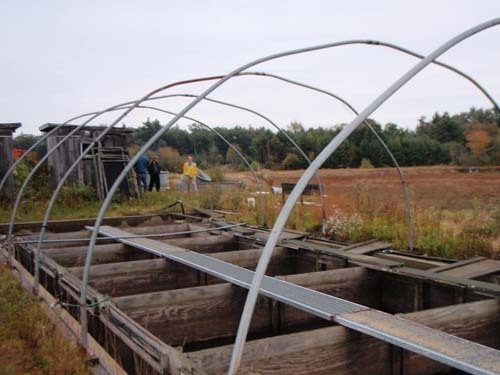
When Brad Morse started fish farming in 1999 the cost of diesel fuel required to power his generator hovered around $1.25 a gallon. Almost 10 years later fuel hit $3 a gallon and Morse, whose farm is far from the electric grid, in 2008 shut down the fish operation in Rochester, Mass.
Today, a team of students at Roger Williams University in Bristol is seeking alternative ways to power the farm. The students and their professors say a self-contained fish farm not dependent on outside electricity holds promise for the fish-farming industry in America and even more so in Third World countries without reliable electricity grids.
And why stop at fish farming? A reliable, affordable and easy-to-construct power source could power a host of applications, from raising shellfish to providing a sustainable source of food.
“I think a lot of people don’t realize the potential applications for people that are not connected to the grid,” said Joshua Boisclair, an engineering student working on the project.
The U.S. Environmental Agency agrees and provided the students $10,000 to start work on the project to deliver affordable electricity to a paddlewheel that circulates water in Morse’s fish farm. The engineering students modeled the existing farm using a computer software program and plan to study water flows to determine how much electricity a system like a wind turbine or solar panels would need to produce.
The project marries students in the civil, electrical, environmental and mechanical fields. Their professors, from the engineering and biology departments, say the combination is as much a way to find a solution as a way to teach students that engineering does not exist in a vacuum. And as such, the university requires engineering students to take a class in the business side of their major.
“As engineers one of the points we always keep stressing is if it doesn’t make sense from the business perspective, no matter how great the system or engineering it’s not going to fly,” said Linda Ann Riley, the university’s engineering program coordinator and the students’ adviser.
The students aren’t high on the idea of a wind turbine. A turbine would be overkill both in terms of electricity generated and capital investment required. The students also dismissed an idea to convert decomposing cranberries already at the farm into energy after learning that cranberries are not a good source of energy.
Associate biology professor Dale Leavitt said the ideas are all part of the expected false starts that senior design classes like this one face as they work their way through new academic territory.
“It’s not like any of the other classes you have to take,” said student George Schork. “Other classes you sit at a desk, you take exams, but with this class you learn the information so you can apply it when you leave this place.”
But before they leave the students will build a model of their system, package it up and move it to Washington, D.C. in April. There the students will face off against teams from other schools in a competition to win additional federal money to build a full-scale mock-up of their system.
The students want to win the money and hand off the project to underclassmen, but they also see the project as a way to raise the profile of renewable energy technology in sectors not traditionally associated with it.
“I think it’s a part of our duty to inform the public that this stuff is out there and it’s very much being implemented. So you better jump on the wagon or be left behind,” Schork said. •