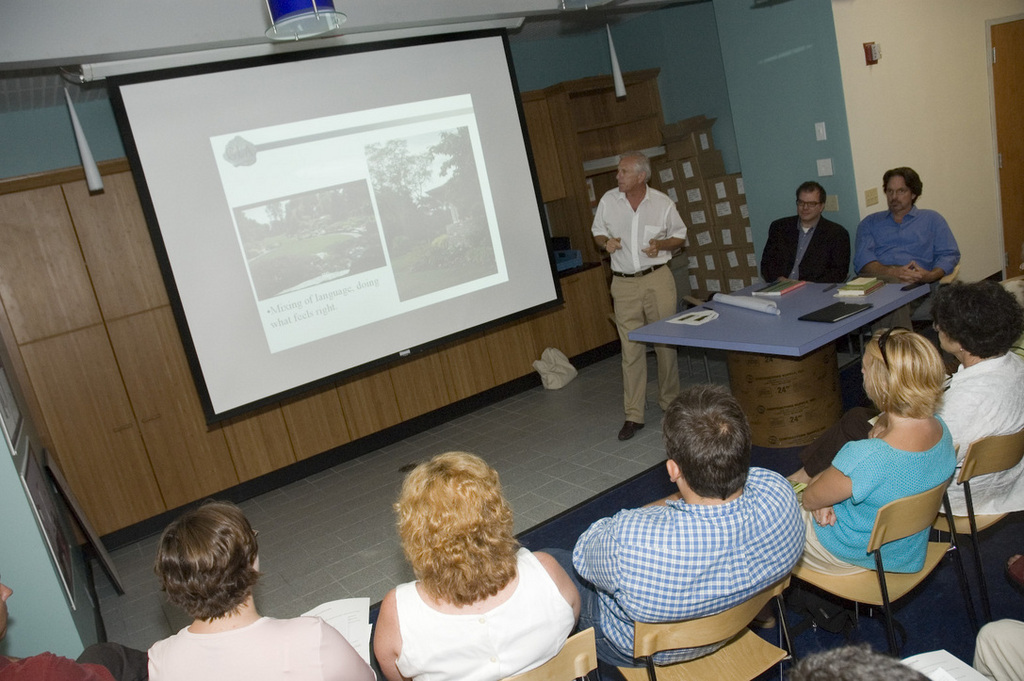
Sustainable design, whether in built environments or landscapes, is a hot topic for architects. That premise was the drawing card for an Aug. 16 discussion held by the Rhode Island chapter of the American Institute of Architects at 158 Washington St. in Providence. It is certainly why Ron Henderson, architect and owner of L + A Landscape Architecture in Providence, was one of the meeting’s speakers.
Henderson’s firm has been commissioned to create a more sustainable landscape around a new development in suburban Beijing, China. If completed, the Xi Haizi Park will incorporate an elevated pond that releases water downstream through a series of aeration rapids, wetlands and pools into West Lake.
The system would draw gray water and storm water from new developments surrounding the park and run it through a chemical water treatment process before entry into the system, thus eliminating costs associated with filling the lake with tap water, as is done now.
It creates a healthy ecological landscape that recycles and reuses water, which is a scarce resource in the suburb.
The AIAri’s committee on the environment organized the event, in part, to communicate the importance of having an environmental conscience in architecture and design.
For architects who want to design “green” homes and buildings that reduce carbon emissions by capturing heat from the sun in the winter and wind in the summer to cool the buildings and by designing building with the proper amount of insulation, the real challenge is in educating clients, said Melissa Arminio, co-chair of the AIAri committee on the environment and project manager for ai Designs in Pawtucket.
“It’s really not something a client is usually thinking of,” she said.
The same is true when designing landscapes, said Henderson, who also teaches at Rhode Island School of Design.
“We have to do a lot of teaching anywhere we go,” he added.
For example, Henderson’s firm had to convince developers of a new campus for Fuzhou University on the southeast coast of China not to “cart away” the mountains on the site. The firm also preserved the landscape’s wetlands and incorporated them into the design instead of moving or destroying them.
Henderson said China is a big client for his firm because so many multinational companies are “flocking” there and investing. Thus many large projects are being planned and completed.
“I think it’s interesting that in China, I would say, on a day-to-day basis in an office, there is more discussion about the environmental impact of projects,” he said. “Some of that is lip service, and some is trying to be implemented.”
Henderson said the same is true in the United States.
“There is a lot of interest,” he said. “But people aren’t sure how to implement it.”
That’s part of the reason why the AIAri committee, which formed in December last year, would like to advocate for sustainable built environments in the state, Arminio said.
One way to do that is to ask the state to create guidelines for “green” building practices mandatory for all public buildings.
Another way is to partner with associations such as the Rhode Island Green Building Council, which is in the process of forming.
“We have some of the same specific goals,” Arminio said. “Together we would have the manpower to reach them instead of working on them separately.”
Arminio said she thinks a second “green” movement is happening now because of the increasing publicity on the topic, but also because it is part of a natural progression.
“Sustainable development isn’t anything new,” she said. “The first movement was in the 1970s during the energy crisis … then it went on the back burner.”
The next event organized by the committee will be Sept. 19 at the AIAri office. It will focus on methods to reduce, separate and prepare construction waste for recycling. •