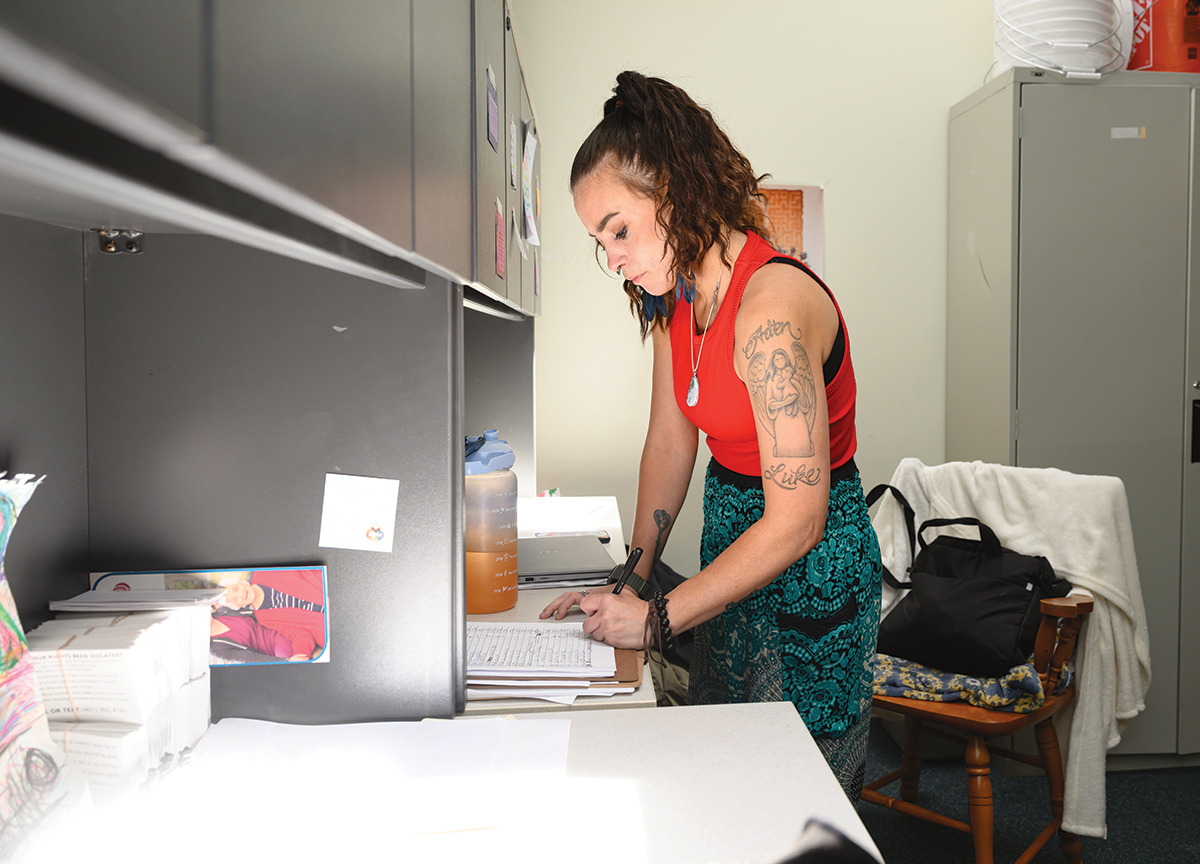
Rivka Reynolds was a longtime activities director for an agency serving people with dementia when a post-traumatic stress disorder forced her to stop working three years ago.
The loss of work, despite her experience as a certified medical technician, nursing assistant, food safety worker and exercise instructor, led her to lose her apartment and car.
She began to drink alcohol to excess before finally beginning her long climb back after checking into a mental health treatment program.
A year and a half ago, she joined Thrive Behavioral Health Inc. in West Warwick as a peer recovery counselor.
“I wanted to make an impact on people suffering from what I went through. I want to be a voice telling people there is a way out,” said Reynolds, 39. “It turned out to be a workforce pathway. This job is my second life.”
Rhode Island is about on par with the rest of the United States in instances of mental illness, which is about 20% of all adults. This includes acute chronic illnesses such as schizophrenia, addictions, depression, anxiety, hopelessness grief from COVID-19 and more. Homelessness, poverty and drug use exacerbate health problems.
Like the rest of the country, Rhode Island’s medical providers and social service agencies are scrambling for workers to help and heal people with mental and behavioral problems.
Staffing needs and locations of treatment are expanding. For example, paraprofessionals – people doing hands-on care – left the field in droves during the pandemic, to protect themselves or to land higher-paying jobs. But the pandemic also raised the value of online telehealth practices. And the pandemic made it possible for some agencies to raise pay levels, with federal help.
The good news is there are job opportunities; training networks among the R.I. Department of Labor and Training, schools and medical providers across the state; and a college degree is not essential to starting a career.
About 1,430 people worked in mental health care in Rhode Island in 2023, the most recent year available, according to the U.S. Bureau of Labor Statistics. The state DLT reports that the number of jobs for substance abuse, behavioral disorder and mental health counselors will increase by 20% between 2022 and 2032. The state average job growth rate is 6.2%.
[caption id="attachment_507224" align="aligncenter" width="1024"]

ESSENTIAL ITEMS:
Thrive Behavioral Health Inc. peer recovery counselor Rivka Reynolds, left, and peer outreach specialist Nicole Cervantes load essential items into Reynold’s car before she takes them to unhoused individuals later that day.
PBN PHOTO/
PAUL SPETRINI[/caption]
The six member agencies of Horizon Healthcare Partners recently had more than 200 posted job openings, said CEO and President James DiNunzio. There is plenty of variety in the varied job descriptions.
Psychiatrists and some specialized nurses and psychologists conduct therapy and prescribe medicine. Licensed social workers and mental health counselors, also called therapists or clinicians, work on diagnosis and therapy. Case managers help clients navigate the care system and find the services they need. These jobs have a range of educational requirements, from postgraduate to associate degrees.
Paraprofessionals may include community health workers, people with roots in specific populations and neighborhoods, and who can interpret a community’s wants, needs and biases to the medical system. Peer recovery specialists have personal experience with illness or addiction. Paraprofessionals include nursing assistants, medical assistants and child care workers. Paraprofessionals often need only certification – not a college degree.
Pay also varies, from average annual pay of $125,000 for psychiatrists, according to a May 2023 report by the U.S. Bureau of Labor Statistics, to $15 to $20 an hour for certified paraprofessionals. The midlevel position of mental health counselors would earn about $50,000 a year in Rhode Island, the report says.
“Rhode Island’s mental health systems have been grossly underfunded for decades,” said Barbara Lamoreux, chief clinical officer at Thrive Behavioral Health.
People in the field in Rhode Island are working to increase the number of workers and their salaries.
Three members of Horizon Healthcare Partners – Thrive Behavioral Health, Community Care Alliance and Newport Mental Health – achieved the status of Certified Community Behavioral Health Clinic in October 2024.
This designation, which comes with federal grants, requires these clinics to provide round-the-clock crisis services to anyone who needs them, regardless of ability to pay. Medical and other services must be comprehensive and coordinated so that patients don’t have to struggle to piece together care from several providers.
Thrive’s Lamoreux said the status boost allows the agency to do cost-based reimbursement and to raise salaries to market value. “We are not at 100%, but we are getting there,” she said.
Education, training and upskilling are available from many places, including Community College of Rhode Island and Rhode Island College. The R.I. Executive Office of Health and Human Services recently launched a state-funded program called Ladders to Licensure. Partnerships between mental health care agencies and three colleges will help people who are already working in the field to obtain their licenses while on the job.
Training vendors include Massachusetts-based C4 Innovations and the Substance Use and Mental Health Leadership Council of Rhode Island. The DLT offers a web page of Job Seeker Resources, and similar help exists at EOHHS’ Caring Careers website. The Providence Center conducts internships and offers guidance about starting a career in mental health care.
Who is suited to do this work? Tonya Glantz, director of the Institute for Education in Health Care at RIC, says mental health workers recognize that “people are more than the problem they are labeled with.”
Reynolds, the counselor at Thrive, said, “This work drives hope into me.” To people considering this field, she advises, “Give it a shot. Try and try until you find a fit.”