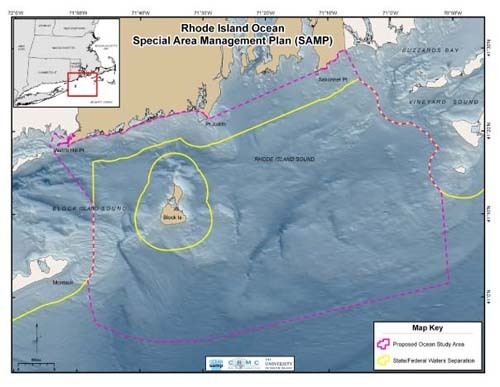
The team preparing the Rhode Island Ocean Special Area Management Plan (SAMP), a two-year effort costing more than $7 million, has reached the halfway mark and a plan should be ready for adoption in August of 2010.
That’s according to Grover Fugate, executive director of the R.I. Coastal Resources Management Council (CRMC), project manager for the SAMP process that will see a plan prepared for management of the state’s ocean waters, mostly in the area of Rhode Island Sound and Block Island. The study area comprises 1,547 square miles.
“It’s always a balancing act between protecting the environment while allowing reasonable coastal development,” Fugate said of the SAMP process, adding that in some ways the task is not that different from what the CRMC does every day. “That’s been our charge and what we’ve been doing for 35 years,” he said of the balancing act.
What makes this project unique, however, is the extensive scope of it, the number of state and federal agencies involved and the pressure to prepare for what Fugate called “literally an explosion” of proposals along the Northeast coast for wind farms, including two under discussion in Rhode Island.
There is “an immense amount of pressure” to develop alternative energy sources in the form of wind power from Maine to the Carolinas, Fugate said, reeling off the status of wind farm developments in nine coastal states, all of which he said are actively engaged in planning for wind power. Maryland, in particular, “is coming on strong,” he said. New Jersey has five leases in the works, Delaware is “very active,” while Maine and Massachusetts are pursuing wind farms as well, according to Fugate.
Although specific elements of the plan have not been finalized, Fugate said he expects the Rhode Island SAMP will include “preferred sites” for two proposed wind farms: a small-scale one off the southern end of Block Island and a larger “utility-grade” facility proposed for federal waters in the mid-eastern section of Rhode Island Sound. “We’re leaning that way right now,” Fugate said.
Such provisions, however, will be far from the final steps needed to actually construct and operate wind farms. Many state and federal regulations must be satisfied after a site has been formally accepted, including as many as 11 federal laws that must be considered before any proposal can obtain final approval from all the parties involved.
“There is no contact, no interaction, right now between the financial and political sides of this and the strictly scientific part,” said Chip Young, who is working on communications for the SAMP. “The financial and political parts are removed” from the planning process, he said.
Deepwater, however, will be working with the SAMP team in the future on an offshore meteorological data tower. Young explained that the SAMP team will utilize data from the tower, which Deepwater is required to build as part of its development proposal.
The SAMP team also will provide research reports to Deepwater, at the same time they are released to the public, and expects to conduct pre-application consultations with proposed developers, Young confirmed. “The team is engaging in this way with all stakeholders,” the project Web site said of the SAMP team’s relationship with Deepwater.
Indeed, according to Fugate, there is and will be “extensive opportunities” for stakeholder input and public involvement as the plan is finalized.
A series of stakeholder meetings is scheduled from now until June 2010; the next one is an Oct. 6 public session at 6 p.m. at Corless Auditorium, URI Bay Campus. As the CRMC prepares to adopt the plan next year, Fugate said, there will be public workshops, a period to submit written comments and “at least one” public hearing. He also mentioned the contact link on the SAMP Web site for submission of public comments.
Regarding what will be in the plan, Fugate expects those ocean areas that the commercial fishing industry has identified as vital will be preserved. However, because some are in federal water, the state can only indicate its “preference” for a certain use such as commercial fishing and cannot “designate” federally controlled waters for particular purposes, he explained.
In the same way, recreational boating areas, commercial shipping lanes and regular traffic routes now in use will be identified, Fugate said, as will areas integral to the preservation of the wildlife and endangered species that rely on the ocean for survival. “It all has to be accounted for,” he said.
Led by the CRMC, the SAMP team includes at least 60 research scientists from the University of Rhode Island, Fugate said, as well as representatives of federal agencies such as the U.S. Army Corps of Engineers and the Minerals Management Service, which have authority in federal waters. Fugate explained that the federal government is a partner in the planning process.
The SAMP team also has a subcommittee, chaired by Michael Tikoian, a science advisory task force made up of scientists and academics, and a legal advisory task force that includes members of the state attorney general’s staff and the Conservation Law Foundation.
Funding consists of: $3.2 million provided by the Rhode Island Renewable Energy Fund, collected through an electricity-bill surcharge; $2.8 million in state funding that Gov. Donald L. Carcieri helped secure; $660,000 in federal dollars obtained by U.S. Sens. Jack Reed and Sheldon Whitehouse; and approximately $1 million of in-kind contributions from URI, according to Fugate.
The ocean waters of southeastern New England have been receiving a lot of attention lately from both Rhode Island and Massachusetts state agencies, as well as the federal government. Last week, the Obama administration convened in Providence a meeting of the Ocean Policy Task Force, a group of senior-level federal officials working on a national policy to ensure protection of oceans, coasts and the Great Lakes.
In Massachusetts, meanwhile, officials also are working on an ocean-management plan.
A Sept. 15 public hearing in New Bedford on a draft proposal saw the prospect of wind farms in Buzzards Bay draw the most public comment, with intense disagreement on how much wind development should be allowed in the bay adjacent to Rhode Island Sound and Vineyard Sound. The Bay State plan on the whole designates 2 percent of state waters for commercial wind facilities. The Massachusetts plan is scheduled for release at the end of the year. •