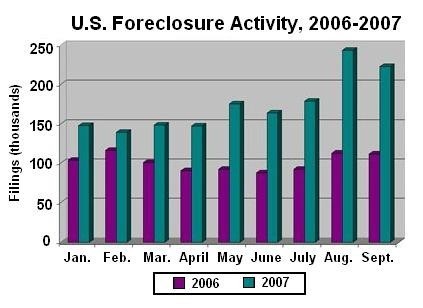
IRVINE, Calif. – The number of U.S. homeowners facing foreclosure fell 8 percent in September from August’s 32-month high, although it remained 99 percent above the level in September 2006, RealtyTrac Inc. said today in its monthly report.
Nationwide, the September foreclosure rate was 1 filing for every 557 households.
The highest rate, for the ninth month in a row, was in Nevada, which had 1 filing for every 185 households. Florida was No. 2, with 1 filing for every 253 households, followed by California with 1 for every 253 households. Other states with foreclosure rates in the Top 10 last month were Michigan, Arizona, Georgia, Ohio, Colorado, Texas and Indiana.
“U.S. foreclosure activity experienced a fairly broad-based retreat in September, with 39 states reporting decreasing activity and national numbers down in all foreclosure categories – defaults, auctions and bank repossessions,” James J. Saccacio, RealtyTrac’s CEO, said in a statement. “Nevertheless, it’s important to note that September’s total was still the second highest monthly total we’ve seen since we began issuing our report in January of 2005. It’s too early to tell if September’s numbers represent a one-month lull or … signify that more buyers and investors are getting back in the market and snatching up discounted foreclosure properties.”
Rhode Island’s ranking improved to 29th in September, from 24th the month before, as the state’s foreclosure rate fell to 1 filing per 1,617 households. The rate declined 25.34 percent from August but increased 35.78 percent from September 2006. A total of 277 foreclosure actions were reported in the state last month.
Massachusetts improved two notches to 14th, from 12th place in August, as the state’s foreclosure rate fell to 1 filing per 770 households. The rate fell 22.88 percent compared with August though it rose 27.46 percent compared with September 2006. A total of 3,491 foreclosures were reported in the Bay State last month.
Foreclosures on loans made in 2005 may “start to wind down” at the end of the year, while loans made in the first half of 2006 will probably lead to additional foreclosures in the middle of 2008, Rick Sharga, RealtyTrac’s executive vice president of marketing. told Bloomberg News. He blamed adjustable-rate mortgages (ARMs) for the high rate nationwide, saying: “Borrowers are going into default as soon as they hit their adjustments.”
RealtyTrac Inc., based in Irvine, Calif., is a publisher of data and advice for real estate markets nationwide. To learn more, visit www.RealtyTrac.com.