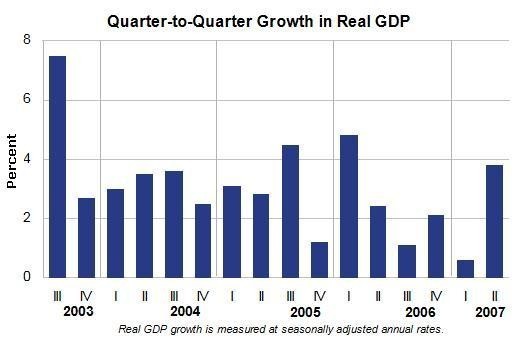
WASHINGTON – The nation’s real gross domestic product, adjusted for inflation, increased at an annual rate of 3.8 percent in the second quarter, after edging up at a 0.6-percent pace in the first quarter, according to the final report released today by the U.S. Bureau of Economic Analysis.
The pace was the fastest in more than a year, the BEA noted, and matched the median forecast from a Bloomberg News survey of 74 economists. Their predictions ranged from 3.5 percent to 4.0 percent.
“The acceleration … reflected upturns in net exports, federal government spending and inventory investment; an acceleration in business investment; and a smaller decrease in residential home investment,” the BEA said in a news release. “In contrast, consumer spending decelerated sharply,” though it still increased in the quarter.
Aside from personal consumption spending, the increase in the real GDP reflected an 11.0-percent increase in nonresidential fixed investment (including construction and related expenditures), a 7.5-percent increase in exports, a 2.7-percent decline in imports, and increases in equipment and software purchases and local, state and federal government spending, the BEA said.
Partially offsetting those improvements was a decline in real residential fixed investment (mostly, housing construction), which fell 11.8 percent from the preceding period. The quarter-over-quarter decline was the smallest in the past year. The index had fallen 16.3 percent in the first quarter, 17.2 percent in the fourth quarter of 2006, 20.4 percent in the third quarter of 2006 and 11.7 percent in the year-ago quarter.
The real GDP’s second-quarter growth was revised downward from the BEA’s preliminary estimate, issued on Aug. 30. (READ MORE) The revisions reflected updated estimates of net exports and business construction spending, both of which were smaller than previously estimated. Those changes outweighed upward revisions to second-quarter business spending on equipment and software, which was higher than previously thought.
Real personal consumption expenditures (PCE) – the personal spending that constitutes about 70 percent of the economy – increased 1.4 percent, the same as in the preliminary estimate, after increasing 3.7 percent in the first quarter. The second-quarter gain was the smallest since the fourth quarter of 2005, the BEA report showed.
A Bloomberg survey earlier this month predicted that spending will grow at an average annual pace of 2.25 percent in the second half of this year, slowing from the 2.55 percent rate in January through June and the 3.7 percent per year average over the past decade.
“We see a pretty dismal outlook, given the continued imbalance in the housing market and tighter credit conditions,” Zach Pandl, an economist at Lehman Brothers Holdings Inc. in New York, told Bloomberg. “This number remains largely unaffected by the credit crunch,” he said of the second-quarter GDP reading, “and even the third-quarter figures will only have a limited impact.”
The GDP report also included the BEA’s final estimate of second-quarter corporate profits, which rose 4.2 percent compared with the same period last year. A 21.3-percent increase in net corporate profits earned abroad and a 4.6-percent increase in profits from domestic financial corporations more than offset a 1.4-percent decrease in profits of non-financial corporations.
Additional information, including the full Gross Domestic Product and Corporate Profits report, is available from the U.S. Department of Commerce’s Bureau of Economic Analysis at www.bea.gov.