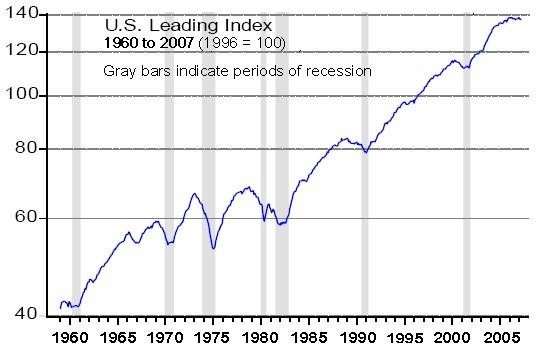
The U.S. index of leading indicators edged up 0.1 percent in March to 137.4 points (1996 = 100), after declining 0.6 percent in February and 0.3 percent in January, The Conference Board reported today. The March index remained 0.8 percent below its year-ago level and 0.9 percent below its high in January 2006.
The increase matched the 0.1-percent prediction from a survey of 52 economists by Bloomberg News.
The index is designed to predict U.S. economic activity over the next three to six months.
Seven of the index’s 10 indicators increased in March. Strong improvements were seen in unemployment (as claims declined), the real money supply and the average manufacturing work week, and smaller gains were seen in vendor performance, building permits and new factory orders for consumer goods and materials. But those were mostly offset by declines in stock prices, consumer expectations and the interest-rate spread.
“Clearly the labor market has been a major source of strength for the economy,” Joshua Shapiro, chief U.S. economist at Maria Fiorini Ramirez Inc. in New York, told Bloomberg.
According to The Conference Board report, “Weaknesses among the indicators have become increasingly more widespread than strengths over the past few months.” Over the six months from September to March, the leading index fell 0.1 percent as only three of 10 components advanced.
“Despite a small pick up in December, the leading index has been essentially flat since mid-2006,” the board said in a statement today. “At the same time, real [gross domestic product] GDP growth was at a 2.5-percent annual rate in the fourth quarter of 2006, following a 2.0 percent rate in the third quarter.
But, the board added, “The recent behavior of the leading and coincident indexes suggests that slow economic growth is likely to continue in the near term.”
ISO 9001:2026: A Practical Opportunity to Build for What’s Next
For Rhode Island manufacturers, ISO 9001 has been much more than a certificate on the…
Learn More
The board’s coincident index – a measure of current economic activity, which this month rose 0.1 percent to 123.7 points, after rising 0.2 percent in February and 0.1 percent in January – has risen 0.9 percent over the past six months.
The Conference Board – a nonpartisan, nonprofit research group with offices in New York City, Chicago and abroad – produces reports including The Consumer Confidence Index and the Leading Economic Indicators for the United States and other nations. Additional information is available at www.conference-board.org.