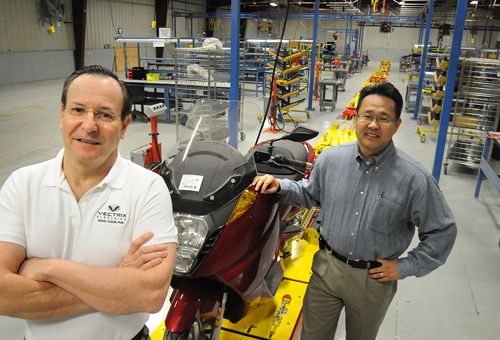
After 14 years, multiple false starts and a near-death experience, could this finally be the moment for Vectrix Corp.?
The electric-scooter maker’s new management team, which bought the former Middletown company’s assets out of bankruptcy, thinks so. Jason Kim, the new chief operations officer, said he signed on because he “was impressed with the technology and impressed with the overall potential reach of the product into various markets.”
Founded in 1996 by a group of former Lockheed Martin engineers, Vectrix spent more than $50 million developing the V1, a two-wheel, two-seat, all-electric scooter. The zero-emission vehicle, with a top speed of 62 mph and a range of 40 to 60 miles on a single charge, won good reviews and counted Leonardo DiCaprio and Jay Leno among its owners.
Financially, though, Vectrix was not a success – the company racked up enormous losses and was hobbled by a confusing distribution strategy.
Things finally came to a head last spring: The London Stock Exchange suspended trading in Vectrix shares, and the company announced it would lay off 60 employees and seek a buyer as sales proved “very disappointing.” By September, the company was in bankruptcy and only a skeletal staff remained.
Like its fellow vehicle makers General Motors and Chrysler, though, bankruptcy may the best thing that could have happened to Vectrix. Its assets were purchased by a deep-pocketed ownership group led by Singapore’s GP Batteries International Ltd., Asia’s largest battery maker and Vectrix’s longtime supplier. “They realized there was going to be massive growth in the electric-vehicles market,” Kim said.
The new owners set up shop at Vectrix’s old research and development office in the New Bedford Business Park, and recruited Kim and a new vice president of sales and marketing, Brian Buccella, from T3 Motion Inc., a California company that makes Segway-like electric-standup vehicles.
If buyers agree, Vectrix has a real opportunity. Electric bike sales have been growing rapidly, particularly in China, where The New York Times reports an estimated 120 million are on the roads. India and Europe are also seeing higher demand, and in a sign the U.S. market may be next, Best Buy Co. is testing electric-bike sales in select stores.
“What happened in the last 10 years is the battery technology has given way to lighter, quick-charge, longer-life lithium, and the bikes have lightened up,” said Jay Townley, a bicycle-industry consultant. He expects the domestic market to take off in 2011 or 2012.
However, Vectrix will face tough competition: Giant Manufacturing Co. of Taiwan, Asia’s largest bike maker, and The Netherlands’ Accell Group N.V. already have staked out leads, and other large automakers like Honda are taking a look, too, Townley said.
Vectrix was relaunched at an international dealer expo in Indianapolis last month. The company’s goal for this year is to get back up to speed after the trauma of 2009 – and to make sure it can manufacture bikes without losing money on every sale.
“It’s U.S. design – the innovation is here, and yet they outsourced [manufacturing] to Poland,” Kim said of Vectrix’s former management. “We know it’s more expensive here, but at the same time we believe in the U.S. We’re not getting money from the government, but we believe in the product, and we believe in U.S. content.”
Kim also has begun marketing Vectrix bikes to buyers of fleets for law enforcement, and private and campus security departments. “We think it’s a great consumer product, but more than that, we think it’s a great fleet application,” he said.
Meanwhile, the new team is still clearing up issues left by the old Vectrix and its complicated corporate structure. A particular headache has been the manufacturing subsidiary in Poland, which remains tied up in bankruptcy court there.
Kim said he and the other Vectrix executives in New Bedford are working with Polish authorities to sort out the matter, including an “exclusive deal” that Polish Vectrix signed last fall with Hesketh Motorcycles Ltd., a British firm, to sell the VX-1 in the U.K. as the Hesketh HZE-Vectrix.
Kim, an operations expert, is also exploring how to bring down the price of Vectrix’s bikes. He said the cost needs to get below $10,000 each, ideally to somewhere between $7,000 and $8,000. “It’s a target, something we’re striving to do,” he said. •