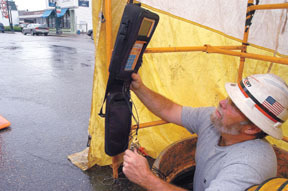
Avenue in Providence.
Verizon Communications is again at the bargaining table to discuss contracts with its more than 11,000 Rhode Island and Massachusetts union employees.
New York-based Verizon, which has 1,300 Rhode Island employees, said it began contract discussions with employees in 13 states that represent more than 75,000 union employees last week in hopes of securing a contract agreement by Aug. 2, when the existing contract expires.
The negotiations come nearly three years after Verizon employees in the Northeast held a 17-day strike against the telecom giant and nearly 14 years after the unions held a 17-month strike.
ISO 9001:2026: A Practical Opportunity to Build for What’s Next
For Rhode Island manufacturers, ISO 9001 has been much more than a certificate on the…
Learn More
Union representatives of the International Brotherhood of Electrical Workers, one of the two unions that represent Verizon workers, are comparing these negotiations with those of 2000, which led the union to block Verizon entrances in dozens of locations throughout the region. Verizon workers are also represented by the Communication Workers of America.
Massachusetts Jobs with Justice recently sent out letters to fellow unionists saying there is a strike on the horizon. The letter asks for solidarity and support if a strike is to occur. The letter was signed by representatives of several different locals including William McGowan, manager of IBEW Local 2323 of Rhode Island.
Verizon’s New England employees are mostly union workers who were employed by New England Telephone, Bell Atlantic and NYNEX, which are all now part of Verizon and are spread throughout Verizon’s 52 Rhode Island locations.
Some of the most pressing issues on the bargaining table include health care, job security and compensation. The union won on a few of those issues in 2000 when Verizon agreed to continue to give the laborers medical benefits without having to contribute to the cost and agreed not to transfer work out of New England.
On opening day of negotiations, Myles Calvey, chairman of the T-6 Council, which represents all the councils in New England, said the union “will never be ready to concede diminishments in health care, will never agree to concessions on movement of work while Verizon is recording billion-dollar profits, and will never agree to a contract that doesn’t protect the livelihood of members while Ivan Seidenberg, Verizon’s CEO, is receiving millions in compensation.”
Verizon, however, said it plans to bring its issues to the table that include absenteeism, high wages and health care.
Verizon’s Northeast spokesperson Jack Hoey said the company’s cost in lost days due to absenteeism is $600 million annually.
“Among our union employees absenteeism is twice that of the industry and three times that of Verizon managers,” said Hoey.
Rising health care cost is also an issue for Verizon. Health costs are rising more than 12 percent a year, Hoey said, and employees pay an average out-of-pocket expense of 5 percent for medical care compared to the national average of 26 percent.
A third issue Verizon will bring to the table is pay. In New England, according to Verizon, a technician (exclusive of overtime pay) receives $60,000 in wages and $20,000 in benefits.
Paul Feeney, spokesperson for Local 2222 in Boston, said it was too early to tell where the negotiations were going because Monday, June 16, was the first day at the bargaining table for the New England division. Feeney, however, did say the tone set by the company does not sound promising.
He said Verizon started by telling the union representatives that a tough economy, competition and regulatory issues may force the company to transfer work to other areas.
Those issues, Feeney said, may be the reason behind a future strike.
“Right now we are in a mode where we are listening to the company and so far what has been brought to the table is completely unreasonable,” he added. “It’s a little too soon to say (whether there will be a strike), but if they continue to demand concessions in health care and movement of work, it’s a possibility.”
Hoey, on the other hand, said Verizon and the unions “ought to be able to reach an agreement without a strike” and that the company is “cautiously optimistic.”
Verizon, which had $67.5 billion in revenues in 2002, has faced difficult economic times in the last two years because the telecom industry has plummeted, said Hoey.
“We are facing unprecedented challenges in the traditional wire-line business as opposed to wireless,” he said. “It’s a ‘perfect storm’ where there are a series of forces that have impacted the wire-lined business across the whole country but in particular in some of our more competitive areas like New England and New York.”
Cox Communications, which has a 98-percent market share in Rhode Island, and Comcast are two major competitors. Competitors coupled with the increase use of instant messaging and Internet has resulted in the decline in wire-lined services for Verizon.
“If you look at New England – to put meat on the bones – you’ll see the number of phone lines declined in 2002 by 5.2 percent compared to 2001, which is equivalent to 366,000 fewer phone lines,” Hoey said.
For the complete current issue, visit our subscription Web site, or call (401) 273-2201, ext. 227 or 234.