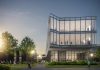
Women & Infants Hospital on Wednesday moved 68 babies and 17 high-risk pregnant women into its new South Pavilion, a five-story addition that includes the nation’s largest single-room neonatal intensive-care unit, with 80 bassinets, as well as adult patient rooms and amenities.
The new NICU takes up 50,000 square feet over two floors in the building, replacing a cramped 9,400-square-foot NICU that was designed for 41 infants but has become ever-busier as medicine has gotten better at saving premature and low-birthweight babies.
Research has shown that the physical environment – light, noise, temperature and more – can make a substantial impact on the fragile babies’ development. The new NICU aims to provide an optimal environment and maximize families’ involvement in their infants’ care.
“The single-room NICU expands the field of neonatology from ‘survival’ to ‘quality of life,’ ” said Dr. James Padbury, pediatrician-in-chief at Women & Infants and a professor at the Warren Alpert Medical School of Brown University. To document the full impact of the change, he and Brown colleague Dr. Barry Lester, a psychologist and researcher, are conducting a study of infants in the old and the new NICU to compare outcomes.
While the new building’s clinical features are undoubtedly the main focus, however, Women & Infants last week also noted another advantage. The South Pavilion has many “green” features, and the hospital is pursuing certification from the U.S. Green Building Council through its Leadership in Energy and Environmental Design (LEED) program.
“Having a ‘green’ building reflects our commitment to community, not only our state and region, but our belief that we all need to do our part to protect the planet and our fragile environment for future generations,” said Constance A. Howes, president and CEO of Women & Infants. “Each year, we bring thousands of babies into the world and save the lives of hundreds of women. As international leaders in health care, we believe it is our responsibility to ensure that the world is a healthy, vibrant place for them.”
The building was already named one of the best new green projects in the Northeast by Real Estate & Construction Review, which will feature the building in a piece on Northeast Green Success Stories.
Designed by the Boston firm of Anshen + Allen, the building aims for silver-level LEED certification for creating a sustainable site – in an urban area, with easy public-transportation and bike access, plus an environmentally conscious storm water system and a light-colored roof that helps prevent heat build-up.
In addition, the building and landscaping are water-efficient, and the building and equipment are energy-efficient. The project is also expected to earn LEED points for recycling waste, using recycled materials, and for high indoor environmental quality.



No posts to display
Sign in
Welcome! Log into your account
Forgot your password? Get help
Privacy Policy
Password recovery
Recover your password
A password will be e-mailed to you.
- Featured Event -